Detecting Insurance Fraud Starts With the Paper Trail


My unpopular opinion after a decade around fraud teams: the cleverest insurance fraud usually looks painfully boring.
Not cinematic. Not a suspicious claimant in sunglasses. More often, it is a receipt that looks fine at 4:58 p.m. on a Friday, an invoice with one edited line item, or a repair estimate that has quietly changed bank details. The story may be dramatic, but the proof is usually ordinary paper.
That is why detecting insurance fraud starts with the paper trail. Before the interviews, before the SIU referral, before the predictive scoring model starts waving its arms, there is a basic question: do the documents support the claim, or have they been bent to fit the payout?
The answer matters. The FBI estimates insurance fraud costs the United States more than $308 billion per year, adding hundreds of dollars to household premiums. In the UK, insurers are also seeing a sharper digital edge. The BBC reported a 71% rise in fraudulent claims cited by Admiral, with fake images and digitally altered evidence playing a growing role.
Fraud has always followed friction. If claims teams make it easy to submit a document and hard to verify it, guess where the fraud goes?
The paper trail is where the claim gets real
A claim is a story. The paper trail is where that story has to stop being charming and start being provable.
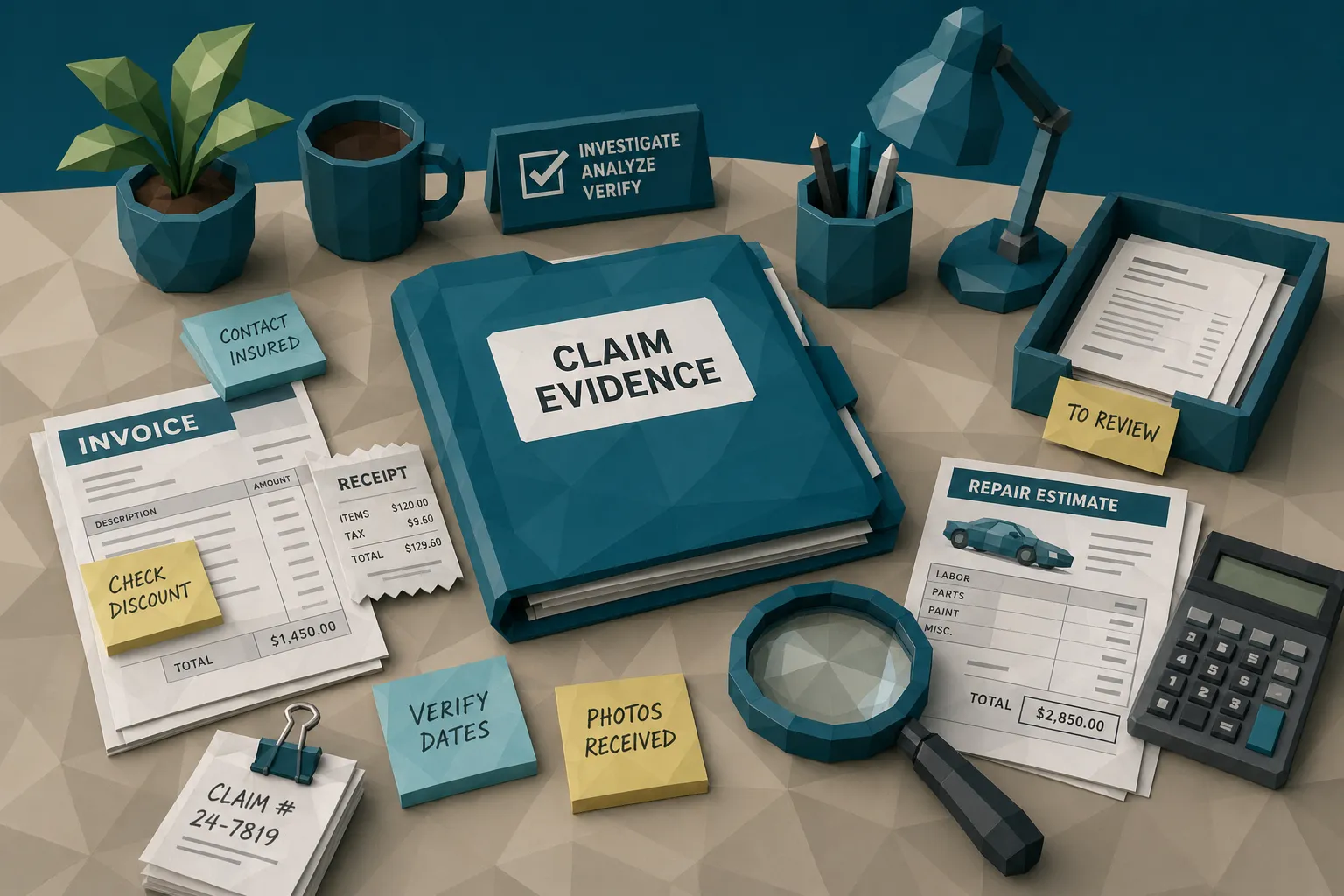
For a property claim, that might mean contractor invoices, repair estimates, receipts for replacement items, bank details, photographs, and correspondence. For health insurance, it could be bills, explanation of benefits documents, provider details, itemized charges, dates of service, and payment instructions. For warranty claims, it might be purchase receipts, service records, diagnostic reports, and replacement invoices.
The interesting part is not any single document. The interesting part is whether they agree with each other.
I once reviewed a small property claim where the invoice looked clean, almost too clean. The vendor name matched. The total matched the requested payout. The dates were plausible. Nobody would have framed it and called it “Fraud of the Year.” But the receipt image had been saved through editing software, the invoice numbering did not match the vendor’s usual pattern, and the bank account was newly introduced right before payment. None of those signals screamed fraud alone. Together, they politely tapped us on the shoulder and said, “You may want to slow down.”
That is the paper trail doing its job.
Fraud teams need fewer hunches and better evidence
Here is another hot take: “That feels suspicious” is not a detection strategy.
I like experienced adjusters. The best ones can smell trouble through a PDF attachment. But relying on instinct alone is unfair to the adjuster, inconsistent for the claimant, and hard to defend when a decision is challenged.
Good fraud detection needs evidence that can be explained. Not a mysterious black box verdict. Not a vague “high risk” label. Evidence.
In document-heavy claims, that evidence often falls into a few buckets:
- Visual signs that a document has been edited, copied, pasted, regenerated, or physically altered
- Metadata that conflicts with the claim timeline, submission source, or stated origin
- Mathematical inconsistencies, like totals, tax, discounts, or quantities that do not add up
- Duplicate or near-duplicate documents submitted across claims, policies, vendors, or time periods
- Payment-context anomalies, such as new payees, mismatched bank details, or unusual routing behavior
The last point is underrated. A lot of document checks ask, “Does this file look real?” That is useful, but incomplete. A better question is, “Does this document make sense in the context of this claim and this payment?”
A forged invoice is dangerous. A forged invoice attached to a rushed payout request with changed payment information is more dangerous. Context turns a suspicious file into a stronger fraud picture.
Why traditional claim review misses manipulated documents
Most claims workflows were built to process, not interrogate.
That sounds harsh, but it is true. We designed systems to capture fields, route tasks, calculate coverage, and pay legitimate claims quickly. That is a good thing. Nobody wants a genuine customer waiting three extra weeks because a fraud manager got philosophical about a paint receipt.
The problem is that speed can flatten evidence.
Optical character recognition can extract vendor name, date, and amount, but it does not necessarily tell you whether the total was pasted over the original. A rules engine can flag a claim above a threshold, but it may ignore a perfectly threshold-friendly invoice that has been altered by 18%. A manual reviewer can spot obvious nonsense, but no human can reliably inspect every pixel, metadata field, duplicate pattern, and payment change across thousands of claims.
I learned this the annoying way early in my career. We had a case where three different claims included invoices from the same repair business. All passed the basic field checks. Later, after a deeper review, we noticed the same background texture and layout artifacts repeated across supposedly different invoices. Someone had used one legitimate document as a template and created variations. The data fields were “valid.” The document history was not.
That is the difference between reading a document and examining it.
AI-generated evidence has changed the economics of fraud
Let’s be honest: creating fake documentation used to require effort. Bad fraudsters used correction fluid. Better fraudsters used Photoshop. Now, anyone with a laptop can generate a plausible-looking receipt or invoice in minutes.
That does not mean every claimant is suddenly a criminal mastermind. It means the barrier to experimentation has dropped.
Verisk’s 2025 fraud report points to rising concern around claim manipulation and the use of generative tools. One finding that should make every insurer sit up: younger consumers reported higher willingness to consider altering claim evidence with AI compared with older groups. I do not read that as “Gen Z is uniquely villainous.” I read it as proof that digital manipulation is becoming culturally casual. If editing a receipt feels like editing a selfie, claims teams have a problem.
This is why the paper trail needs modern scrutiny. We cannot treat invoices and receipts as static objects anymore. They are digital artifacts with histories, fingerprints, inconsistencies, and relationships to payments.
The boring sequence that catches interesting fraud
If I were designing a fraud-resistant claims workflow from scratch, I would not start by making every adjuster suspicious of everyone. That is a quick way to ruin customer experience and morale.
I would start by making the paper trail harder to fake and easier to verify.
First, preserve the original files at intake. Do not strip away useful information before anyone has had a chance to inspect it. Screenshots, compressed PDFs, forwarded attachments, and portal uploads can all carry different evidence. The original submission is often the cleanest version of the truth, even when the truth is ugly.
Second, screen documents before payment, not after. Post-payment recovery is the fraud equivalent of chasing a taxi after it has already turned the corner. Sometimes you catch it. Usually you just get cardio.
Third, connect the document to the claim context. Does the vendor exist? Does the invoice timing match the loss event? Does the payee align with prior payments? Has this claimant, provider, repairer, or bank account appeared elsewhere? One weak signal may be noise. Three weak signals in the same direction become a route map.
Fourth, route with evidence. A good alert should help the reviewer understand why the case matters. “Suspicious document” is not enough. “Possible edited total, metadata inconsistent with claimed creation date, and new payment account added after submission” gives an adjuster or SIU analyst something to work with.
This is also where trust infrastructure matters beyond insurance. In hiring, for example, platforms like TalentTrust are built around making credentials and decisions verifiable. Different industry, same principle: when the stakes are high, trust should be evidenced, not assumed.
What claims managers should look for in the paper trail
If you manage claims operations, you do not need every handler to become a forensic examiner. You do need a repeatable way to ask better questions of submitted documents.
When I review a claim file, I am usually looking for alignment. Not perfection. Real documents are messy. Phones compress images. People scan receipts sideways. Small businesses use odd invoice templates. Mess is normal.
What bothers me is selective neatness.
A receipt photo is blurry, but the total is strangely crisp. An invoice has normal compression noise everywhere except around the bank account. A repair estimate was supposedly issued by a local contractor, but the metadata suggests it was created after the claim was submitted. A document has no visible errors, but the tax calculation is wrong in a way that benefits the claimant. A contractor’s invoice number sequence jumps around like a caffeinated squirrel.
None of those proves fraud by itself. They do tell us where to look.
For insurance teams, the highest-value paper trail checks usually include visual tampering detection, metadata forensics, duplicate document matching, mathematical validation, and payment-context review. The goal is not to block every claim with a smudge. The goal is to separate normal mess from meaningful inconsistency.
The payment trail is part of the paper trail
One mistake I see often is treating payment information as an administrative detail. It is not. Payment data can be one of the strongest fraud signals in the file.
A claim document says one thing. Payment behavior says another.
Consider a home repair invoice submitted with a contractor name that matches the claim narrative. So far, so good. But the payment account belongs to an unrelated individual. Or the routing details were changed after the invoice upload. Or the same bank account has appeared across multiple claims with different vendors. Suddenly, the invoice is not just a document. It is a doorway to funds.
This is where Docklands AI’s approach is relevant. The platform is built to detect manipulated, photoshopped, and AI-generated invoices and receipts using document forensics such as visual tampering analysis, metadata review, mathematical checks, and physical manipulation detection. Crucially, Docklands also uses payment information from the claim, expense, or payment workflow to build a deeper fraud picture. That matters because the question is rarely “Is this image weird?” The better question is “Does this document, claimant, vendor, and payment path make sense together?”
For claim managers, that context is the difference between noisy alerts and useful triage.
Speed still matters, so do not turn fraud review into a swamp
Fraud controls fail when they become too heavy. I have seen teams create review processes so slow that honest claimants suffered, adjusters rebelled, and leadership quietly worked around the controls. The fraud team felt virtuous. The operation felt trapped. Nobody won.
The trick is to screen broadly and review narrowly.
That means every invoice, receipt, estimate, and bill can be checked automatically for integrity signals, while only higher-risk documents go to human review. Clean documents keep moving. Questionable ones arrive with evidence. SIU gets fewer junk referrals. Adjusters are not asked to become full-time pixel detectives.
This is especially important in health insurance, P&C, home insurance, warranty claims, and any claims environment with high document volume. If the fraud process cannot keep up with the claims process, the business will choose speed. It always does.
A useful fraud detection layer should work inside the existing workflow through APIs, webhooks, reporting, and dashboards. It should support claims operations rather than demand a grand system replacement. Fraud prevention should feel like a checkpoint, not a construction project.
A practical paper trail mindset for 2026
The insurance fraud landscape in 2026 is not about one magic tool or one heroic investigator. It is about disciplined skepticism at the document level.
Here is the mindset I recommend: trust the claimant experience, verify the evidence.
That distinction matters. We should not make legitimate customers feel accused. But we also should not pay claims based on documents that no one has meaningfully inspected. The paper trail is the compromise. It gives claims teams a neutral place to start.
Ask whether the documents are internally consistent. Ask whether they match the timeline. Ask whether the file history makes sense. Ask whether the payment path belongs. Ask whether similar documents have appeared before. And when something is off, preserve the evidence before it gets overwritten, compressed, or buried in notes.
Fraudsters love gaps. Gaps between document intake and payment. Gaps between the invoice and the bank account. Gaps between the claims system and SIU. Gaps between what OCR extracts and what the file actually contains.
Close those gaps, and a lot of fraud becomes less clever than it thought it was.
Frequently Asked Questions
Why does detecting insurance fraud start with documents? Documents are often the evidence used to justify payout. Invoices, receipts, estimates, medical bills, and payment instructions can reveal inconsistencies before money leaves the insurer.
Can a normal-looking invoice still be fraudulent? Yes. Many fraudulent claim documents look ordinary at first glance. The warning signs may be hidden in metadata, edited totals, reused layouts, duplicate submissions, or mismatched payment details.
Does OCR detect insurance fraud? OCR helps extract text from documents, but it does not reliably verify authenticity. Fraud detection needs document integrity checks, metadata analysis, mathematical validation, duplicate matching, and payment-context review.
How should claims teams avoid slowing down legitimate claims? Screen documents automatically at intake or before payment, then route only higher-risk files for human review. This keeps clean claims moving while giving investigators evidence on suspicious cases.
What role does payment information play in claim fraud detection? Payment data can reveal mismatched payees, new bank accounts, repeated accounts across unrelated claims, or last-minute changes. Combined with document forensics, it creates a clearer fraud picture.
Bring the paper trail into your fraud workflow
If your claims team is still relying on manual spot checks, OCR fields, or gut feel to validate invoices and receipts, you are leaving too much to chance.
Docklands AI helps insurers detect manipulated, photoshopped, physically altered, and AI-generated claim documents before payment. The platform combines document forensics with payment-context analysis, so teams can prioritize suspicious claims with clearer evidence and fewer distractions.
If you want to see what your current paper trail is hiding, visit Docklands AI and explore how document-level fraud detection can fit into your claims workflow.
Request a Demo Today!
Book your demo below.