Fake Target Receipt Red Flags Most Reviewers Miss
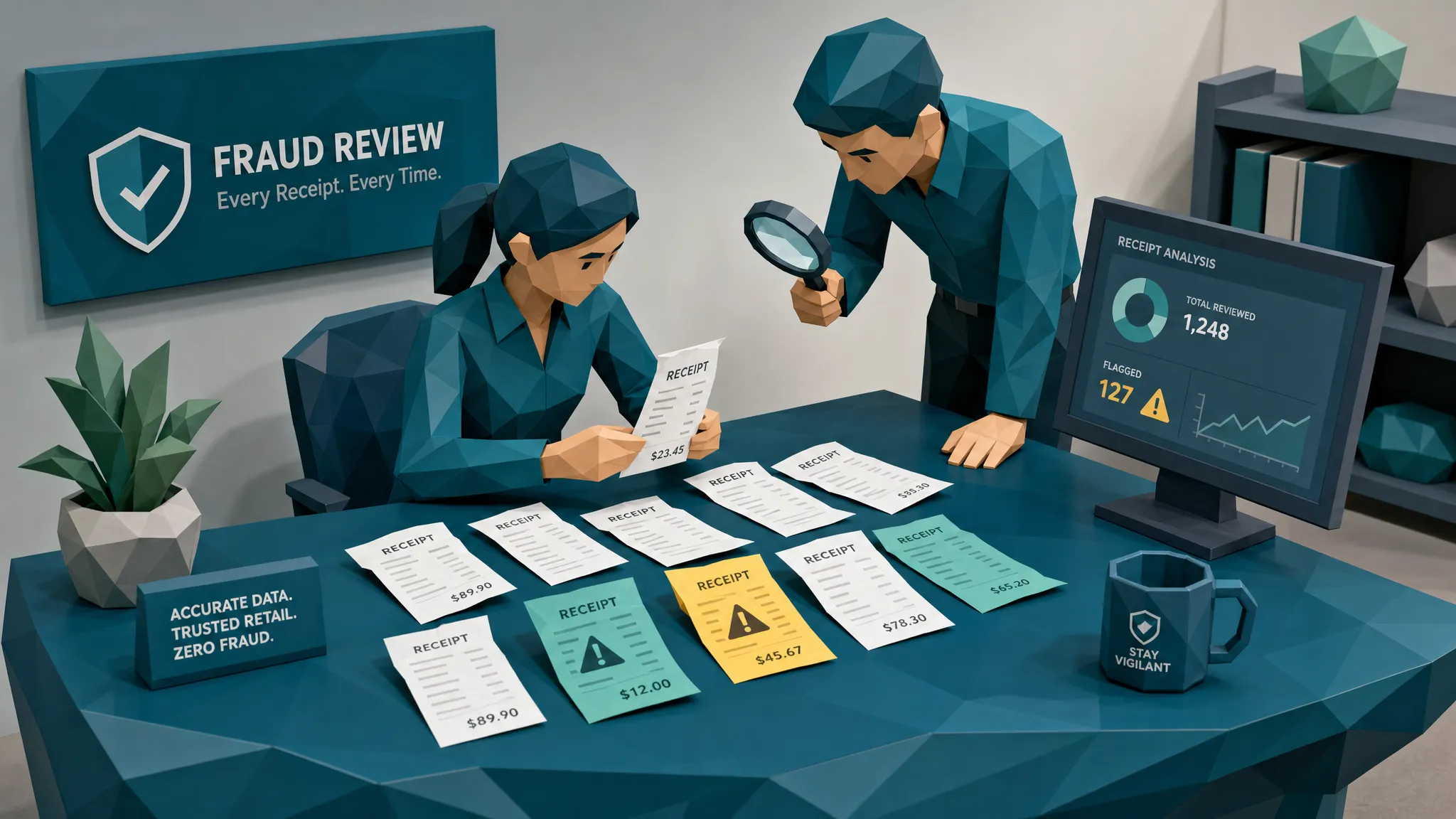

I’ll say the quiet part out loud: when a reviewer catches a fake Target receipt, it is usually not because the logo looks wrong. That is the movie version of fraud review, complete with dramatic zoom and suspicious music.
In real life, a fake Target receipt often looks painfully normal. It looks like something someone dug out of a glove box, photographed under bad kitchen lighting, and uploaded in a hurry. That ordinariness is exactly why it works in insurance claims, warranty claims, employee expenses, and procurement card reviews.
Target is used here as a familiar U.S. retail example, not as a technical guide to Target receipt formats. I’m not going to publish a forger’s checklist. What I will share is the fraud-review lens I wish more teams used: stop asking whether the receipt “looks like a receipt” and start asking whether the receipt, payment trail, and story all belong in the same room.
That distinction matters. The FBI estimates insurance fraud costs the U.S. more than $308 billion per year, adding hundreds of dollars to premiums for the average family. A single retail receipt may look too small to worry about, but leakage rarely arrives wearing a cape. It usually arrives as a pile of “minor” reimbursements nobody had time to question.

Why fake Target receipts get through review queues
My hot take: fake retail receipts get through because they are boring.
A receipt from a luxury jeweler triggers curiosity. A receipt from an obscure contractor might get a second look. But Target? Everyone shops there. The purchase story feels familiar before anyone reads it: cleaning supplies after a water leak, replacement bedding after smoke damage, baby supplies during displacement, office snacks, printer paper, a small appliance, a gift card, a phone charger.
Fraudsters understand this. They do not need the receipt to be perfect. They need it to be plausible enough to survive a tired reviewer on a Tuesday afternoon.
I once watched an adjuster catch a suspicious big-box receipt in about 40 seconds. Not because the receipt looked fake. It didn’t. The problem was the timeline. The claimant said the items were emergency replacements purchased immediately after a covered loss, but the purchase date, claim activity, and payment evidence told a different story. The receipt was the loudest document in the file, but the lie was hiding in the calendar.
Search behavior tells the same story. When terms like “fake Target receipt” start appearing around claim and reimbursement processes, that is demand, not trivia. Marketing teams use search intelligence to understand buyer intent, often with help from specialists like a no-jargon SEO agency. Fraud teams can borrow the habit: watch what people search, what templates circulate, and which document types become popular in suspicious submissions.
Red flag 1: the receipt fits the claim a little too neatly
The first red flag is not messiness. It is convenience.
A fake Target receipt often appears at the exact moment a claimant, employee, or vendor needs proof for a category that is hard to verify. The items sit just inside policy limits. The date supports the story perfectly. The amount is high enough to matter, but low enough to avoid escalation. It is fraud’s version of turning in homework with coffee stains added for realism.
For claims teams, look at whether the purchase timing makes human sense. Did the person allegedly buy replacement items before the loss was reported, before they had access to the damaged property, or after the reimbursement request was already questioned? For expense teams, ask why the receipt lands just under a manager approval threshold again and again.
The question is not, “Could someone buy these items at Target?” Of course they could. The better question is, “Would this specific person buy these specific items at this specific time, using this specific payment method, for this specific event?”
That is where many reviews improve instantly.
Red flag 2: the payment story is weaker than the receipt story
Receipts are claims of payment. They are not payment proof by themselves.
A real purchase usually leaves a trail: card statement, bank transaction, expense card feed, order confirmation, loyalty account record, delivery or pickup notice, refund record, or at least a consistent tender story. A suspicious receipt often floats alone, like it walked into the file without friends.
I pay close attention when the receipt says one payment method, but the reimbursement request points somewhere else. I also slow down when a high-value reimbursable purchase is supported only by a cropped image, a screenshot, or a vague explanation about using cash or gift cards. None of those details prove fraud. They do make the receipt less self-authenticating.
This is one reason we care about payment context at Docklands AI. Checking whether an image is manipulated is useful, but pairing document evidence with the payment information on a claim, expense, or invoice gives a deeper fraud picture. A fake Target receipt can look acceptable in isolation and fall apart when it meets the payment trail.
Red flag 3: the math passes OCR but fails common sense
OCR is great at reading text. It is not great at being suspicious.
A manipulated receipt may have totals that look clean enough for extraction, yet still raise questions when you review the relationship between items, discounts, tax, returns, coupons, and reimbursements. Retail receipts are messy in legitimate ways. That is exactly why fraudsters like them. Complexity gives cover.
The clue I look for is not one tiny rounding difference. Real receipts can be messy, and taxes vary by product, state, and purchase type. The bigger concern is a pattern of arithmetic that keeps benefiting the submitter. Totals that land neatly below thresholds. Discounts that appear to explain an amount but do not match the surrounding story. Returns or voids cropped out of view. Multiple receipts where the math has the same strange personality.
Fraud often has a handwriting style, even when it uses a printer.
Red flag 4: the product mix tells a different story
A receipt can be real and still be misused.
That point gets missed all the time. A person may submit a genuine Target receipt, then claim it supports a loss, expense, or warranty event it does not actually support. In contents claims, I’ve seen receipts used as proof for “replacement” items that were clearly general household shopping. In employee expenses, I’ve seen retail receipts used to bury personal items among legitimate office supplies.
The product mix should match the event. If the claim is for emergency lodging supplies, why are there discretionary electronics? If the expense is for client materials, why are there personal care items mixed in? If the warranty claim depends on proof of purchase, why is the receipt photo cropped so the item details are barely visible while the total is crystal clear?
Reviewers often focus on the document as an object. I prefer to read it as behavior. Shopping behavior has patterns. Fraudulent reimbursement behavior has patterns too.
Red flag 5: the image quality is bad in strangely selective ways
A low-quality image is not automatically suspicious. People upload awful photos every day. I have seen legitimate receipts photographed on car seats, kitchen counters, and once, memorably, on top of a dog crate. Fraud review is glamorous work.
The concern is selective degradation. If the entire image is blurry, that may simply be a bad photo. If only the date, total, tender section, or item description looks compressed, smudged, sharper, flatter, or oddly lit compared with the rest of the receipt, I want a closer look.
Common review misses include cropped edges, inconsistent shadows, repeated paper texture, text that seems to sit above the receipt instead of on it, and screenshots of screenshots. Again, none of this is proof on its own. But when these cues line up with weak payment evidence or a too-perfect claim story, you have something worth escalating.
This is also where human reviewers hit a ceiling. Pixel-level tampering is hard to see at volume, especially after an image has been compressed by email, a portal, or a phone app.
Red flag 6: metadata quietly disagrees with the document
Metadata is the receipts’ backstage pass. Sometimes it tells you nothing. Sometimes it tells you everything.
A receipt image may carry timestamps, device information, location clues, file history, software traces, or editing indicators. The absence of metadata is not proof of fraud, because many platforms strip it automatically. But metadata that contradicts the story deserves attention.
For example, if a receipt was allegedly photographed at the time of purchase, but the file was created weeks later, modified through editing software, or uploaded from a time zone that makes no sense for the claim, the reviewer should not shrug and move on. Treat it as a question to resolve, not an accusation to throw.
This matters more in 2026 because evidence manipulation has become easier and faster. The BBC reported that Admiral saw a 71% rise in fraudulent claims in 2025, with AI-generated images and deepfakes among the drivers. Retail receipt manipulation sits in the same practical universe: cheap tools, fast edits, and a reviewer queue that was never built for forensic work.
Red flag 7: the same receipt keeps reincarnating
Duplicate detection sounds simple until you meet near-duplicates.
A literal duplicate is easy: same file, same receipt, same amount. Most systems can catch that. The more interesting cases are receipts that look almost the same but have one or two fields altered. A date changes. A total changes. A line item disappears. A different employee submits a suspiciously similar image. A claim file contains a retail receipt that resembles one submitted months earlier in another region.
I’ve seen teams miss this because they only compare extracted fields. If the date and amount differ, the system treats the receipt as new. But the paper angle, shadows, crop, item structure, and template behavior may tell a different story.
This is where document-level comparison matters. A fake Target receipt is often not fully invented. It may be a recycled real receipt, lightly edited and reused because recycling is faster than creating something from scratch.
Red flag 8: the submitter’s behavior changes when asked for originals
The cleanest fraud signal is sometimes not in the receipt. It is in the reaction.
When a reviewer asks for the original file, a clearer image, payment corroboration, or a statement screenshot from an official channel, legitimate submitters may be annoyed, but they usually understand. Suspicious cases often produce evasive explanations, sudden urgency, replacement documents that look “cleaner” than the first version, or a complete inability to provide any supporting payment evidence.
Be careful here. People lose receipts. Phones break. Bank statements can be hard to access. I do not like treating normal inconvenience as guilt.
What matters is the cluster: weak original evidence, inconsistent payment story, document artifacts, and pressure to pay quickly. One oddity is a question. Four oddities are a pattern.
How I review a suspicious retail receipt without slowing every honest claim
The best process is boring, consistent, and documented. That may not sound thrilling, but neither does explaining to finance why you paid the same fake receipt six times.
First, preserve the original submission. Do not overwrite it with annotations or compressed versions. If your portal transforms files, keep the initial upload separately where possible. Evidence loses value when the intake process quietly scrubs the clues.
Then compare the receipt to the payment story. Does the tender method align with the claimant’s statement, reimbursement request, or expense card data? Does the timing make sense? Are there refunds, chargebacks, split payments, or gift-card explanations that need corroboration?
After that, inspect the document itself. Look at consistency in the text, image quality, layout, math, and metadata. Avoid saying “this looks fake” in your notes. Say what you observed: “date region shows different compression,” “payment evidence not provided,” “subtotal and reimbursement category do not align,” or “near-duplicate found in prior submission.” Specific evidence protects honest claimants and helps SIU, audit, or finance teams make better decisions.
Finally, route by risk. Most receipts should not get a courtroom-level review. Clean documents with clean context should move. Questionable documents should pause with clear reasons. The goal is not to turn every reviewer into a detective. The goal is to stop treating every retail receipt as equally trustworthy.
The ACFE’s occupational fraud research has long estimated that organizations lose about 5% of revenue to fraud. You do not reduce that with vibes. You reduce it with controls that catch small, repeatable abuses before they become normal operating cost.
Where Docklands AI fits
Manual review still matters. A good adjuster, AP manager, or expense reviewer understands context better than any standalone document check. But humans are not built to spot pixel-level edits across thousands of files while also answering emails, clearing exceptions, and surviving month-end.
Docklands AI helps teams screen invoices and receipts for manipulation before money moves. For retail receipts, that means looking for signs of photoshopping or tampering, AI-generated document patterns, metadata issues, mathematical irregularities, physical manipulation clues, duplicates, and payment-context conflicts. The platform is designed to integrate through APIs and webhooks, with reporting and analytics for teams that need consistent review coverage rather than occasional spot checks.
The important part is evidence. A useful fraud flag should tell reviewers why something is risky. A vague score without context just creates a second queue for people to mistrust.
Frequently Asked Questions
Can a fake Target receipt look completely real? Yes. Many suspicious receipts are based on genuine documents, recycled images, or realistic templates. That is why reviewers should compare the receipt with payment evidence, claim timing, metadata, item context, and duplicate patterns rather than relying on appearance alone.
What is the first thing to check on a suspected fake Target receipt? Start with the payment story. If the receipt cannot be tied to a credible card transaction, bank record, order confirmation, or reimbursement context, the document should not be treated as strong proof by itself.
Is missing metadata proof that a receipt is fake? No. Many phones, apps, email systems, and portals strip metadata automatically. Missing metadata is only meaningful when combined with other red flags, such as inconsistent timing, visual tampering, weak payment evidence, or duplicate patterns.
Should reviewers contact Target to verify a receipt? Follow your organization’s policy and use approved, official verification channels. Do not rely on phone numbers, email addresses, or links supplied by the claimant or employee when verifying purchase evidence.
How do teams avoid falsely accusing legitimate claimants or employees? Use evidence-based escalation. Preserve originals, document specific inconsistencies, ask for corroboration, and route cases according to risk. The goal is to resolve uncertainty fairly, not to turn every imperfect receipt into an allegation.
Stop letting familiar receipts bypass scrutiny
A fake Target receipt rarely announces itself. It survives because the brand feels familiar, the amount feels reasonable, and the reviewer has 80 other documents waiting.
If your team reviews receipts for insurance claims, employee expenses, warranty claims, or AP reimbursements, add document and payment-context screening before approval. Docklands AI helps detect manipulated, photoshopped, and AI-generated invoices and receipts before they become paid losses.
If you want to see what your current process is missing, start with Docklands AI and put a real batch of receipts to the test.
Request a Demo Today!
Book your demo below.