Fraud Detection With AI Works Best When Evidence Leads
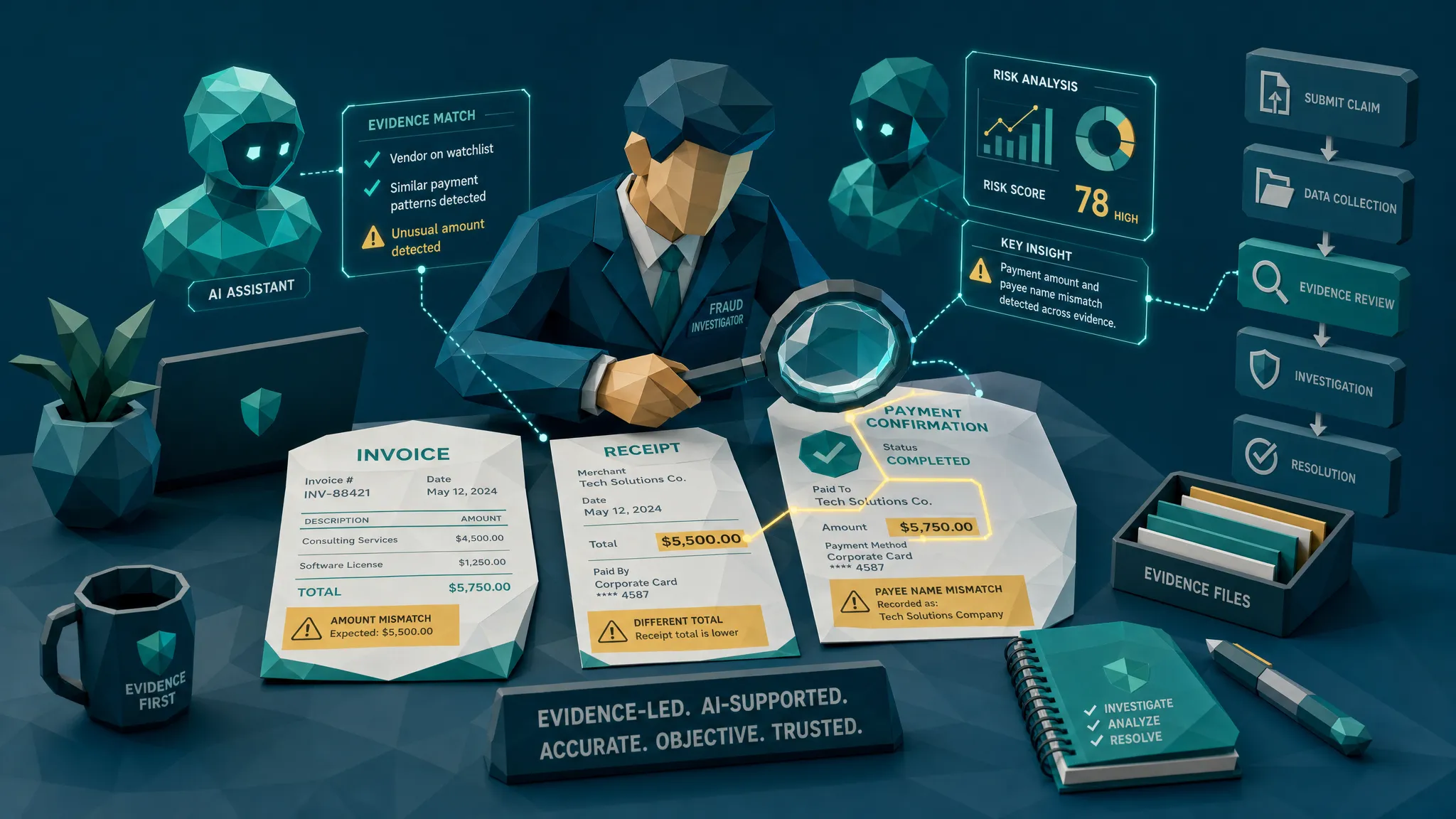

My hot take after a decade around fraud teams: fraud detection with AI only earns trust when evidence leads and the model follows. If the system starts with a mysterious score and asks reviewers to “believe the machine,” you have not built a fraud control. You have built a very expensive shrug.
I learned this the hard way years ago on a property claim that looked boring enough to cure insomnia. The invoice total matched the estimate. The vendor existed. The claimant sounded reasonable. The only odd thing was a replacement receipt that had been “rescanned” because the original was apparently too blurry. That rescanned version had cleaner edges than a luxury hotel lobby, a timestamp that made no sense, and payment details that did not match the first submission. The fraud was not hiding in one field. It was hiding in the evidence chain.
That is where AI can be excellent, provided we ask it to do the right job. Not “guess who is lying.” Instead: preserve the file, inspect the document, compare the payment story, surface the contradictions, and let the reviewer make a decision with something more useful than a red, yellow, or green badge.
Scores are helpful. Evidence is defensible.
Fraud teams do not lose sleep because they lack scores. They lose sleep because they need to explain decisions under pressure.
A claims manager needs to know why a repair invoice was held. An AP manager needs to justify why a supplier payment was paused. An expense manager needs to challenge a receipt without sounding like they are accusing someone based on vibes. I have seen plenty of fraud tools produce risk scores that looked scientific until someone asked, “What exactly did it find?” Then the room got quiet.
A risk score without an evidence trail is a horoscope in a blazer.
Evidence-led fraud detection starts with the artifacts that can be reviewed, documented, and acted on. That might be a mismatched font around a total, metadata showing the file was edited after submission, a duplicate receipt with a slightly different amount, a tax calculation that does not reconcile, or payment details that changed just before approval. The AI helps find and prioritize those signals, but the evidence carries the argument.
That distinction matters because fraud is expensive, and false accusations are expensive in a different way. The FBI notes that non-health insurance fraud costs more than $40 billion per year in the United States, adding an estimated $400 to $700 annually to premiums for the average family. In finance operations, the Association for Financial Professionals has repeatedly found that payments fraud targets a majority of organizations. The problem is not theoretical. The money leaves, the audit trail gets messy, and everyone suddenly becomes very interested in whether “approved” meant “verified.”
Modern fraud does not always look fake
The old training examples were almost charming. Crooked totals. Bad logos. A receipt that looked like it had been assembled in Microsoft Paint by someone on a lunch break.
Those still exist, bless them. But modern invoice and receipt fraud is quieter. A fraudster may alter a genuine invoice, regenerate a clean-looking receipt, reuse a real document from a prior claim, or change payment information while leaving everything else untouched. The document can look plausible because parts of it are plausible.
That is why I get nervous when teams rely only on OCR, rules, or manual review. OCR reads what the document says. Rules check whether the extracted values fit policy. Manual reviewers spot what they can see while juggling a queue that never stops growing. None of those approaches reliably answer the more important question: should we trust this document as evidence?
In insurance, that question is getting sharper. The BBC reported on a rise in fraudulent claims linked to AI-generated fake images and deepfakes, citing figures from Admiral. Verisk’s 2025 fraud research also points to growing concern around manipulated evidence and consumer willingness to use AI in claims. Whether you manage P&C claims, health claims, warranty claims, AP invoices, or employee expenses, the pattern is the same: when creation tools get easier, verification has to get better.
The evidence stack that actually helps reviewers
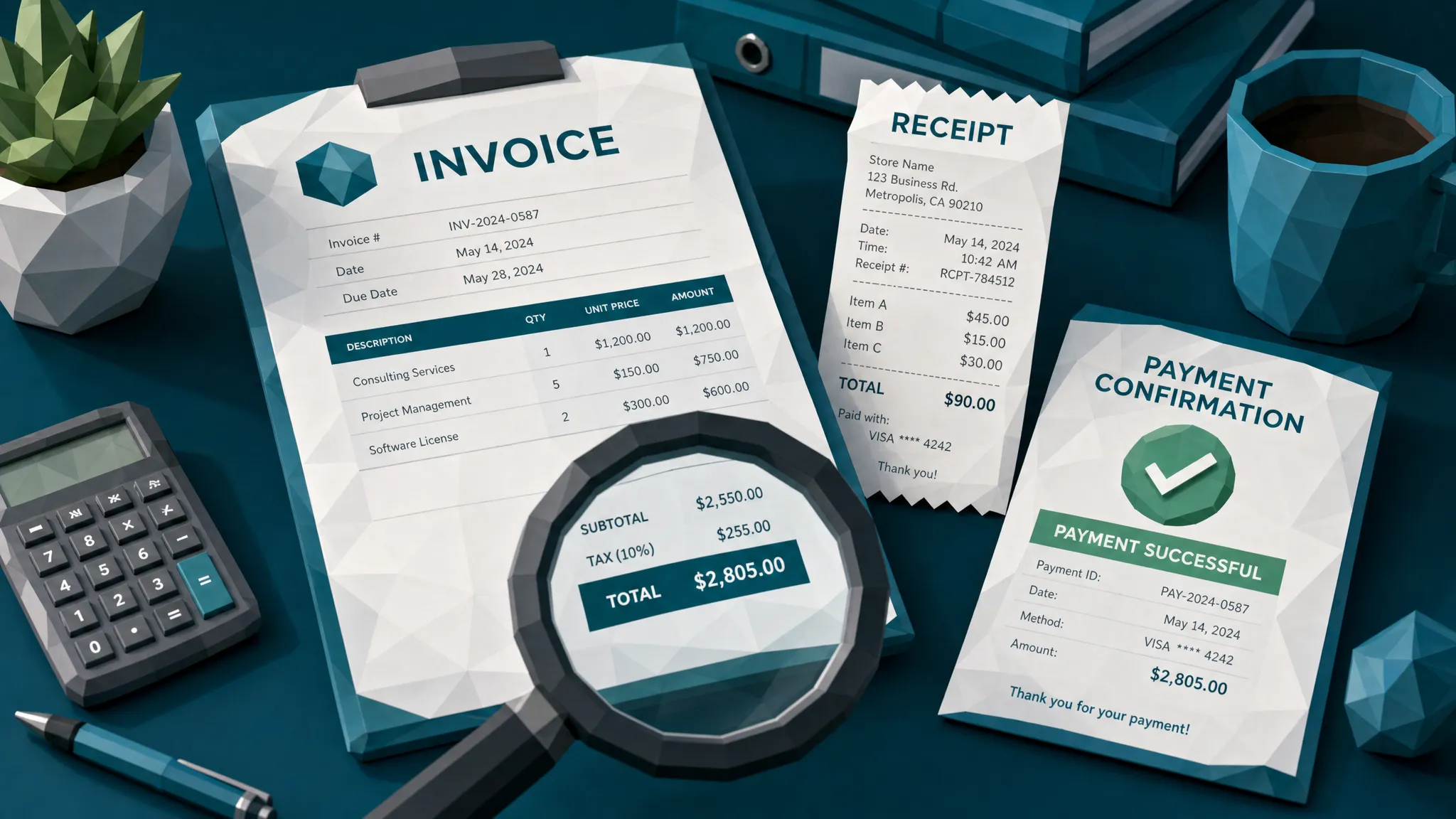
When I talk about evidence-led AI, I mean a workflow that looks at the original document from several angles before money moves. No single signal is perfect. Metadata can be stripped for legitimate reasons. A photo can be blurry because someone took it in a van at 7 p.m. after a long day. A math error might be sloppy bookkeeping rather than fraud.
But signals become powerful when they agree with each other.
A suspicious invoice with changed bank details is interesting. A suspicious invoice with changed bank details, metadata showing recent editing, a remittance block with different image compression, and a vendor account that has never used that IBAN before is a very different conversation.
In practice, the strongest evidence stack usually includes four layers.
First, inspect the document itself. That means looking for signs of tampering, inconsistent pixels, pasted regions, formatting drift, unusual compression, and artifacts that suggest a document has been altered or synthetically created. This is where photoshopped invoices, edited receipts, and generated documents often start to unravel.
Second, inspect the file history. Metadata, timestamps, device details, software traces, GPS data where available, and edit history can all help. A missing metadata field is not automatically suspicious, but metadata that contradicts the claim story deserves attention.
Third, inspect the numbers. Fraudsters are often weirdly good at logos and weirdly bad at arithmetic. Subtotals, tax, tips, VAT, currency conversions, invoice line items, and payment references should reconcile. “Close enough” is not a control, although it is apparently a lifestyle choice in some expense reports.
Fourth, connect the document to the payment context. This is the part too many document checks miss. A receipt or invoice is not floating in space. It is tied to a claimant, employee, supplier, bank account, policy, purchase order, approval path, or reimbursement request. If the payee story does not match the document story, the document deserves another look.
This is why payment platforms and fraud controls are increasingly converging. In travel payments, for example, services like Elia Pay’s payment platform combine payment management, fraud prevention, and reconciliation for agencies. Different market, same lesson: fraud detection gets stronger when the evidence is tied to how money actually moves.
Where AI helps, and where it should stay humble
AI is very good at scale. It can inspect every invoice or receipt instead of the lucky 2% selected for review. It can compare files against prior submissions. It can surface subtle inconsistencies that tired humans miss at month-end. It can route high-risk cases faster than a shared inbox named “AP Exceptions,” which, in my experience, is where productivity goes to die.
But AI should stay humble about intent.
A manipulated document is evidence. A duplicate receipt is evidence. A mismatch between payment details and vendor history is evidence. Whether that amounts to fraud, error, policy violation, or something else still requires process judgment.
That is not a weakness. That is how mature fraud operations work. The best systems do not try to replace investigators, adjusters, AP specialists, or finance reviewers. They help them spend less time hunting and more time deciding.
This is especially important for false positives. If a system flags too much, people stop listening. If it explains too little, people stop trusting. If it blocks payments without evidence, it creates business pain. Evidence-led AI reduces that friction because alerts are anchored in specific findings: “This amount region shows editing artifacts,” “This receipt resembles a prior submission,” “The file was modified after the claimed transaction date,” or “The payment account differs from the supplier’s historical pattern.”
Now the reviewer has something to verify. That is the difference between a useful alert and a digital panic button.
Claims, AP, and expenses each need the same discipline
The documents differ, but the discipline is remarkably similar.
In insurance claims, invoices and receipts often support the payout decision. A manipulated repair invoice, inflated medical bill, or recycled receipt can turn a normal claim into leakage. The danger is that claims teams are under pressure to move quickly, and most documents look normal enough at first glance. Evidence-led screening lets clean claims keep moving while suspicious documents go to SIU or specialist review with a clear reason.
In accounts payable, the trap is process confidence. A fake or altered invoice can pass through intake, OCR, matching, and approval if the fields look right and the vendor seems familiar. I have seen AP teams say, “But it matched the PO,” as if a match were a holy relic. Matching is useful. It does not prove the file was not altered, duplicated, or redirected.
In employee expenses, the social dynamic is different. Nobody wants to accuse a colleague over a dinner receipt. That is exactly why evidence matters. A reviewer can say, “This receipt appears to match a prior submission with a changed date,” rather than, “I have a bad feeling about your Tuesday tacos.” Much better for compliance. Much worse for awkward lunchroom energy.
A simple operating model: let evidence lead from intake
The biggest mistake I see is waiting until after approval, reimbursement, or payment to investigate document integrity. By then, you are in recovery mode. Recovery is slow, political, and often unsuccessful. Prevention is cleaner.
A practical evidence-led workflow starts at intake. Preserve the original file before it gets compressed, converted, renamed, or lovingly mangled by downstream systems. Run document integrity checks before the file is reduced to extracted fields. Connect the findings to payment and claim context. Route only meaningful exceptions to reviewers. Keep the evidence attached to the case record.
If you are implementing this in 2026, I would avoid a big-bang rollout. Start with shadow testing. Run AI screening alongside your current workflow for a representative sample of claims, invoices, or expenses. Compare what it finds against manual outcomes, known fraud, recoveries, and reviewer feedback. Calibrate severity levels. Then decide what gets auto-cleared, what gets light review, and what requires a hard stop.
The goal is not to create more work. The goal is to stop wasting human attention on documents that have no meaningful risk signals, while catching the ones that do.
What “good” looks like in an evidence-led alert
A good alert is specific. It does not simply say “high risk.” It tells the reviewer what was found and where to look.
For example, a useful alert might say the invoice total region appears edited, the bank account differs from prior supplier payments, and the PDF metadata shows modification after submission. That reviewer can now verify the bank change, contact the vendor through a trusted channel, and document the reason for holding payment.
A weak alert says “92% suspicious.” Suspicious of what? The font? The claimant’s aura? The moon phase?
When evaluating fraud detection with AI, I would ask vendors the boring questions first because boring questions save money:
- Does the system preserve and analyze the original file, not only OCR output?
- Does it show the specific document evidence behind each alert?
- Does it combine visual, metadata, mathematical, duplicate, and payment-context signals?
- Can it integrate with existing claims, AP, expense, or payment workflows through APIs or webhooks?
- Can reviewers feed outcomes back so alerts improve operationally over time?
That is enough of a list. Any more and we will need snacks.
How Docklands AI fits into this approach
Docklands AI is built around this evidence-first philosophy for invoices and receipts. The platform helps detect manipulated, photoshopped, physically altered, and AI-generated documents before they become paid claims, supplier payments, or employee reimbursements.
The important part is that Docklands does not treat the document as a flat image or a handful of extracted fields. It analyzes forensic signals such as tampering, metadata, mathematical irregularities, physical manipulation, and duplicate patterns. It also uses payment information from the claim, expense, or payment workflow to build a deeper fraud picture. In my view, that payment-context layer is where a lot of practical accuracy comes from, because fraud usually has a money destination.
For teams already running claims platforms, AP automation, ERPs, or expense tools, the point is not to rip out what works. The point is to add a fraud evidence layer at the moment where it can still prevent loss: before payment.
Frequently Asked Questions
Does AI replace fraud investigators or reviewers? No. In a mature workflow, AI helps surface evidence, prioritize risk, and reduce manual hunting. Human teams still make decisions, handle edge cases, contact vendors or claimants, and document outcomes.
What is the biggest mistake teams make with AI fraud tools? Treating a risk score as proof. Scores can prioritize work, but reviewers need specific evidence such as document tampering, metadata contradictions, duplicate patterns, math issues, or payment-context mismatches.
Where should AI document screening sit in the workflow? Ideally at intake and again before payment when risk changes, such as new bank details, resubmitted documents, or late-stage claim updates. Screening after payment is still useful for audits, but prevention is better than recovery.
Can AI detect AI-generated invoices and receipts? It can help, especially when detection combines document forensics, metadata analysis, mathematical checks, duplicate detection, and payment context. No single clue is perfect, so the strongest approach uses multiple evidence signals.
How do teams reduce false positives? Use evidence-backed alerts, severity bands, reviewer feedback, and payment-context checks. The system should not flag every oddity equally. A blurry receipt is common. A blurry receipt with impossible metadata and a duplicate payment trail is different.
Let the evidence do the talking
Fraud detection with AI works best when it behaves less like a fortune teller and more like a careful investigator: preserve the original, inspect the document, connect the payment story, and show the work.
If your team reviews invoices, receipts, claim documents, or expense evidence, Docklands AI can help you catch manipulated and AI-generated documents before they cost real money. Request a demo to see how evidence-led document fraud detection can fit into your claims, AP, or expense workflow.
Request a Demo Today!
Book your demo below.