Fraud Insurance Claim Tactics Adjusters Should Watch


I have a slightly unpopular opinion after a decade in fraud work: the most dangerous fraudulent insurance claim is rarely the cartoonishly fake one. It is the file that looks oddly ready for payment.
The photos are tidy. The invoice is crisp. The claimant has every document within an hour. The vendor is cooperative, maybe too cooperative. Everyone is polite. The file glides through the workflow like it has TSA PreCheck.
That is exactly why adjusters need a sharper nose for document-led fraud. The FBI notes that insurance fraud adds an estimated $400 to $700 per year to the average family’s premiums. McKinsey has also reported that only a fraction of fraudulent claims are detected. Meanwhile, submitted evidence is getting easier to manipulate, from edited repair receipts to synthetic damage photos.
When people talk about fraud insurance claim tactics, they often imagine a fake slip-and-fall or a staged burglary. Those still happen. But the modern playbook is quieter. It lives in invoices, receipts, metadata, payment instructions, timestamps, and the little contradictions that appear when a document is pretending to be a real-world event.
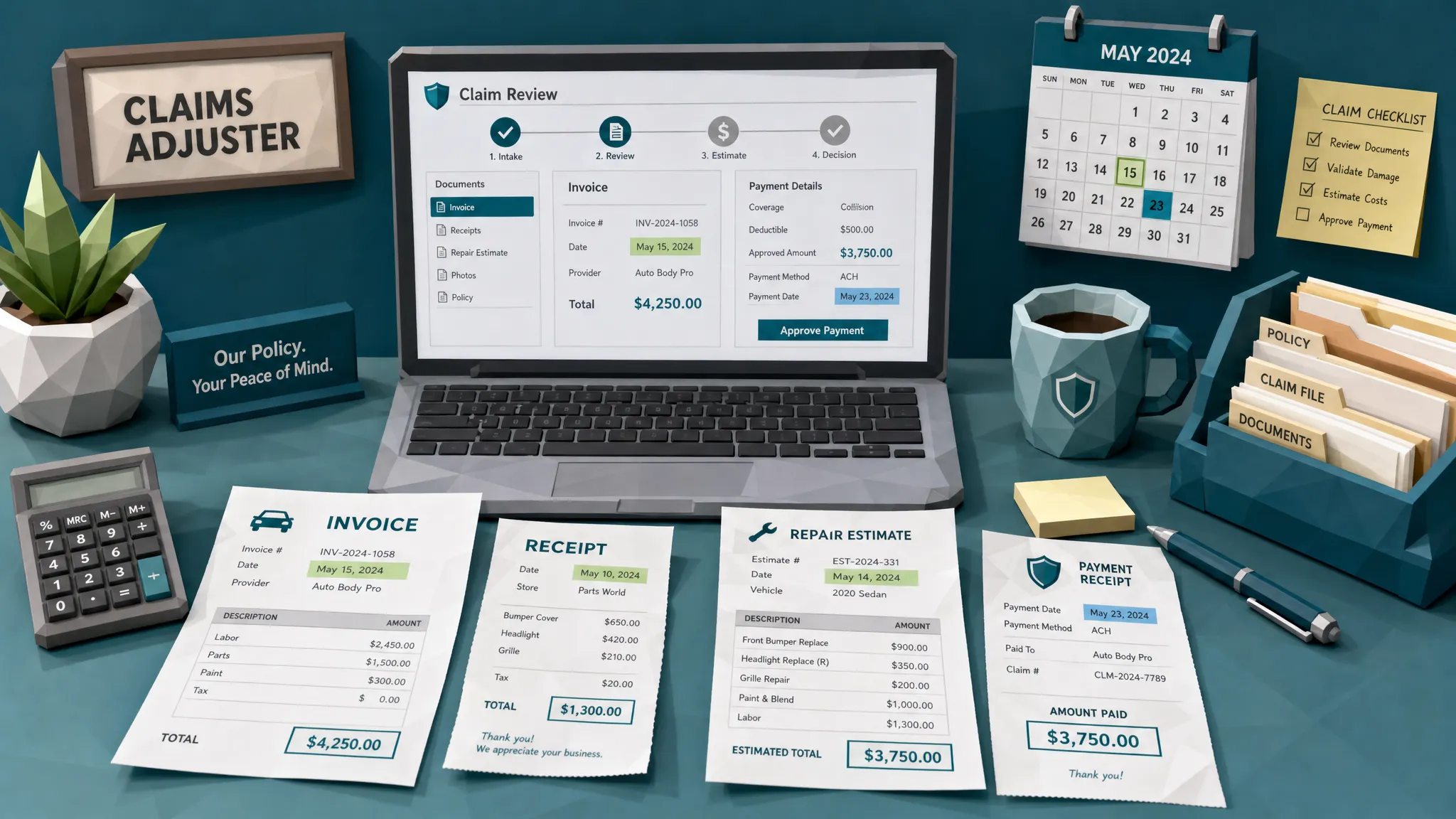
The adjuster’s real job is pattern recognition
Before we go further, let me say the obvious thing that still gets forgotten in training rooms: an adjuster is not a detective in a trench coat. You are not there to accuse a policyholder because a PDF looks funny or a receipt has a smudge.
Your job is to notice when the story, the documents, and the payment trail do not behave like they came from the same reality.
I once reviewed a water damage claim where the loss was absolutely real. A pipe had burst, drywall was removed, and the photos matched the reported room. The fraud was not the loss. The fraud was the upgrade. The repair invoice quietly included work in two rooms that were never affected, with labor hours that would have required a crew of very enthusiastic superheroes. The claim looked legitimate because part of it was legitimate.
That is the hot take: many suspicious claims are not fake from top to bottom. They are real claims with fake layers added.
Tactic 1: The real loss with the inflated repair story
This is one of the most common patterns I see. A claimant has a genuine covered loss, then the supporting documents stretch the truth. The invoice adds extra rooms, premium materials, unrelated repairs, inflated labor, or equipment rental that does not match the photos.
Adjusters should watch for line items that feel disconnected from the visible damage. If a kitchen leak turns into a whole-house flooring replacement, you do not need to panic, but you should slow down. Ask whether the scope explains the jump. Compare estimates against photos, inspection notes, prior claim history, and local pricing norms.
The key is proportionality. Fraudsters love legitimate losses because the claim already has a believable anchor. Once the event is accepted, the document stack gets less scrutiny. I call this the clean plate trick. Put one real steak on the plate, then hide three fake side dishes under gravy.
Tactic 2: Receipts that look like they were born inside a template
A normal receipt is often a little ugly. Thermal paper fades. Store logos are imperfect. Fonts vary. Photos are taken at bad angles because, apparently, receipts are most often photographed on a car seat under nightclub lighting.
Synthetic or heavily edited receipts can look too polished. Perfect spacing, unnaturally consistent fonts, overly sharp totals, and missing point-of-sale quirks can all be clues. So can tax math that is close but not quite right, or a merchant address that exists but does not match the claimed location.
This matters more now because the tools are easier. The BBC reported on a sharp rise in fraudulent claims involving AI-generated fake images and deepfakes, based on figures from insurer Admiral. A 2025 Verisk fraud report also found that carriers see claims manipulation becoming more sophisticated.
My practical advice is simple: do not ask whether the receipt looks pretty. Ask whether it behaves like a receipt from that merchant, that date, that location, and that payment method.
Tactic 3: The same invoice wearing a fake mustache
Duplicate and near-duplicate invoices are still wildly effective. The sloppy version is the same invoice submitted twice. The smarter version changes the claimant name, invoice number, date, or total while leaving the underlying document structure intact.
I once saw a roofing estimate show up in two unrelated storm claims. Different names, different dates, different totals. Same weird staple shadow near the top left. Same tiny coffee stain in the margin. The fraudster remembered to edit the numbers but forgot that paper has a memory.
Adjusters should be cautious when a document feels familiar, especially during catastrophe surges. Similar layouts are normal for large vendors, but identical artifacts, repeated photo angles, matching line-item sequences, or recycled estimate language deserve a closer look.
This is where manual review struggles. A human can recognize the same invoice twice if the files are close together. A high-volume claims operation needs technology to compare documents across thousands of submissions, including near matches.
Tactic 4: Date gymnastics
Dates are boring until they solve the case. Fraudulent claims often rely on moving time around. A receipt gets backdated to fall within coverage. A repair estimate appears before the reported inspection. A medical bill refers to treatment before the alleged injury. A hotel receipt covers dates that do not match travel or evacuation timelines.
The mistake I see in weak reviews is treating each date as a field to be read, rather than a clue to be reconciled. The reported loss date, photo timestamps, invoice issue date, service date, payment date, document creation time, and claim submission time should form a plausible sequence.
Metadata can help, but it is not magic. Some systems strip it. Some phones handle it differently. Some legitimate documents are rescanned. Still, when a file claims to be created after it was supposedly submitted, or when a repair photo has a timestamp that predates the storm, you have a signal worth checking.
Tactic 5: The vendor who appears only when money is moving
Post-loss vendor fraud is a classic. After hailstorms, floods, fires, or warranty events, fraudsters may create a vendor identity that looks just real enough to pass a rushed review. They may use a generic business name, a fresh website, a mobile number, and a professional-looking estimate.
To be clear, marketing outreach is not suspicious by itself. Plenty of legitimate contractors and carriers use sophisticated channels, including all-in-one direct mail platforms such as DirectMail.io, to reach customers after a storm or service event. The red flag is when polished outreach is the vendor’s only footprint.
Look for vendors with thin histories, inconsistent addresses, mismatched licensing, newly introduced payment details, or phone numbers shared across unrelated claims. If the vendor did not exist until the week the claim was filed, I get curious. Not accusatory, just curious enough to verify.
Tactic 6: The late payee or bank-detail switch
If you remember only one thing from this article, make it this: payment information is evidence.
Fraudsters often spend more time making the invoice look real than making the payment trail make sense. Late changes to payee name, routing details, mailing address, or direct-payment instructions should not be treated as admin noise. They can be the whole scheme.
In claims, this might look like a contractor asking to be paid directly after the estimate is approved. It might be a claimant switching reimbursement to a new account. It might be an assignment-of-benefits document that appears late and looks inconsistent with the rest of the file.
The document may pass a surface review, while the payment context tells a different story. A repair invoice from a known vendor paired with an unfamiliar bank account is not proof of fraud, but it is not a shrug either.
Tactic 7: Photo evidence that forgets physics
Damage photos are now part of the fraud battlefield. Edited images, reused photos, staged damage, and generated images can all support inflated or fabricated claims.
The tells are often small. Lighting that does not match across the same room. Shadows that fall in conflicting directions. Damage edges that look too smooth. Repeated textures. Cropping that avoids context. Photo quality that changes dramatically between images supposedly taken at the same time.
A good adjuster also compares photo evidence to the claim narrative. If the claimant reports sudden storm damage but the photo shows long-term wear, old staining, or mismatched debris, you need more context. If every photo is extremely close-up, ask for wider shots. Fraud hates context.
That last line is worth taping to a monitor. Fraud hates context.
Tactic 8: The claimant who knows your thresholds too well
Some claims sit right below review thresholds with suspicious regularity. Not once, which can happen. Repeatedly.
You may see repair receipts just under the amount that triggers vendor verification. Multiple smaller invoices instead of one larger one. Separate claims that appear to split a single incident. Medical or warranty submissions that conveniently avoid documentation requirements.
This is where experience matters. A single threshold-friendly amount is not a fraud finding. A pattern of threshold-friendly behavior is a different animal. As one old SIU colleague used to say, whenever a number kisses the limit but never crosses it, buy it dinner and ask questions. He was terrible at metaphors, but good at fraud.
Tactic 9: The pressure play
Fraud is not only in the documents. It is also in behavior.
Watch for claimants or vendors who push hard for speed while resisting normal verification. They may be charming, angry, distressed, or highly procedural. They may switch channels from portal to email to phone to avoid a consistent record. They may send documents in formats that degrade quality, then complain when you ask for originals.
Real claimants can be upset too. A house fire or denied medical bill will not make anyone their best self. The difference is whether the pressure is paired with document contradictions, payee changes, missing originals, or evasive answers.
The best response is calm process. Ask for the original file. Request a wider photo. Verify the vendor. Pause payment if your procedures allow it. No drama required.
A 10-minute triage routine for suspicious claim documents
When something feels off, I use a short sequence. It keeps the review fair, evidence-led, and less dependent on gut instinct.
- Preserve the original submission file before converting, compressing, printing, or forwarding it.
- Compare the document to the claim story, including date of loss, location, damage type, and service timeline.
- Recalculate totals, taxes, discounts, deductibles, and line-item math.
- Check whether the payee, vendor, address, and payment instructions match known records.
- Look for duplicate or near-duplicate documents across the claim history and related claims.
- Ask open-ended clarification questions rather than making accusations.
- Escalate to SIU or fraud review when multiple independent signals point in the same direction.
That last point matters. One oddity is often noise. Three unrelated oddities are a chorus.
What adjusters should send to SIU
A weak referral says the claim seems suspicious. A strong referral says the invoice total does not reconcile, the vendor bank details changed after approval, the receipt metadata conflicts with the reported purchase date, and the same image artifact appears in another claim.
SIU teams need specifics. They need the original documents, not screenshots of screenshots. They need the timeline, payment context, and the exact reason you paused. They need to know whether the claimant gave an explanation and whether that explanation resolved the issue.
The more evidence you provide, the less SIU has to rediscover. That means faster decisions, fewer false positives, and less friction for honest claimants.
Where automated document forensics fits
I am a fan of good adjusters. I am also realistic. Nobody can manually inspect every pixel, metadata field, math inconsistency, duplicate pattern, and payment-context mismatch at claims volume without going cross-eyed.
This is where Docklands AI fits into the workflow. Docklands AI helps organizations detect photoshopped, manipulated, and AI-generated invoices and receipts before they lead to payment leakage. It analyzes document evidence for tampering, metadata issues, mathematical irregularities, signs of physical manipulation, and AI-generated content. It also uses payment information from a claim, expense, or payment to build a deeper fraud picture, which is critical because documents and money movement should agree with each other.
For claims teams, the practical value is not replacing adjusters. The value is giving adjusters and fraud teams better signals earlier, with evidence attached. Docklands AI can integrate through APIs and webhooks, and it supports reporting, analytics, user and project management, and security controls such as 2FA.
My preferred workflow is simple: let clean claims keep moving, route questionable documents into an evidence lane, and give SIU enough detail to act without starting from scratch.
The best fraud control is boring consistency
Fraud detection does not need to feel like a spy movie. In fact, the best claims controls are usually boring. Preserve originals. Check the math. Compare dates. Verify payees. Reconcile documents against payment context. Escalate based on evidence, not vibes.
The fraudsters are counting on your process being busy, fragmented, and polite. They know adjusters want to help people. They know cycle time matters. They know a clean-looking document can slip through when everyone is measured on speed.
So here is my final hot take: the best adjusters are not cynical. They are curious. They know most claimants are honest, but they also know that a believable document is not the same thing as a truthful one.
Frequently Asked Questions
What is a fraud insurance claim? A fraud insurance claim is a claim that includes false, exaggerated, manipulated, or intentionally misleading information to obtain a payout. It can involve a completely fabricated loss, but it often involves a real loss with inflated invoices, altered receipts, staged photos, or misleading payment details.
What documents should adjusters scrutinize most closely? Invoices, receipts, repair estimates, medical bills, photos, assignments of benefits, and payment-change instructions deserve close attention. The riskiest documents are usually the ones that directly affect payout amount or payee.
Should adjusters accuse claimants when documents look suspicious? No. Adjusters should document the issue, preserve the original evidence, ask neutral clarification questions, and follow escalation procedures. Accusations should be avoided unless the investigation supports them and the organization’s process allows it.
Can AI-generated receipts and invoices be detected? Yes, many can be detected when reviewers or tools examine visual consistency, metadata, math, duplicate patterns, and payment context together. A generated document may look convincing at a glance but still fail to match the surrounding claim evidence.
What is the biggest red flag before payout? A late change to payee or payment information combined with document inconsistencies is one of the strongest warning signs. Payment details are part of the evidence, not a back-office afterthought.
Put better eyes on the paper trail
If your claims team is seeing cleaner documents, faster submissions, and stranger inconsistencies, it may be time to add document-level screening before payout. Docklands AI helps insurers detect manipulated, photoshopped, and AI-generated invoices and receipts while connecting document findings to payment context.
Learn how Docklands AI can support your claims fraud workflow at Docklands AI.
Request a Demo Today!
Book your demo below.