Hotel Receipts Are Easier to Fake Than Most Teams Think
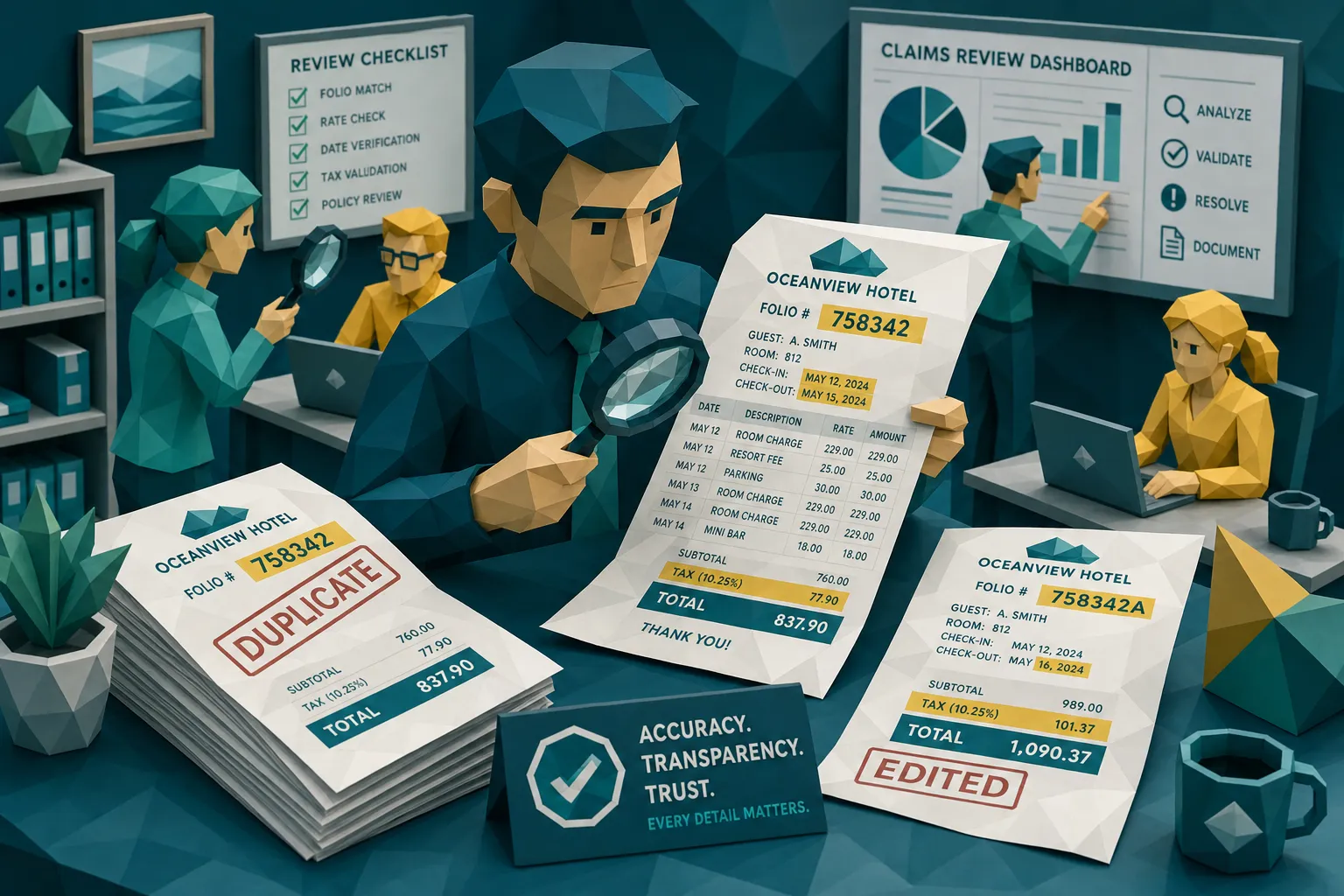

I have a small hill I will happily die on: hotel receipts are among the most over-trusted documents in expense, claims, and AP workflows.
They look official. They have logos, room tax, folio numbers, check-in dates, checkout dates, and that comforting last four digits of a card. They feel boring, and boring documents often get waved through. After 10 years working around fraud controls, I can tell you that boring is exactly where trouble likes to hide.
I am not going to explain how to fake a hotel receipt. I enjoy sleeping at night, preferably in a hotel with a legitimate folio. What I will explain is why hotel receipts are so often accepted with too little scrutiny, what signals reviewers miss, and how teams can screen them before they become paid losses.
The problem with hotel receipts is that they look more reliable than they are
A hotel receipt, or hotel folio, is supposed to be the final record of a stay. It should show what was charged, what was paid, taxes, fees, adjustments, and the remaining balance. In a perfect world, it would be tidy and standardized.
In the real world, hotel receipts are a mess.
One property prints a clean PDF. Another emails a low-resolution scan. A third produces a folio with city taxes, tourism fees, resort fees, parking, minibar charges, and refunds that look like someone spilled accounting soup on the page. Add third-party booking platforms, corporate travel tools, mobile screenshots, currency conversions, and partial reimbursements, and suddenly the reviewer has a puzzle dressed up as a receipt.
That mess creates cover. A manipulated hotel receipt can hide inside the normal chaos of legitimate hotel billing.
Years ago, I reviewed a hotel folio that had already been approved by a manager. Nothing dramatic. No cartoonish typo. No fake hotel called “Definitely Real Inn.” The amount had been increased by a few hundred dollars, but the tax line still matched the original lower room rate. It was the receipt equivalent of ordering three pizzas and paying sales tax on one. The document looked official, but the math was quietly snitching.
My hot take: the amount is not the best clue
Most teams stare at the total. I get it. The total is where the money leaves the building. But in hotel receipt fraud, the total is often the least interesting part.
The better questions are: did this person stay there, did they pay that amount, and does the stay make sense in the context of the claim, trip, or business event?
That is where many controls fall short. OCR can read “$642.19.” A policy engine can check whether lodging is allowed. A manager can nod because the employee was traveling. None of that proves the hotel receipt is authentic or that the payment happened as shown.
This matters across several teams. Expense managers see hotel receipts for business travel. Claims teams see them in additional living expense claims, trip interruption claims, warranty travel reimbursements, and relocation scenarios. AP teams may see lodging pass through vendors, contractors, field teams, or project-based billing.
Hotel receipt risk also rises in industries with distributed operations: construction, healthcare networks, field sales, retail rollouts, manufacturing, and supplier visits. A brand coordinating sourcing, samples, and production through an apparel development and manufacturing partner may have legitimate travel across factories, trade shows, and vendor meetings. That kind of movement creates plenty of real hotel spend, which unfortunately also creates room for fake or inflated submissions.
Why fake hotel receipts slip through normal review
The first reason is simple: reviewers are busy. A finance analyst handling hundreds of monthly expense reports is not doing forensic document analysis on every hotel folio. They are checking dates, amounts, policy limits, and maybe the merchant name. That is understandable. It is also exactly the gap a fraudster exploits.
The second reason is that hotel billing has legitimate complexity. Room taxes vary by city. Resort fees appear in one market and not another. Parking may be charged separately. Deposits and authorizations confuse people who do not live in folio land. If a reviewer sees something odd, it is easy to shrug and assume “hotel billing is weird.” Often, it is. Sometimes, weird is the point.
The third reason is that hotel receipts often arrive as screenshots or compressed PDFs. By the time they reach an expense platform or claims portal, the original file may have been resized, converted, cropped, or stripped of useful file history. That makes manual review harder and reduces the evidence available later.
The fourth reason is social. Most organizations do not want to treat employees, claimants, or contractors like suspects. Good. They should not. But trust should not mean skipping basic document integrity checks. Trust is a culture value. Verification is a payment control.
The stakes are not theoretical. The ACFE Report to the Nations has long estimated that organizations lose around 5% of revenue to occupational fraud. On the insurance side, the FBI notes that insurance fraud costs the United States more than $300 billion per year and adds hundreds of dollars to the average family’s premiums. Hotel receipts are only one document type, but they sit inside both of those loss streams.
The most common hotel receipt manipulations I see
Date stretching
This is the classic move. A genuine one-night stay becomes a three-night stay. A checkout date moves just enough to align with a reimbursable event. In claims, the hotel stay may be adjusted to overlap with a covered loss period. In employee expenses, dates may be nudged to fit a conference or sales trip.
The date fields are often edited cleanly, but the surrounding evidence does not always cooperate. File timestamps, booking records, card settlement dates, loyalty account data, and travel calendars can tell a different story. I have seen receipts where the checkout date changed, but the payment timestamp still pointed to the original stay. That is the kind of detail a tired human reviewer can miss at 4:57 p.m. on a Friday.
Rate inflation
A nightly rate changes from $189 to $289. Taxes move, but not quite correctly. Fees are added that do not match the property, city, or season. The fraudster is betting that no one will recalculate occupancy tax or compare the rate to the booking confirmation.
This is where math becomes underrated. A hotel receipt is full of small arithmetic promises. Room rate times nights should reconcile. Taxes should broadly fit the jurisdiction and taxable base. Adjustments should flow into the final balance. When those promises break, you may have more than a clerical issue.
Personal charges quietly removed
Not every manipulation increases the total. Sometimes the goal is to make a receipt look policy-compliant. Alcohol, spa charges, movies, room service, or extra guest fees disappear. The total may remain plausible, but the itemization has been sanitized.
This is one reason I dislike controls that only look at the final amount. A $480 hotel receipt can be perfectly within policy and still be manipulated. If the original folio had $120 of non-reimbursable charges removed, the company is still paying for something it did not agree to cover.
Duplicate and near-duplicate folios
Duplicate receipt fraud is not always a literal copy. The same underlying hotel receipt might be submitted twice with a changed date, cropped header, altered room number, or different employee name. In claims, a receipt might be reused across related files. In AP, a contractor may pass through the same lodging cost on multiple invoices.
This is where human memory fails. A reviewer might recognize the same receipt if it lands twice in the same week. They will not reliably catch a near-duplicate across six months, three entities, two claim systems, and a folder named “final_final2.pdf.”
Synthetic hotel receipts
The newest headache is the fully synthetic receipt. A document can be generated to resemble a hotel folio without ever starting from a real stay. It may include a real hotel name and address, plausible taxes, a fake folio number, and a clean layout.
The broader fraud environment is moving in that direction. Verisk’s 2025 Fraud Report highlights growing willingness among younger consumers to consider altering claim evidence with AI tools, and the BBC reported a sharp rise in fraudulent claims linked to manipulated and AI-generated evidence. Hotel receipts are part of that same document ecosystem.
What a good review should actually check
A strong review does not mean accusing people because a receipt looks funny. One odd signal is a question, not a conviction. The goal is to separate clean receipts from receipts that deserve a closer look.
Here is the practical sequence I recommend when hotel receipts matter financially:
- Preserve the original file: Do not rely only on OCR text or a platform preview. Keep the submitted PDF, image, or email attachment because visual and file-level clues may matter later.
- Check the receipt against the payment trail: Compare the final balance, payment method, last four digits, authorization timing, reimbursement request, corporate card feed, or claimant payment details.
- Reconcile the math: Review room rate, nights, taxes, fees, credits, deposits, and final balance. Hotel math can be messy, but it should not be magical.
- Compare the stay to context: Look at the business trip, claim loss date, repair timeline, conference schedule, vendor visit, or policy coverage window.
- Screen for document manipulation: Look for visual edits, metadata issues, duplicated layouts, copy-paste artifacts, and signs that fields were changed after the fact.
That last step is where most manual processes struggle. A person can spot obvious edits. They cannot reliably inspect every pixel, metadata field, mathematical relationship, and duplicate pattern at scale.

The booking confirmation trap
One of my pet peeves is treating a booking confirmation like a hotel receipt. They are not the same thing.
A booking confirmation shows that a room was reserved. A final hotel receipt shows what was actually charged and paid after checkout. The difference matters. A traveler can reserve a room and cancel it. A claimant can submit a confirmation even if a stay was shortened. A contractor can pass along an estimated lodging cost instead of the settled amount.
For reimbursement, the final folio should usually be the document of record. If your workflow accepts confirmations as proof of payment, you are giving fraud and error a very comfortable sofa to nap on.
Why payment context beats document-only review
Here is another opinion from the fraud trenches: asking “does this receipt look real?” is too narrow.
A receipt can look real because it is based on a real document. The real question is whether this document supports this payment, for this person, for this claim or expense, at this time.
That is why payment context is so powerful. If a hotel receipt says the charge was paid on a Visa ending in 1234, but the employee is asking reimbursement to a different account and no matching corporate card transaction exists, that is worth attention. If a claim includes hotel lodging after a home loss, but the stay begins before the reported loss date, that is worth attention. If the same hotel folio layout appears across unrelated claimants with small edits, that is very worth attention.
Payment fraud is not limited to receipts, of course. The Association for Financial Professionals has reported that a large share of organizations continue to face attempted payments fraud. Hotel receipts may seem small compared with supplier invoices or wire fraud, but they often sit in high-volume workflows where small leaks add up quietly.
How to reduce hotel receipt fraud without annoying everyone
The worst fraud controls punish honest people with paperwork. Nobody wants a sales team uploading three screenshots, two affidavits, and a note from the concierge because they stayed at a Hampton Inn.
The better approach is risk-based screening. Let normal receipts move quickly. Escalate the ones with evidence-backed concerns. That means a reviewer should see why a receipt was flagged, not just a vague “suspicious” label.
For example, a useful alert might say: the tax calculation does not reconcile with the stated room rate, the PDF metadata suggests editing software was used after checkout, and the receipt is visually similar to a prior submission with a different date. That is actionable. A reviewer can ask for the original folio, verify with the hotel, compare card data, or route the case to SIU or internal audit.
A bad alert says: “possible fraud.” That is how you create alert fatigue, and alert fatigue is where good controls go to retire.
Frequently Asked Questions
Are hotel receipts easy to fake? Yes, compared with many other financial documents, hotel receipts can be relatively easy to manipulate because formats vary widely, billing is complex, and reviewers often accept screenshots or PDFs without checking file history, math, or payment context.
Can OCR detect fake hotel receipts? OCR can read fields like dates, totals, hotel names, and tax amounts, but reading a receipt is not the same as verifying it. Fraud detection needs document integrity checks, math review, metadata analysis, duplicate detection, and payment-context comparison.
What is the difference between a hotel receipt and a booking confirmation? A booking confirmation shows that a room was reserved. A hotel receipt or final folio should show what was actually charged and paid after the stay. For reimbursement or claims, the final folio is usually stronger evidence.
What should claims teams check on hotel receipts? Claims teams should compare the hotel stay to the loss date, coverage period, claimant location, payment method, and any related invoices or receipts. They should also look for altered dates, inflated rates, duplicate submissions, and synthetic documents.
Should every hotel receipt be manually reviewed? No. Manual review does not scale and can slow legitimate reimbursements. A better model is automated screening across all receipts, with human review reserved for high-risk items that come with clear evidence.
Catch fake hotel receipts before they become paid losses
Hotel receipts deserve more scrutiny than most teams give them. Not because every traveler or claimant is dishonest, but because the document is easy to trust and surprisingly easy to abuse.
Docklands AI helps organizations detect manipulated, photoshopped, and AI-generated invoices and receipts before payment. For hotel receipts, that means screening for visual tampering, metadata anomalies, mathematical irregularities, physical manipulation, duplicate patterns, and payment-context mismatches.
If your team handles employee expenses, insurance claims, contractor reimbursements, or high-volume AP workflows, we can help you spot the hotel receipts that deserve a second look without slowing down the honest majority. Request a demo and see what your current process is missing.
Request a Demo Today!
Book your demo below.