How Fraudsters Create Fake Receipt Evidence Fast


Let me get the awkward bit out of the way: if you landed here hoping for a tutorial on how to create fake receipt evidence, you are going to be disappointed. I have spent a decade looking at doctored receipts, inflated claims, and “miraculously” itemized restaurant bills from places that closed three years ago. I am not going to hand out the recipe.
What I will do is explain why fake receipt evidence is now so fast to produce, why old-school checks miss it, and how finance, claims, and fraud teams can catch more of it before money leaves the building.
My hot take: the biggest change is not that fraudsters became geniuses. They became faster. A mediocre fake receipt created in two minutes can still beat a slow review process if your controls are built for a paper world.
Fake receipt evidence is now a speed problem
A few years ago, a suspicious receipt usually had a certain charm. Crooked scan. Odd spacing. A total that looked like it had been typed by someone wearing oven mitts. You could often spot the rough ones with the naked eye.
Today, the bar is lower for the fraudster and higher for the reviewer. Anyone can take a real receipt, alter a few fields, generate a synthetic-looking document, or reuse an old expense with small changes. The tools are cheap, mobile, and familiar. The fraudster does not need to make a museum-quality forgery. They only need to survive the first pass.
That matters because most operational controls are designed around extracted data: merchant, date, amount, category, claim number, employee, vendor, policy limit. Those checks are useful, but they usually ask, “Does this information make sense?” They do not always ask, “Is this evidence real?”
And that is the gap fake receipts exploit.
The scale is not theoretical. The FBI estimates insurance fraud costs the United States more than $308 billion annually, and that cost flows back into premiums and operations. In expense and occupational fraud, the ACFE’s Report to the Nations continues to show how quickly small schemes add up when they are repeated and left undetected.
The common ways fraudsters produce receipt evidence quickly
I will keep this defensive and practical. We do not need to describe the exact playbook to understand the threat.
In real investigations, fake receipt evidence usually falls into one of a few buckets.
They alter a genuine receipt
This is the classic move because it starts with something real. A legitimate receipt has the right store layout, logo, tax structure, paper texture, and transaction style. The fraudster changes the total, date, item description, tip, or payment line.
This is why genuine-looking receipts can be the most dangerous. A receipt can be authentic in origin and fraudulent in its current form. I once reviewed a restaurant receipt where the subtotal, tax, and final total were all individually plausible. The problem was the tip line. It had been changed just enough to avoid attention, but the math beneath it did not reconcile cleanly. The reviewer had approved it because the merchant was familiar. Familiarity is useful in fraud work, but it is not evidence.
They reuse an old receipt with minor edits
This one is common in employee expenses and insurance claims. A receipt from last month becomes this month’s hotel meal. A repair receipt from one claim appears again under a different claimant. A contractor invoice gets recycled with a different date and slightly adjusted total.
Traditional duplicate checks often miss this because they look for exact matches. Fraudsters know that. They change the date, crop the image, rotate the photo, alter the file name, or resubmit through a different channel. A human reviewer sees “close enough to normal.” A good forensic system sees “suspiciously similar to something we have seen before.”
They create a synthetic receipt from scratch
Synthetic receipts have become more convincing. They may include plausible merchants, normal-looking line items, and totals that fit policy thresholds. The weakness is often not one glaring error. It is the collection of small contradictions: odd spacing, inconsistent typography, strange tax behavior, missing payment details, metadata that does not match the claimed timeline, or a vendor that does not fit the context.
This is where I see teams get fooled. They look for the Hollywood fake. The one with a misspelled logo and a $9,999 sandwich. Real fraud is usually boring. Boring is a strategy.
They photograph or print manipulated evidence
Some fraudsters edit a receipt digitally, print it, then photograph it to hide the editing artifacts. Others alter paper receipts physically and submit a photo. This creates a new layer of noise: shadows, folds, blur, camera compression, and perspective distortion.
That noise can help them. It can also hurt them. Physical manipulation leaves its own traces, such as inconsistent ink density, unnatural edges, shadows that do not behave, or regions of the document that have a different texture from the rest.
They pair receipt evidence with a plausible story
A fake receipt rarely travels alone. It arrives with a claim narrative, an expense category, a vendor name, a payment request, and often a bit of urgency.
That last part is important. Urgency is the cologne of fraud. Too much of it and something probably stinks.
In accounts payable, that urgency might be “pay today to avoid service interruption.” In insurance, it might be “I need reimbursement immediately.” In expenses, it might be “I’m closing my month-end report.” The document may only be one piece of the fraud, but it is often the piece that makes payment feel justified.
Why fast fake receipts beat manual review
Manual review has a tough job. Reviewers are asked to move quickly, avoid annoying good employees or customers, and catch fraud that may be intentionally subtle. That is a rough assignment. I have met plenty of excellent claims adjusters and AP managers. The problem is not laziness. The problem is volume.
When a reviewer has thirty seconds to look at a receipt, they tend to check the obvious things. Is the date within range? Is the amount under policy? Does the merchant make sense? Is there an image attached? Great, next.
Fraudsters optimize for that moment. They do not need to defeat a forensic lab. They need to defeat a tired Tuesday afternoon.
This is also why generic “document looks real” checks are not enough. Receipt fraud detection has to consider the document, the metadata, the math, the history, and the payment context together. A receipt can look fine in isolation and still be wrong when compared with the claim, expense policy, vendor history, prior submissions, or payment details.
The signals fake receipt evidence leaves behind
Here is the good news: fast fraud usually leaves debris. Fraudsters move quickly, and speed creates mistakes.
Visual inconsistencies
Visual clues include mismatched fonts, uneven spacing, inconsistent alignment, odd shadows, repeated texture patterns, broken receipt edges, compression artifacts around edited fields, and totals that appear sharper or blurrier than surrounding text.
I like to think of this as the “new paint on an old wall” problem. If you patch one spot, the patch may technically match the color, but under the right light you can still see where the work was done.
Metadata contradictions
Metadata can reveal timestamps, software traces, device information, edits, exports, and sometimes location hints. It can also be stripped entirely, which is not proof of fraud but can be a useful signal when the surrounding story depends on timing.
For example, a receipt supposedly photographed at a repair shop on Monday may carry signs that it was modified later, exported through editing software, or captured on a device timeline that does not fit the claim narrative. Again, no single signal should convict anyone. But contradictions deserve attention.
Math that almost works
Fraudsters are surprisingly bad accountants. That is not an insult, it is a recurring investigative gift.
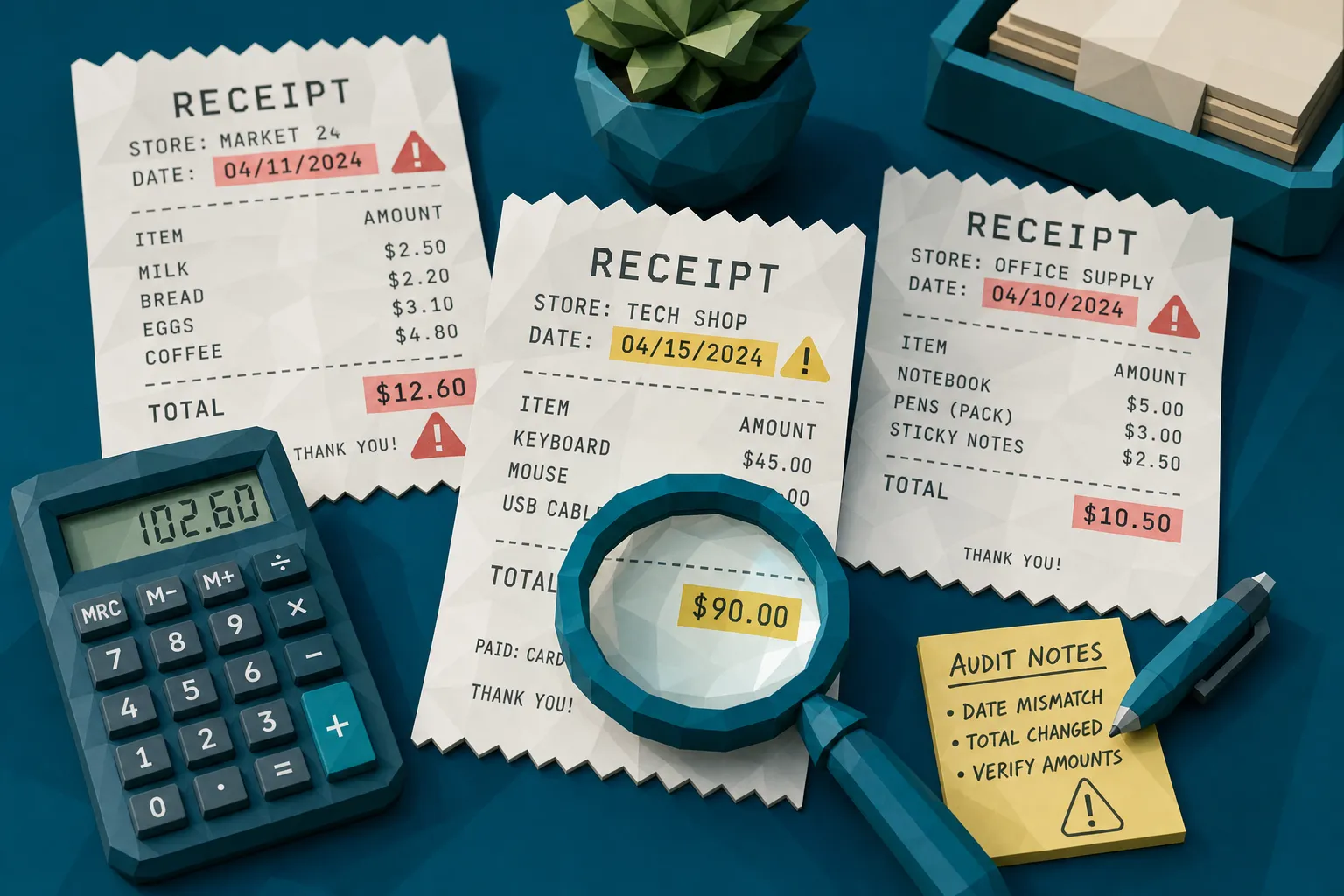
Common issues include tax rates that do not match the merchant location, tips that do not reconcile, subtotals that do not add up, rounded figures that look too convenient, and totals that sit just below approval thresholds. In insurance claims, repair invoices and receipts may also conflict with estimates, depreciation calculations, policy limits, or prior payments.
Duplicate and near-duplicate patterns
A reused receipt may not be identical, but it often shares enough visual structure to be detected. The logo, paper tear, item order, terminal ID, receipt width, or background can match prior evidence. Near-duplicate detection is one of the most useful controls because it catches the lazy version of fraud, and believe me, there is plenty of lazy fraud.
Payment context that does not fit
This is where Docklands AI’s view is a bit different from basic image checks. A receipt is not just an image. It is evidence attached to a payment decision. The payee, bank details, claimant, employee, vendor, claim type, amount, timing, and submission history all matter.
A receipt from a real merchant may still be suspicious if it supports a payment to an unrelated party. An invoice may look clean but conflict with the bank account history. An expense may be policy-compliant on its face while matching a pattern of repeated threshold-level submissions.
The “create fake receipt” search problem finance teams should care about
People searching phrases like “create fake receipt” are not all hardened criminals. Some are curious. Some are testing boundaries. Some are employees who think padding a meal by $18 is harmless. Some are claimants who believe an insurer will never notice.
That gray area matters. Fraud often starts as rationalization, not master planning.
I once had a case where an employee submitted a small altered rideshare receipt. When questioned, they said, “I assumed everyone did it.” That sentence should be printed on a poster in every finance department. Culture, controls, and detection all meet right there.
For personal budgeting, the honest version of this problem is simple: track the real transaction instead of inventing paperwork later. Tools like MoneyPatrol’s expense tracking and budgeting app can help individuals keep cleaner records, which makes legitimate reimbursement and tax documentation much less painful. For companies and insurers, clean recordkeeping helps, but it does not replace fraud screening.
What AP, claims, and expense teams should do differently
My advice after years in this work: stop treating the receipt as an attachment and start treating it as evidence.
That means preserving the original file when possible, rather than relying only on screenshots, compressed previews, or OCR text. The original contains signals that often disappear once the document is converted, resized, or copied into another workflow.
It also means screening before payment. Post-payment recovery is expensive, awkward, and often unsuccessful. Once money has gone out, your leverage drops. Before payment, you still have options: request originals, validate the merchant, escalate to SIU, pause reimbursement, or verify payment details through trusted channels.
And yes, this needs to be automated. Not because humans are bad at judgment, but because humans should not be forced to perform forensic inspection on every $42 lunch receipt. Let software screen the whole population and route the interesting cases to people who can make the right call.
A practical pre-payment workflow looks like this:
- Preserve the original receipt, invoice, or image submitted with the claim or expense.
- Check the document for visual tampering, metadata issues, math inconsistencies, and duplicate patterns.
- Compare the document against payment context, vendor history, employee behavior, and claim details.
- Route only high-signal exceptions for review, with clear evidence attached.
- Capture investigation outcomes so future screening gets sharper over time.
Notice what is not in that workflow: asking reviewers to stare harder. “Stare harder” is not a control. It is a cry for help with a login.
Where Docklands AI fits
Docklands AI is built for the part of fraud detection that traditional OCR and workflow tools often miss: document integrity.
The platform analyzes invoices and receipts for signs of manipulation, including AI-generated documents, Photoshop-style tampering, metadata anomalies, mathematical irregularities, physical manipulation, and duplicate or suspicious submission patterns. It also uses payment information tied to a claim, expense, or payment to build a deeper fraud picture than a simple “does this image look real?” check.
For insurance teams, that means suspicious claim receipts and invoices can be screened before payout. For accounts payable, it means altered or synthetic invoices can be flagged before approval or payment runs. For expense teams, it means duplicate, edited, or fabricated receipts can be caught before reimbursement.
The goal is not to block every odd-looking receipt. That would be chaos. The goal is to separate harmless messiness from meaningful risk and give reviewers evidence they can actually use.

A few reviewer habits that still matter
Technology helps, but process discipline still matters. The best fraud teams I have worked with are not paranoid. They are consistent.
They do not accuse people based on a weird font. They ask for the original. They verify merchants through known channels. They compare receipts to payment records. They look for repeated behavior, not one-off inconvenience. They document why an item was escalated or cleared.
That last point is underrated. If you cannot explain why a receipt was flagged, you have created an operational headache. Evidence-backed alerts are much easier to defend than vague suspicion.
Frequently Asked Questions
Is it illegal to create fake receipt evidence? Yes, using a fake or altered receipt to obtain reimbursement, claim payment, tax benefit, or vendor payment can be fraud. The consequences can include employment action, claim denial, civil recovery, and criminal referral depending on the circumstances.
Why do fake receipts pass expense or claims review? They pass because many workflows focus on extracted fields, policy thresholds, and manual spot checks rather than document authenticity. A receipt can have a plausible date and amount while still being altered, reused, or synthetic.
Can OCR detect fake receipts? OCR can read receipt text, but reading is not the same as verifying. OCR may capture merchant, date, and amount while missing visual tampering, metadata contradictions, near-duplicates, or payment-context issues.
What is the fastest way to detect suspicious receipt evidence? The fastest practical approach is automated pre-payment screening that checks visual integrity, metadata, math, duplicates, and payment context together. Human reviewers should focus on the highest-risk exceptions.
Should every suspicious receipt be treated as fraud? No. Poor image quality, missing metadata, or odd formatting can have innocent explanations. The right approach is evidence-based triage, not instant accusation.
The bottom line
Fraudsters can create fake receipt evidence fast because the tools are accessible and many controls still review receipts like static paperwork. That is the mismatch.
We do not beat fast fraud by making finance teams slower. We beat it by screening earlier, preserving evidence, connecting documents to payment context, and giving reviewers fewer but better alerts.
If your team is still relying on manual spot checks, OCR fields, or “that looks fine to me,” now is the time to upgrade the control. Docklands AI helps organizations detect manipulated, photoshopped, and AI-generated invoices and receipts before they become paid losses.
Visit Docklands AI to see how document-level fraud detection can fit into your claims, AP, or employee expense workflow.
Request a Demo Today!
Book your demo below.