Invoice Analytics Can Reveal Fraud Before Payment

My hot take: most invoice analytics is too polite. It waits until the invoice is paid, files the loss into a tidy category, and then tells everyone what happened in a very attractive chart. That is useful for reporting. It is less useful when the money has already gone walkabout.
After 10 years around fraud teams, AP queues, claims desks, and expense reviews, I have learned that the best invoice analytics does not start with spend categories. It starts with a rude question: “Should we pay this at all?”
I once reviewed a contractor invoice that looked boring enough to cure insomnia. Same vendor, same logo, same invoice format, same project code. The totals even matched the purchase order. The problem sat in the remittance block, where the bank details had been swapped with surgical neatness. A human approver saw a familiar supplier. OCR saw clean fields. A standard dashboard would have seen “facilities maintenance, approved.” The only useful question was whether the document and the payment story belonged together.
That is where invoice analytics becomes fraud prevention rather than accounting archaeology.
What invoice analytics should mean in 2026
When finance teams say “invoice analytics,” they often mean cycle time, spend by vendor, exception volume, tax totals, approval aging, and duplicate payment reports. All good. All needed. None of them are enough.
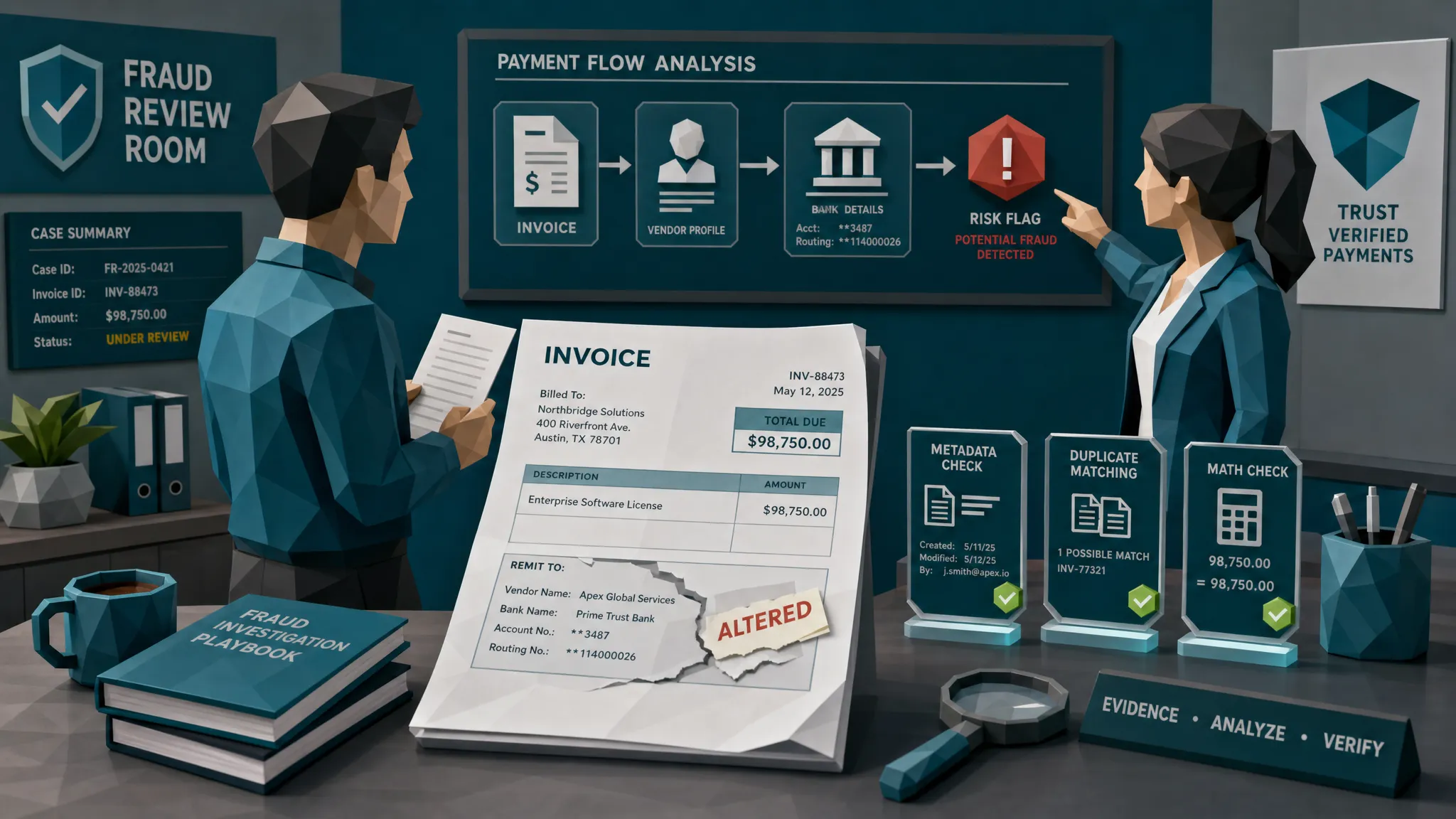
For fraud prevention, invoice analytics should connect five things before payment: the original document, the extracted invoice data, the payment details, the vendor or claimant history, and the surrounding workflow behavior. If those five do not agree, I want a reviewer to see the evidence before the payment run.
That sounds obvious, but many organizations still separate these clues across systems. The AP platform has the workflow. The ERP has the supplier record. The claim system has the policyholder. The expense platform has the reimbursement request. The original invoice or receipt is treated like a delivery box after the contents have been unpacked. Unfortunately, fraud often hides on the box.
The cost of that blind spot is not theoretical. The FBI estimates insurance fraud costs the United States more than $308 billion per year, adding hundreds of dollars to household premiums. In payments, the AFP Payments Fraud and Control Survey has repeatedly shown how widely organizations are targeted. And business email compromise, which often lands right in AP workflows, caused reported losses of $2.9 billion in 2023, according to the FBI’s IC3.
Fraudsters do not need to beat every control. They only need to beat the one control between them and payment.
The pre-payment advantage nobody should ignore
Here is the unglamorous truth: recovery is a miserable strategy.
Once a fraudulent invoice is paid, the work becomes harder, slower, and much more expensive. You need bank recalls, vendor outreach, internal investigation, legal review, maybe law enforcement, and a long meeting where someone says “lessons learned” with the energy of a damp towel.
Pre-payment invoice analytics changes the mood. Instead of asking “How did this get paid?” you ask “What evidence do we have before releasing funds?” That one timing shift matters for AP managers, claims adjusters, expense teams, and fraud managers alike.
For an insurer, the invoice might be a repair bill, medical supplier receipt, hotel invoice, or replacement estimate. For AP, it might be a supplier invoice with altered bank details or a near-duplicate submitted under pressure near month-end. For employee expenses, it might be a restaurant receipt with a changed total or a hotel folio missing personal charges.
In all three worlds, the winning move is the same: inspect the document and its payment context while you can still say no.
The fraud signals hiding inside invoice analytics
Good invoice analytics does not flag a document because it “feels wrong.” That phrase is fine for detective novels. In finance operations, we need evidence.
The first signal is document integrity. A manipulated invoice often carries visual clues: pasted text, inconsistent spacing, mismatched fonts, strange compression artifacts, or totals that look sharper than the rest of the scan. I have seen invoices where the amount was edited so cleanly that the only visible clue was a slightly different shade behind two digits. To the naked eye, it looked like a smudge. To a forensic review, it was a confession with better kerning.
The second signal is metadata. Timestamps, software history, device details, and file creation patterns can contradict the invoice story. A receipt supposedly photographed at a job site may have been created by editing software hours later. A PDF from a long-standing supplier may suddenly have no normal file history. Metadata is not always available and it is not proof by itself, but when it disagrees with the business context, I pay attention.
The third signal is mathematical consistency. Fraudsters are surprisingly bad at arithmetic, which is comforting for those of us who still count on our fingers under the table. Subtotals, tax, discounts, currency conversion, service fees, and line items should reconcile. In claims, the repair estimate should make sense next to the loss description. In AP, the invoice total should behave like a normal invoice from that vendor. In expenses, the tip, tax, and total should not look like they were assembled during a bumpy train ride.
The fourth signal is duplication. Classic duplicate detection catches exact matches, but fraud has moved on. A near-duplicate invoice may reuse the same layout, photo, invoice number pattern, vendor details, or line items with a changed date and amount. The document is “different” enough to beat simple checks, but similar enough to betray itself when compared across prior submissions.
The fifth signal, and the one I think deserves far more attention, is payment context. Who is being paid? Has the account changed? Does the claimant, employee, vendor, or contractor normally use this payment path? Does the invoice ask for a payment method that clashes with prior history? If a small business normally accepts card payments and has clean settlement records through modern tools such as tap to pay on phone apps, but the submitted invoice suddenly pushes a different beneficiary account with urgency, that mismatch deserves a second look.
That is the practical heart of invoice analytics for fraud: the document must agree with the money trail.
Why OCR-only analytics misses the good stuff
OCR is useful. I like OCR. It saves teams from retyping invoice numbers until they start dreaming in vendor IDs. But OCR is a transcription tool, not a truth machine.
When an invoice is converted into fields, the messy evidence often gets left behind. The system captures the invoice number, amount, date, and vendor name. Lovely. But the fraud may sit in the visual layer, the metadata, the copied remittance block, the physical manipulation, or the way the payment instructions differ from the historical pattern.
This is why teams get surprised by fraudulent invoices that “passed every check.” They did pass every check, because the checks were looking at the polite version of the invoice, not the original evidence.
I have a simple rule: if your invoice analytics cannot explain what is suspicious in the original file, it is a reporting tool pretending to be a fraud control.
The insurance claims version of the problem
Claims teams see this constantly. A policyholder submits a repair invoice after a home damage claim. The amount is plausible. The vendor exists. The description matches the incident. The claim handler wants to keep cycle time down, because legitimate customers do not enjoy being treated like suspects. Fair enough.
But the invoice may still be altered. The date may have been moved to fit the policy period. The total may have been inflated. A genuine receipt may have been reused from another job. An AI-generated invoice may look cleaner than the vendor’s actual paperwork.
The cultural shift matters here. The Verisk 2025 Fraud Report noted changing attitudes toward using AI to alter claim evidence, especially among younger consumers. Whether you view that as fraud, “creative paperwork,” or the world’s worst arts and crafts project, the operational result is the same: claims teams need document-level checks before payout.
Invoice analytics for claims should not slow every claim. It should separate clean evidence from questionable evidence, then give SIU teams enough detail to act without redoing the whole review from scratch.
The AP version, where speed can become the trap
AP teams are often measured on speed, cost per invoice, and straight-through processing. I understand why. Nobody wants a finance process that moves like a sleepy forklift.
But if automation sends a manipulated invoice through faster, the KPI looks great right up until the loss is discovered.
In AP, fraud usually exploits routine. Same supplier lookalike. Similar invoice number. Familiar approver. Slightly changed bank details. A duplicate with a small edit. A shell vendor with documents that look “good enough.” The fraudster’s best friend is a team that has seen 400 invoices before lunch.
Pre-payment invoice analytics gives AP a way to stay fast without being gullible. Clean invoices move. Suspicious invoices pause with specific evidence attached. That last part matters. Vague fraud scores create arguments. Evidence creates decisions.
The expense version, where small fraud becomes a habit
Employee expense fraud is often dismissed as low value. That is a dangerous little fairy tale.
Small receipt manipulation scales beautifully when nobody checks. A changed restaurant total here, a duplicate taxi receipt there, a hotel folio reused after a conference. Individually, these may look like minor policy issues. Collectively, they train the workforce that the control environment is decorative.
The ACFE Report to the Nations has long estimated that organizations lose around 5% of revenue to occupational fraud. Not all of that is expense abuse, of course, but the lesson is useful: small schemes become expensive when detection is late and inconsistent.
Expense invoice analytics should compare receipts against policy, payment records, prior submissions, metadata, and visual evidence. The goal is not to interrogate every traveler over a sandwich receipt. The goal is to make repeated manipulation harder than honest reimbursement.
What useful invoice analytics looks like in practice
A practical workflow starts by preserving the original document. That means the uploaded invoice, receipt, photo, or PDF should be retained, not merely converted into extracted fields. If you lose the original, you lose the best evidence.
Next, screen the document before approval or payment. The screening should look for tampering, synthetic document signals, metadata inconsistencies, math problems, physical manipulation, and duplicates or near-duplicates. Then it should connect those findings to payment information, vendor history, claim context, employee behavior, or approval patterns.
The output should be boringly clear. A reviewer should see why the invoice was flagged, what evidence supports the concern, and what action makes sense. “High risk” is not enough. “Remittance block appears visually inconsistent with the rest of the invoice, bank account differs from vendor history, and a near-duplicate invoice was submitted 42 days ago” is useful.
That is the difference between analytics as decoration and analytics as a control.
A quick word on false positives
Fraud teams do not need more noise. They need sharper noise.
I have seen systems that flag everything from round-dollar invoices to first-time vendors as if each one were a criminal mastermind. That does not improve controls. It teaches reviewers to ignore alerts, which is how bad invoices slip through with a cheerful little green checkmark.
The better approach is to combine signals. A new vendor is not automatically suspicious. A new vendor with a manipulated PDF, unusual bank details, inconsistent metadata, and a rushed approval path deserves attention. Invoice analytics should help teams stack evidence, not panic over single quirks.
This is also where feedback matters. When reviewers confirm or dismiss alerts, those outcomes should improve future triage. The point is not perfection. The point is fewer bad payments and fewer wasted investigations.
Where Docklands AI fits
Docklands AI is built for the part of invoice analytics that traditional reporting often misses: document and payment evidence before the money moves.
The platform helps organizations detect manipulated, photoshopped, and AI-generated invoices and receipts using document forensics, metadata analysis, mathematical irregularity checks, physical manipulation detection, and payment-context signals. That matters because a document can look real in isolation while still failing when compared with the claim, expense, vendor, or payment story around it.
For insurance claims, that means screening invoices and receipts before payout. For accounts payable, it means checking supplier invoices before approval or payment release. For employee expenses, it means catching altered and duplicate receipts before reimbursement. Docklands AI also supports API and webhook integration, reporting and analytics, dashboards, multiple users and projects, and 2FA security, so fraud checks can sit inside existing workflows rather than becoming another spreadsheet someone forgets to open.
And yes, I have a bias here: I think the future of fraud prevention belongs to teams that treat invoices as evidence, not paperwork.
Frequently Asked Questions
What is invoice analytics? Invoice analytics is the process of analyzing invoice data, documents, payment details, and workflow patterns to understand risk, performance, and financial activity. For fraud prevention, it should include document integrity checks and payment-context analysis before payment.
How can invoice analytics reveal fraud before payment? It can compare the invoice file, metadata, math, vendor history, payment instructions, duplicates, and workflow behavior. When those signals conflict, teams can pause the invoice and review evidence before funds are released.
Is OCR the same as invoice analytics? No. OCR extracts text from invoices, which is useful for processing. Fraud-focused invoice analytics goes further by inspecting the original document, checking for manipulation, validating math, comparing duplicates, and reviewing payment context.
Which teams benefit most from pre-payment invoice analytics? Accounts payable, insurance claims, employee expense, payroll, internal audit, and fraud teams all benefit. Any workflow that pays invoices, receipts, claims, or reimbursements can reduce leakage by checking evidence earlier.
Can invoice analytics reduce false positives? Yes, if it combines multiple signals and explains the evidence behind each alert. Single-rule alerts create noise. Evidence-backed alerts help reviewers focus on the invoices most likely to be fraudulent.
Stop treating invoice fraud as a post-payment report
If your invoice analytics only explains losses after the fact, it is doing half the job. The more valuable question is what your invoices, receipts, metadata, math, duplicates, and payment details reveal before approval, payout, or reimbursement.
Docklands AI helps fraud, AP, claims, and expense teams detect manipulated and AI-generated documents before they cost money. If you want invoice analytics that works as a pre-payment fraud control, visit Docklands AI and see how document evidence and payment context can strengthen your workflow.
Request a Demo Today!
Book your demo below.