Where AI Powered Fraud Detection Actually Earns Trust


After ten years around claims, AP, expenses, and the occasional “my dog ate the receipt” situation, I have a fairly unfashionable opinion: the least interesting part of AI powered fraud detection is the AI label.
Trust does not arrive because a vendor says the model is smart. Trust arrives when a claims adjuster, AP manager, expense reviewer, or SIU analyst can look at an alert and say, “Yes, I understand why this document needs a second look.”
I learned that lesson the boring way, over a facilities invoice for a little under $2,000. The supplier was real. The logo looked fine. The approver remembered the job. A basic invoice system would have waved it through while humming a cheerful tune. What changed the room was not a mysterious fraud score. It was evidence: the remittance block had different compression from the rest of the PDF, the file history suggested editing after the invoice date, and the bank account did not match prior payments. We called the vendor using the number already on file. They had never sent that invoice.
That is where trust begins. Not with drama. With a good question.
Fraud is expensive enough that we cannot treat detection like a science fair project. The FBI notes that non-health insurance fraud costs more than $40 billion annually in the United States and can add $400 to $700 a year to the average family’s premiums. The ACFE estimates that organizations lose about 5% of revenue to occupational fraud. And payments teams know the same pressure from a different angle, with AFP research repeatedly showing how common payment fraud attempts have become.
So here is my hot take: AI powered fraud detection earns trust only when it helps humans make better decisions before money leaves the building.
The hot take: trust is earned after the alert
A fraud alert is not the finish line. It is the start of a professional conversation.
If the system says “high risk” and nothing else, people either ignore it or overreact to it. Both are bad. Ignore it, and fraud keeps leaking through. Overreact, and you turn honest claimants, suppliers, or employees into suspects because a machine got nervous.
The best fraud teams I have worked with treat AI as a sharp intake screener, not a judge in a robe. It should pause the right claim, invoice, or receipt. It should show the reviewer what looked odd. It should preserve the original file. It should leave a clean trail of what happened next.
That last part matters more than most people admit. I have seen brilliant fraud tools fail because they created noisy queues nobody wanted to own. I have also seen modest tools become trusted because they gave reviewers practical, repeatable evidence.
Trust is not built in the demo. It is built at 4:47 p.m. on a Friday, when a reviewer has 60 documents left and needs to know which three actually deserve attention.
Where AI powered fraud detection really earns trust
The strongest fraud systems do not ask teams to believe in magic. They show their working.
In document fraud, the evidence usually lives in the places a rushed human will not inspect closely: the file history, the pixels around an edited total, the tax calculation, the reused receipt template, the payment details attached to the claim. None of these signals proves fraud alone. Together, they can tell a very persuasive story.
The evidence stack I trust usually includes:
- Visual tampering clues, such as pasted text, inconsistent fonts, odd spacing, or compression differences.
- File and metadata clues, such as edit history, software traces, timestamps, or missing information that should normally be present.
- Math clues, such as subtotals, taxes, discounts, or currency conversions that do not reconcile.
- Duplicate and near-duplicate clues, where the same receipt or invoice appears again with small changes.
- Payment-context clues, such as a payee, bank account, card transaction, claimant, employee, or vendor record that does not fit the document story.
That final point is where many tools either earn trust or lose it.
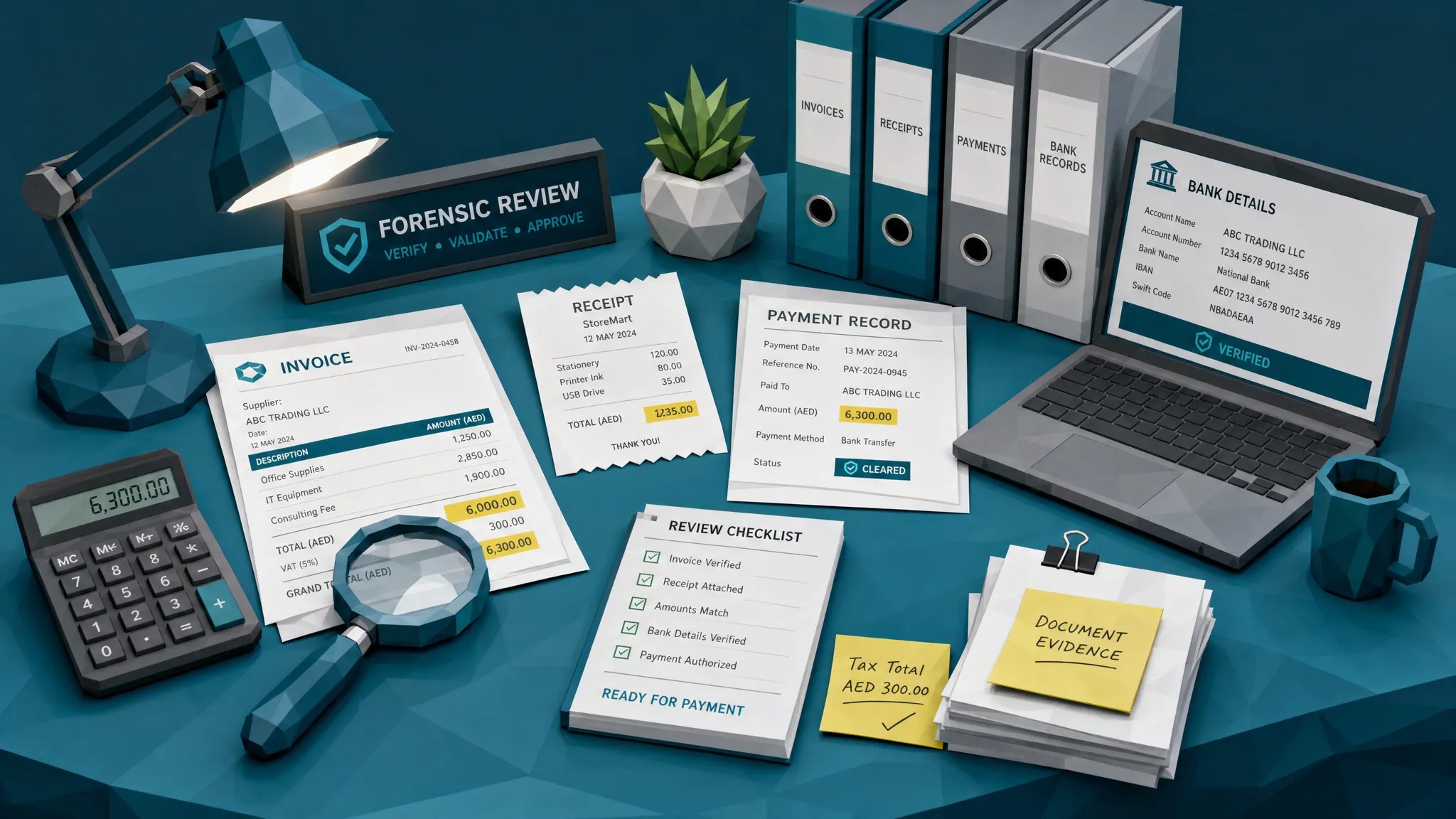
A real-looking document can still be the wrong document
A lot of fraud checks still ask a narrow question: does this invoice or receipt look real?
That question is useful, but it is not enough. I have seen genuine receipts used dishonestly. I have seen real vendor templates with edited bank details. I have seen invoices that looked physically plausible but made no sense once compared with payment history.
Here is a simple example. An employee submits a restaurant receipt for a client dinner. The receipt itself looks fine. The date is plausible. The total is within policy. But the card transaction says the employee paid a different merchant across town 11 minutes later, and the submitted receipt has file traces suggesting it passed through an editing tool. Maybe there is an innocent explanation. Maybe someone uploaded the wrong file. Either way, the right response is not blind reimbursement.
This is why payment context matters. Fraud does not happen inside a PDF. It happens in the gap between a document, a person, a vendor, and a payment.
For finance teams, clean bookkeeping also makes this easier. If vendor records, payment histories, and tax documentation are messy, fraud signals become harder to interpret. Smaller organizations sometimes need outside help to get those foundations in order, and working with experienced tax and accounting advisors can make fraud reviews far less murky.
Trust grows when false accusations go down
A fraud manager once told me, “The fastest way to kill a control is to make everyone hate it.” She was right.
False positives are not just a productivity problem. They are a trust problem. In insurance, a legitimate customer might already be dealing with a flooded kitchen, a car accident, or medical stress. In AP, a small supplier might be waiting on cash flow. In employee expenses, a clumsy accusation can damage morale faster than a bad coffee machine.
Good AI powered fraud detection should not shout “fraud” at every oddity. It should help teams separate three situations: clean documents that can move on, unclear documents that need clarification, and high-risk documents that deserve investigation.
That distinction sounds simple. In practice, it is everything.
A suspicious timestamp by itself might mean the claimant converted an image to PDF. A tax mismatch by itself might mean a cashier system rounded strangely. A changed bank account by itself might be legitimate. But a changed bank account, a manipulated remittance block, and a payment request sent from a new email domain should make any AP manager sit up straighter.
Trustworthy detection reduces lazy suspicion. It gives people the confidence to ask better questions without assuming the worst.
The most trusted systems are operationally boring
I mean that as a compliment.
Fraud teams do not need theatrical software. They need controls that fit the way claims, AP, and expenses already move. A trusted fraud layer should be easy to place at intake, before approval, or before payment. It should route evidence to the right person. It should keep clean items moving. It should record what was flagged and what the reviewer did next.
This is also where security and governance matter. If a system is reviewing invoices, receipts, claim documents, and payment details, access controls are not decoration. Teams should care about who can view evidence, who can change settings, how projects are separated, and whether login security is strong enough for financial data.
Executive reporting matters too, provided it does not become dashboard wallpaper. Leaders need to know how many documents were screened, how many were paused, what value was protected, how quickly reviewers cleared exceptions, and which fraud patterns are repeating. A pretty chart is nice. A chart that changes payment behavior is better.
Rules alone cannot carry trust in 2026
Rules still matter. I like rules. Rules are the seatbelts of finance controls: not glamorous, very useful, and only noticed when something goes wrong.
But rules are predictable. Fraudsters learn thresholds. They split expenses. They reuse templates. They submit just under approval limits. They change only the part of the document they need changed.
The rise of cheap synthetic evidence has made this worse. BBC reporting on Admiral highlighted a sharp increase in fraudulent claims involving AI-generated images and deepfakes. Whether you are handling insurance claims, warranty claims, employee expenses, or supplier invoices, the pattern is the same: fake evidence is getting faster to create and easier to dress up.
That does not mean every organization needs to panic. It means old controls need help.
Rules can still catch obvious policy violations, duplicate invoice numbers, missing fields, or approval-limit games. AI powered fraud detection earns its place when it looks beyond those rules and inspects the document and payment story itself. The goal is not to replace human judgment. The goal is to stop asking tired humans to spot pixel-level edits with tired eyes.
How to roll it out without causing an office rebellion
The best implementation plan I have seen is surprisingly calm. Nobody starts by accusing half the company of fraud. Nobody blocks every claim over $500. Nobody sends a 38-page policy memo written in legal fog.
Start with shadow review. Run the fraud detection tool on real historical documents, including known good and known bad examples if you have them. Compare alerts with actual outcomes. Look for patterns that reviewers agree are meaningful. Then decide which alerts should be informational, which should request clarification, and which should pause payment.
A practical rollout usually includes:
- Shadow testing on recent claims, invoices, or expense receipts before changing the live workflow.
- A reviewer calibration session where fraud, finance, claims, and operations agree on what each evidence type means.
- Severity bands that distinguish low-risk oddities from serious manipulation or payment-context conflicts.
- Clear reviewer language, so alerts say what was found rather than hiding behind a vague risk score.
- Outcome tracking, so confirmed fraud, false positives, and benign explanations improve future handling.
- A pre-payment checkpoint for the highest-risk workflows, because post-payment detection is often just expensive archaeology.
That rollout earns trust because it respects the people who live with the system every day.
Where Docklands AI fits
Docklands AI is built for the place where fraud teams need the most help: invoices and receipts that look normal until you inspect them properly.
For insurance claims, accounts payable, and employee expenses, Docklands AI checks for manipulated, photoshopped, physically altered, and AI-generated documents. It combines document-level inspection with metadata analysis, mathematical irregularity checks, duplicate patterns, and payment information to build a clearer fraud picture.
That payment context is important. A document can look polished and still point to the wrong payee. A receipt can be genuine and still be reused. An invoice can pass basic field checks and still contain an edited bank account or inconsistent file history.
Docklands AI can integrate through APIs and webhooks, support reporting and analytics, and provide the sort of evidence-backed alerts reviewers need to make defensible decisions. The point is not to rip out claims systems, ERPs, or expense tools. The point is to add a fraud detection layer where it can stop bad documents before they become bad payments.
Frequently Asked Questions
What makes AI powered fraud detection trustworthy? It becomes trustworthy when it shows specific evidence, fits the existing workflow, reduces noisy alerts, and supports human review rather than replacing it. A score alone is not enough.
Should AI automatically reject invoices, claims, or expenses? Usually, no. The safer approach is to use AI to route documents. Clean items continue, unclear items get clarification, and high-risk items go to a trained reviewer or investigation team.
How is fraud detection different from OCR or invoice automation? OCR extracts data from a document. Fraud detection asks whether the document and the surrounding payment context make sense. A system can read an invoice perfectly and still miss that it was altered.
Why does payment context matter so much? Fraud often hides in the relationship between the document and the payment. Bank detail changes, mismatched card transactions, unusual payees, vendor history, or claimant behavior can turn a minor document oddity into a serious warning sign.
Can AI detect AI-generated receipts and invoices? It can help, especially when it reviews visual clues, file history, math, duplicate patterns, and payment context together. The strongest result is not a guess that something was AI-generated, but a clear explanation of why the evidence does not fit.
See the evidence before you pay
If your team is reviewing invoices, receipts, claims, or expenses by eye, you are asking good people to catch increasingly cheap fraud with increasingly tired attention.
Docklands AI helps teams detect manipulated, photoshopped, and AI-generated invoices and receipts before payment. If you want fraud alerts your reviewers can understand, defend, and act on, take a closer look at Docklands AI.
Request a Demo Today!
Book your demo below.