Where Fraud Detection Artificial Intelligence Falls Short

Fraud detection artificial intelligence is having a moment. Every claims platform, AP workflow, and expense tool seems to have an “AI fraud” badge somewhere on the slide deck. I get the appeal. Fraud volumes are up, documents are easier to fake, teams are understaffed, and nobody wants to be the person who paid a $47,000 invoice because the PDF looked tidy.
Here is my hot take after a decade in fraud operations: most teams do not have an AI problem. They have a trust problem. They trust the wrong output, at the wrong point in the process, with too little evidence behind it.
Artificial intelligence can be very good at finding patterns. It can compare documents faster than any human. It can spot signals in pixels, timestamps, math, and payment behavior that an exhausted reviewer will miss at 4:57 p.m. on a Friday. But it falls short when leaders treat it like a digital lie detector.
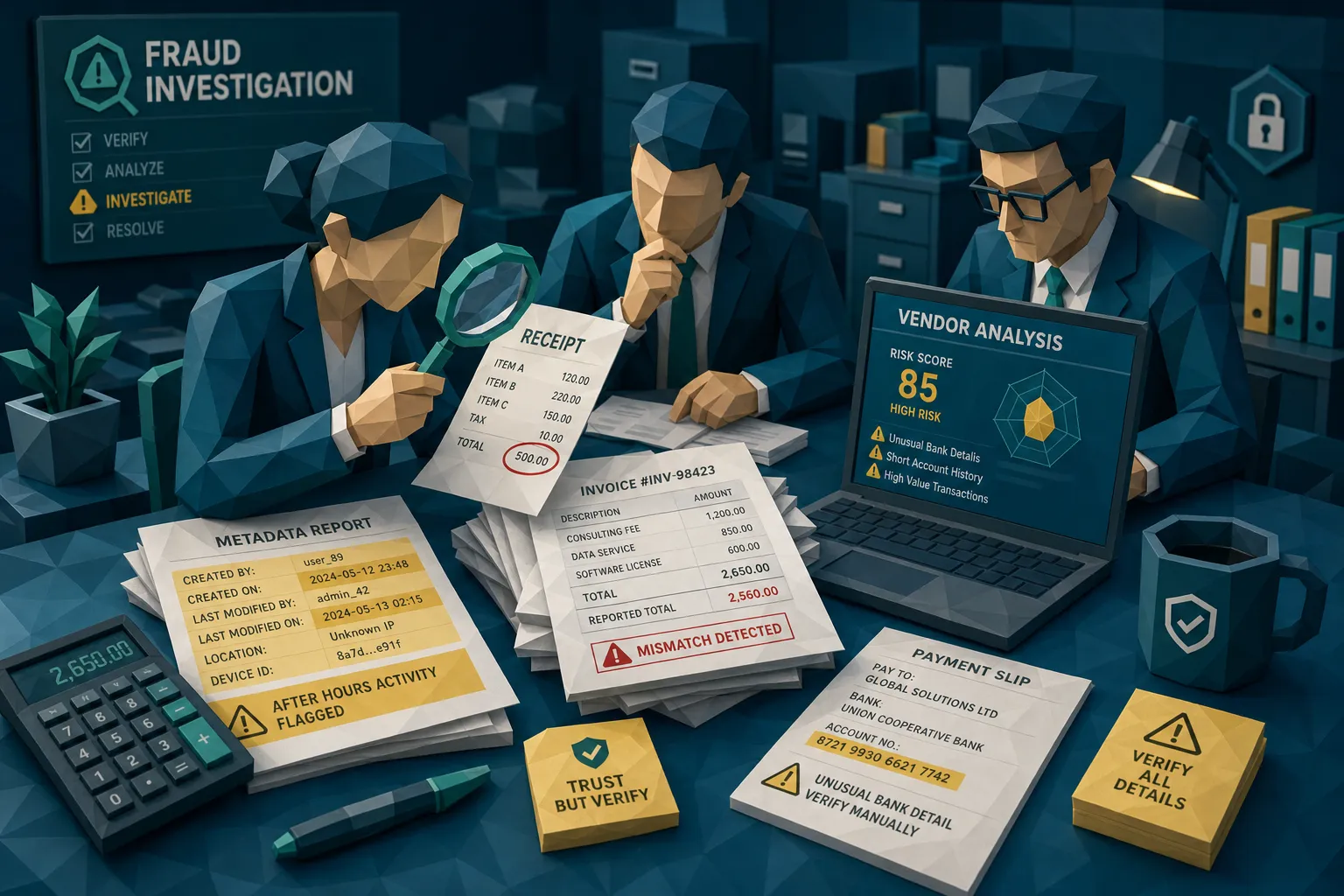
Fraud is rarely one big, flashing red flag. It is usually a stack of small, boring details that do not quite belong together. A receipt total that was edited. A vendor bank account that changed. A claim invoice that looks genuine but appears in three unrelated files. A PDF with a clean total, strange metadata, and a payee nobody has paid before.
That is where the real work begins.
The uncomfortable truth about fraud detection artificial intelligence
The first weakness is simple: AI is trained on what has already happened. Fraudsters are paid, in effect, to make yesterday’s controls look silly.
I once worked with a team that had a beautiful rule for catching round-number expense claims. It worked for a while. Then the suspicious claims started arriving as $487.63, $492.18, and $496.71. Suddenly everyone looked wonderfully precise. Fraudsters had not become honest. They had become less round.
The same thing happens with artificial intelligence. If a model learns that fraud often looks like a certain layout, a certain claim pattern, or a certain vendor behavior, it may miss the next version. And the next version is usually just different enough to sneak through.
That does not make AI useless. It means AI needs fresh feedback from real investigations, confirmed outcomes, and changing attack patterns. A fraud model that never learns from investigator decisions is like a guard dog trained using photos of last year’s burglars. Cute, but not enough.
AI is good at spotting oddness, not proving intent
A common mistake is treating anomaly detection as proof. Something unusual is not automatically fraudulent. Something normal is not automatically clean.
Anyone who has worked claims after a storm knows this. Legitimate claims get messy fast. Receipts are photographed in bad lighting. Contractors use odd templates. Elderly claimants submit scanned copies of scanned copies. A perfectly honest customer may send a receipt with missing metadata because their messaging app stripped it out.
The reverse is also true. Fraud can look painfully normal. A fake invoice may have the right vendor name, the right amount range, and the right approval path. If the document is synthetic or the payment instructions have been quietly altered, field-level checks may smile and wave it through.
Cross-border paperwork makes this even harder. International invoices, legal documents, currency conversions, and remote onboarding create plenty of legitimate variation. For example, Australians working with specialists to invest in Dubai real estate or set up UAE businesses may deal with documentation across banks, jurisdictions, and service providers. That complexity is normal, but it also means finance teams need controls that verify document integrity and payment context rather than simply flagging anything unfamiliar.
This is where a lot of fraud detection artificial intelligence falls down. It confuses “different” with “dangerous” and “ordinary” with “safe.” Good fraud operations need the system to say why something matters, not merely that it looks unusual.
The best evidence often disappears before AI sees it
Many fraud systems start with OCR. They extract the vendor, date, total, tax, and invoice number. That is useful for processing. It is not the same as fraud detection.
An invoice or receipt is a tiny crime scene. The pixels matter. The spacing matters. The compression artifacts matter. The metadata matters. The way a number sits on the page may matter. If you convert the whole thing into a few neat database fields too early, you may throw away the evidence.
I have seen edited receipts where the extracted total was perfectly readable, so the workflow passed it. The issue was not the number. The issue was that the number had a slightly different texture from the rest of the receipt. A human reviewer eventually caught it because the “8” looked like it had been invited to the party late.
That sounds small, but fraud is full of small. A manipulated invoice may pass vendor validation, PO matching, and approval routing while still containing visual edits. A generated receipt may have plausible text but impossible math. A photographed bill may hide physical alteration under glare, cropping, or shadows.
Fraud detection needs to preserve and inspect the original document, not only the extracted fields.
AI-generated evidence has changed the cost of lying
A few years ago, decent document fraud required skill. Someone needed Photoshop, patience, or at least a cousin who knew how to move text around without making the whole thing look like a ransom note.
Now the barrier is lower. Fake receipts, synthetic invoices, altered images, and convincing claim evidence can be produced quickly by people with very little technical ability. That changes the economics of fraud.
The trend is already visible. The BBC reported that Admiral saw a sharp rise in fraudulent claims, with AI-generated images and deepfakes playing a role. Verisk’s 2025 fraud report also points to rising sophistication in claims manipulation and a worrying openness among younger consumers to altering claim evidence with AI.
Here is the catch: an “AI-generated document detector” cannot be your whole defense. The arms race moves too quickly. A detector may catch today’s synthetic artifacts and miss tomorrow’s cleaner output.
The better approach is to combine signals. Does the document look manipulated? Does the metadata make sense? Does the math reconcile? Has the same receipt appeared before? Does the payment destination fit the claimant, employee, vendor, or repair history? When several weak signals point in the same direction, you have something worth reviewing.
False positives can quietly ruin a fraud program
Fraud teams talk a lot about missed fraud. We talk less about the opposite problem: too many weak alerts.
A noisy fraud system is dangerous because people stop listening. If every seventh invoice is “medium risk” and nobody can explain why, reviewers will develop their own unofficial rule: ignore medium risk unless something else looks weird. Congratulations, the expensive AI has become background music.
I once sat with a claims team that had fourteen alert types in their system. Fourteen. One adjuster told me, “Every alert means maybe, so none of them mean much.” That line should be printed on mugs and handed out at fraud technology conferences.
False positives also create business damage. They slow clean claims. They annoy good employees. They delay legitimate suppliers. In insurance, they can turn a stressful customer experience into a complaint. In AP, they can strain vendor relationships. In employee expenses, they can make finance look like the office parking inspector.
The fix is not fewer controls. The fix is better evidence. A useful alert should show the reviewer what triggered it, how strong the signal is, and what to do next. “Suspicious document” is not enough. “Total appears visually inconsistent with surrounding text, PDF metadata indicates post-creation editing, and the same receipt image was previously submitted under another claim” is far more useful.
Payment context is where many systems go blind
Fraud does not end at the document. It ends when money moves.
That sounds obvious, but many systems still treat document authenticity as a standalone question: is this image real or fake? Useful question, wrong finish line.
A real invoice can still be part of a fraudulent payment. A legitimate receipt can be reused. A genuine supplier invoice can be altered to redirect funds. A claim estimate can be valid, but the payee details can be wrong. A contractor can submit the same supporting document through multiple entities.
Accounts payable teams see this constantly. The invoice fields match. The vendor exists. The approval is present. Then, tucked away in the payment details, the bank account is new or the remittance instructions differ from prior payments. If your fraud detection artificial intelligence is only looking at extracted invoice text, it may miss the part that actually costs you money.
This is one reason Docklands AI focuses on both the document and the payment context. The platform analyzes invoices and receipts for signs of manipulation, AI generation, metadata issues, mathematical irregularities, and physical tampering, while also using payment information from claims, expenses, or payments to build a deeper fraud picture. That combination matters because fraudsters do not attack one field. They attack workflows.
Where AI actually works well
I am not anti-AI. Far from it. I have seen automated screening catch issues that manual teams would never have found at scale.
AI works well when it is used as a tireless first reviewer. It can screen every invoice and receipt instead of relying on spot checks. It can compare new submissions against prior documents. It can surface visual tampering signals, metadata contradictions, math problems, and duplicate patterns. It can route the riskiest items to humans while letting clean, low-risk items keep moving.
That last part matters. The goal is not to turn claims, AP, or expense teams into forensic labs. The goal is to give them enough evidence to make better decisions before payment.
This is especially important because the losses are not theoretical. The FBI warns that non-health insurance fraud costs the U.S. more than $40 billion per year, excluding health insurance, and can add hundreds of dollars to family premiums. The Association for Financial Professionals has reported widespread payments fraud targeting organizations. The ACFE Report to the Nations has long estimated that organizations lose around 5% of revenue to fraud.
No sane fraud leader looks at those numbers and says, “Let’s just keep sampling 2% of documents and hope for the best.”
A better operating model: evidence first, AI second
The strongest fraud programs I have seen share a simple habit. They do not ask, “What did the model score?” first. They ask, “What evidence do we have?”
That mindset changes the workflow.
Preserve the original document at intake. Do not rely only on screenshots, forwarded PDFs, or extracted fields. Screen before payment, not after recovery becomes awkward or impossible. Combine document signals with payment signals, because a fake-looking document paid to the right party is a different risk from a clean-looking invoice paid to a new account. Route exceptions with clear evidence so investigators can act quickly. Feed outcomes back into the process so the system improves instead of fossilizing.
This is where fraud detection artificial intelligence becomes genuinely useful. It becomes a control layer, not a magic wand. It helps the team see more, faster, with less guesswork.
The worst version of AI says, “Trust me.”
The best version says, “Here is what I found, here is why it matters, and here is where you should look next.”
What this means for claims, AP, and expense teams
For claims leaders, the priority is speed without gullibility. Customers want fast payouts, and most deserve them. But invoices, receipts, estimates, and photos now need integrity checks early in the process. If a document has signs of editing or reuse, SIU should see the evidence before money leaves.
For AP managers, the big danger is automation without suspicion. Automated payables can move bad invoices faster than manual teams ever could. If your workflow is built for speed but not authenticity, fraudsters will happily enjoy your efficiency.
For expense managers, the risk is death by small cuts. One altered dinner receipt will not sink the company. Thousands of padded, duplicated, or synthetic receipts across a large workforce can become a serious leakage problem. Worse, if employees learn that low-dollar receipts are rarely checked, behavior spreads.
Across all three areas, the principle is the same: use AI to screen broadly, preserve evidence, and escalate intelligently. Do not use it as an excuse to stop thinking.
Frequently Asked Questions
Is fraud detection artificial intelligence unreliable? No. It is unreliable when used as a standalone truth machine. It performs much better when paired with document forensics, payment context, investigator feedback, and clear review workflows.
Why do AI fraud systems miss manipulated invoices and receipts? Many systems rely on extracted fields, rules, or historical patterns. Manipulation often lives in the original file, including pixels, metadata, layout inconsistencies, duplicate image patterns, and payment-context changes.
Can AI-generated invoices and receipts be detected with confidence? Sometimes, but detection should not rely on one signal. Stronger programs combine synthetic-document checks with metadata analysis, math validation, duplicate detection, and payee or vendor context.
How can teams reduce false positives? Focus on evidence-backed alerts. Reviewers need to know what was detected, how serious it is, and what action is recommended. Vague risk scores create alert fatigue and slow legitimate payments.
Where should fraud screening happen in the workflow? As early as possible, ideally at intake or before approval and payment. Post-payment detection may help with recovery and reporting, but prevention is cheaper than clawback.
The bottom line
Fraud detection artificial intelligence falls short when we expect it to replace judgment. It performs best when it strengthens judgment.
If your current controls only check fields, approvals, or policy rules, you may be missing the evidence hidden inside the document itself. Docklands AI helps organizations detect manipulated, photoshopped, and AI-generated invoices and receipts using document forensics, metadata analysis, mathematical checks, and payment-context signals.
If you want to understand where suspicious documents are slipping through your claims, AP, or expense workflow, talk to Docklands AI. Bring the messy documents. Those are usually the interesting ones.
Request a Demo Today!
Book your demo below.