Workers Compensation Predictive Modeling Has a Blind Spot
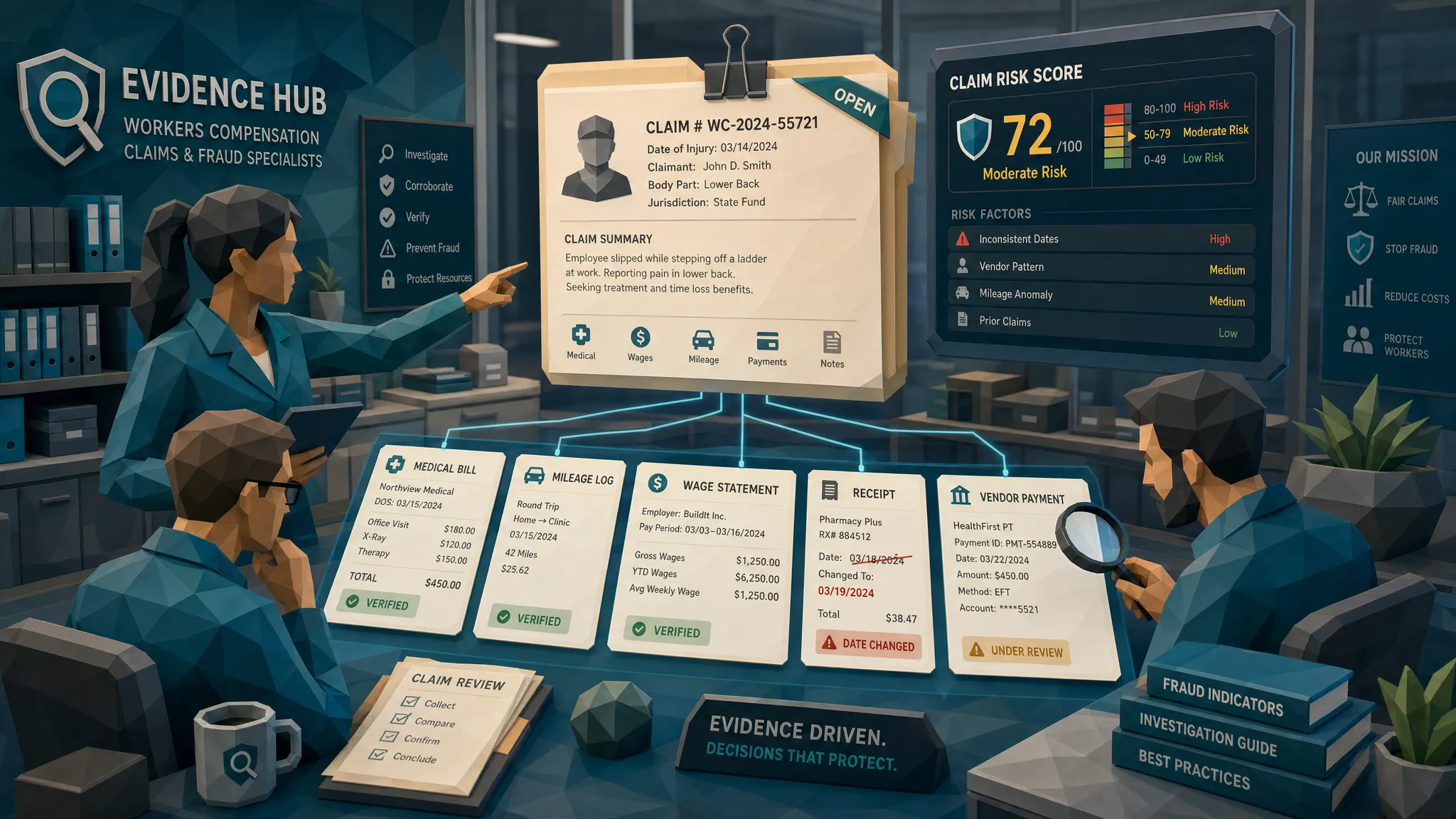

Here’s my hot take after a decade around claim files: workers compensation predictive modeling is excellent at spotting claims that may get expensive, but it is often surprisingly polite about the documents inside those claims. It assumes the paperwork is telling the truth unless another system says otherwise.
That is a dangerous assumption in 2026.
Workers comp models can flag delayed recovery, litigation risk, opioid exposure, comorbidity patterns, provider outliers, and return-to-work probability. Good. Useful. Keep them. I am not here to throw your actuarial team’s laptop into the harbor.
But if a doctored invoice, altered medical bill, recycled mileage receipt, or synthetic wage statement feeds the claim file, the model may treat that document as clean input. Then you get garbage in, beautifully scored garbage out.
The blind spot is not that predictive models are bad. The blind spot is that they are usually looking at the claim story after the evidence has already been translated into tidy fields.
Predictive Models Are Not Evidence Examiners
Most workers compensation predictive modeling is built to answer questions like: How severe is this claim likely to become? Is the claimant likely to litigate? Will this injury exceed expected duration? Does this provider pattern look unusual? Should a nurse case manager get involved?
Those are valuable questions. They help claims teams manage caseloads, reduce leakage, and intervene earlier. I have seen predictive models save teams from drowning in old-fashioned diary chaos, which is no small thing. Any former adjuster who has lived through a Monday morning queue knows that triage is not a luxury. It is oxygen.
But document fraud asks a different question: Is this receipt, invoice, estimate, bill, wage form, or payment proof real, altered, duplicated, or generated?
That question lives at the evidence layer. Many predictive models never truly inspect that layer. They rely on structured data extracted from the file, such as date of injury, diagnosis code, billed amount, provider name, indemnity amount, claimant history, jurisdiction, and claim age.
The problem is simple. Fraudsters do not always attack the claim profile. Sometimes they attack the proof.
A claimant submits a perfectly boring pharmacy receipt, except the date was changed. A medical transportation invoice has a reasonable amount, except the miles were inflated. A vendor invoice looks like it came from a familiar provider, except the remit-to details were swapped. A wage statement appears routine, except one pay period was edited to push the benefit calculation.
Your model may never see the smudge, metadata issue, pasted number, suspicious file history, or near-duplicate pattern. It sees the extracted data and shrugs.
The Workers Comp Fraud Problem Has Moved Downstream Into “Small” Documents
When people picture workers comp fraud, they often imagine the classic scene: someone claiming a back injury while carrying a refrigerator on social media. That still happens, and yes, the internet remains undefeated.
But plenty of leakage is quieter. It hides in supporting documents that do not look dramatic enough to trigger a war room meeting.
I once reviewed a claim where the suspicious item was not the medical report or the claimant’s statement. It was a string of low-dollar transportation receipts. Nothing flashy. No villain soundtrack. Each one looked small enough to ignore. Together, they supported a treatment pattern that kept the claim open longer than expected. Once we compared the receipts, timestamps, provider visits, and payment details, the story started to wobble like a folding chair at a company picnic.
That is the part many models miss. A low-dollar document can validate a high-dollar outcome.
In workers comp, the paperwork trail can include medical bills, pharmacy receipts, durable medical equipment invoices, physical therapy records, mileage logs, interpreter invoices, attendant care receipts, wage records, return-to-work notes, independent medical exam documents, and settlement-related payment instructions.
Some are submitted by claimants. Some come from providers. Some come through vendors, portals, email, scans, phone photos, or third-party administrators. By the time the information lands in a claims platform, the original file may be compressed, converted, OCR’d, renamed, flattened, or stripped of useful context.
That is like asking a detective to solve a burglary after someone has vacuumed the scene and organized the evidence into a spreadsheet.
Why This Blind Spot Is Getting Worse
Fraud has always adapted to controls. Put a rule at $500, and suspicious bills become $487. Require a supervisor approval, and the document starts looking more supervisor-friendly. Add a checklist, and the fraudster studies the checklist.
Now the document creation tools are faster and better. The FBI warns that insurance fraud raises costs for families, and the operational pressure on claims teams has not exactly gone down. More volume, more digital submission channels, more remote evidence, and more pressure to pay clean claims quickly create a lovely little playground for manipulated documents.
Verisk’s 2025 fraud reporting also points to a shift many of us feel in the trenches: claims manipulation is becoming more sophisticated. That tracks with what I hear from fraud managers. The old “this looks fake from across the room” cases are less common. The newer cases look boring until you compare the document to the payment trail, metadata, math, duplicate patterns, and claim timeline.
And workers compensation has a special challenge: many legitimate claim files are messy. Scanned clinic forms are messy. Faxed documents are messy. Small providers may use old templates. Injured workers may submit photos of receipts from dimly lit kitchens. Not every ugly document is fraud.
That is why novelty alone should not trigger suspicion. A reimbursement request may involve something unfamiliar, perhaps a wellness-related product, ergonomic aid, or even warm-air herbal wellness products that a reviewer has never seen before. The question is not whether the item feels unusual at first glance. The question is whether the document, payment details, timing, medical necessity, policy rules, and claim context hold together.
Good fraud detection does not punish weird. It tests consistency.

The Blind Spot Usually Starts at OCR
OCR is useful. It turns documents into searchable text and makes claims workflows faster. I like OCR the way I like coffee: necessary, but not a full breakfast.
The trouble starts when teams confuse text extraction with authenticity review. OCR can read a total amount. It usually cannot tell you whether that total was pasted over the original. It can extract a provider name. It may not notice that the logo was copied from a different invoice. It can capture a date. It may not flag that the file was created three weeks after the alleged treatment.
Once the claim file stores only extracted fields, the model gets a sanitized version of reality. The original file may contain clues that never make it into the model at all.
Common missed signals include visual edits around totals or dates, inconsistent fonts, image compression differences, missing or contradictory metadata, impossible timestamps, altered payment details, repeated receipt templates, math that is close but wrong, and documents that match older claim evidence except for a few convenient changes.
That last one is a classic. Fraudsters love recycling. They are environmentally conscious in all the wrong ways.
Predictive Modeling Can Even Create False Confidence
Here is where I get slightly spicy: a strong predictive score can make a bad document seem safer than it is.
If a claim looks ordinary on severity, claimant history, diagnosis, jurisdiction, and treatment path, reviewers may give the supporting documents less attention. The model says low risk. The queue is full. The adjuster has 47 other things to do before lunch. The invoice gets paid.
That is not laziness. That is human workflow under pressure.
Predictive models are often optimized for prioritization. They help decide where people should spend time. But document fraud can be designed to avoid attention. A manipulated receipt does not need to make the whole claim look suspicious. It only needs to look boring enough to pass.
This is especially true in workers comp because leakage often compounds. A small edited bill supports ongoing treatment. A questionable wage document affects indemnity. A fake mileage log reinforces attendance. An altered invoice gives a vendor payment legitimacy. One document may not blow up the model score, but it can quietly move money.
What Workers Comp Teams Should Add to the Model
I would not replace workers compensation predictive modeling. I would give it better eyes.
A practical setup keeps the predictive model for triage and adds document integrity checks at the points where evidence enters or money is about to leave. The goal is not to make every adjuster become a forensic examiner. The goal is to surface specific reasons a document deserves review.
A useful document integrity layer should look for:
- Digital tampering, including pasted totals, edited dates, and manipulated payment fields
- AI-generated or synthetic invoices, receipts, and supporting documents
- Metadata anomalies, such as suspicious creation times, edit history, device clues, or missing file context
- Mathematical irregularities, including totals, taxes, units, mileage, and line-item inconsistencies
- Physical manipulation clues, such as photographed altered paper, inconsistent shadows, or unnatural image regions
- Duplicate and near-duplicate documents reused across claims, providers, employees, or vendors
Then comes the part many teams skip: connect those findings to payment context.
A receipt is more meaningful when you know who paid, who is being reimbursed, whether the payee changed, whether the provider matches the treatment timeline, whether the bank or mailing address changed late, and whether the same document pattern appeared elsewhere.
That is where document review becomes claims intelligence instead of a fancy magnifying glass.
The Right Output Is Evidence, Not Another Mysterious Score
Fraud teams do not need another black box number floating in the claim file like a fortune cookie. They need evidence they can act on.
A good alert should say what was found, where it was found, why it matters, and what the reviewer should check next. For example: “The invoice total region shows signs of editing, the file metadata indicates modification after the service date, and the remit-to account differs from prior payments to this provider.”
That is useful. That gives an adjuster, SIU analyst, or claim manager a path.
A bad alert says, “Risk score: 83.” Congratulations. We have converted anxiety into math.
In my experience, the best claims teams use severity bands. Clean documents continue through the normal path. Medium-risk items get a quick human look. High-risk items are held for evidence-led review, vendor verification, or SIU referral. Nobody wants a system that stops every claim because a fax looks like it survived a small fire.
How Docklands AI Fits Into the Workers Comp Workflow
Docklands AI is built for this exact gap: detecting manipulated, photoshopped, physically altered, and AI-generated invoices and receipts before they become paid losses.
For workers comp teams, the important point is that Docklands does not need to replace the predictive model, claims platform, or SIU process. It can sit as a document fraud detection layer around the existing workflow, using forensic analysis and payment information to build a deeper fraud picture.
That matters because workers comp fraud is rarely proven by one clue. It is usually a cluster: a suspicious edit, a mismatched payment trail, a strange timestamp, a duplicate pattern, and a claim timeline that suddenly looks a little too convenient.
Docklands AI supports checks such as tampering detection, AI-generated document detection, metadata forensics, mathematical irregularity review, physical manipulation detection, reporting, analytics, API and webhook integration, executive dashboards, 2FA security, and multiple user and project support.
The operational win is simple: let predictive modeling keep doing what it does well, while document forensics checks whether the evidence deserves trust.
A Simple Test for Your Current Model
If you want to know whether your workers comp predictive model has this blind spot, ask one uncomfortable question:
Can the model explain whether the documents supporting the claim are authentic?
Not whether the billed amount is unusual. Not whether the provider is in network. Not whether the claim duration is outside expected range. Those are useful, but they are not authenticity.
Ask whether the system can preserve and inspect the original document file, detect tampering, compare near-duplicates, analyze metadata, validate math, and connect document findings to payment context.
If the answer is “we extract the fields and run rules,” then you have a gap.
If the answer is “we spot check suspicious claims,” you still have a gap. Spot checks are comforting, but fraudsters do not take turns politely appearing in the sample.
And if the answer is “our adjusters would notice,” I say this with love: your adjusters are already doing six jobs while eating lunch over a keyboard. Give them evidence, not a scavenger hunt.
Frequently Asked Questions
What is workers compensation predictive modeling? Workers compensation predictive modeling uses claim data to estimate outcomes such as claim severity, litigation risk, treatment duration, return-to-work likelihood, and potential cost escalation. It helps teams prioritize attention, but it usually does not verify whether submitted documents are authentic.
Why can predictive models miss workers comp fraud? They often rely on structured data extracted from claim files. If a receipt, invoice, wage statement, or medical bill was altered before the data was extracted, the model may treat the false information as legitimate input.
Should document forensics replace predictive modeling? No. Predictive models and document forensics solve different problems. Predictive modeling helps prioritize claims. Document forensics helps determine whether the evidence inside those claims has been manipulated, duplicated, or synthetically created.
Which workers comp documents should be screened? High-value and high-impact documents should be screened, including medical bills, pharmacy receipts, durable medical equipment invoices, wage statements, mileage logs, transportation receipts, provider invoices, payment proofs, and any document tied to reimbursement or benefit calculation.
How do we avoid slowing down legitimate claims? Use evidence-based routing. Clean documents should move through normal processing. Suspicious documents should be routed with specific findings, such as metadata conflicts, visual edits, math issues, duplicate matches, or payment-context mismatches.
Close the Blind Spot Before It Becomes Leakage
Workers compensation predictive modeling is useful, but it should not be asked to do forensic work with one eye closed. If the model trusts manipulated documents, the claim score can look clean while the evidence underneath is quietly leaking money.
Docklands AI helps claims and fraud teams inspect invoices, receipts, and supporting documents for tampering, AI generation, metadata issues, math problems, physical manipulation, and payment-context inconsistencies before payment decisions are made.
If you already have predictive modeling in place, good. Keep it. Then add the missing evidence layer. See how Docklands AI can help your team detect manipulated claim documents before they cost you.
Request a Demo Today!
Book your demo below.