A Tampered Invoice Rarely Fails in Just One Place
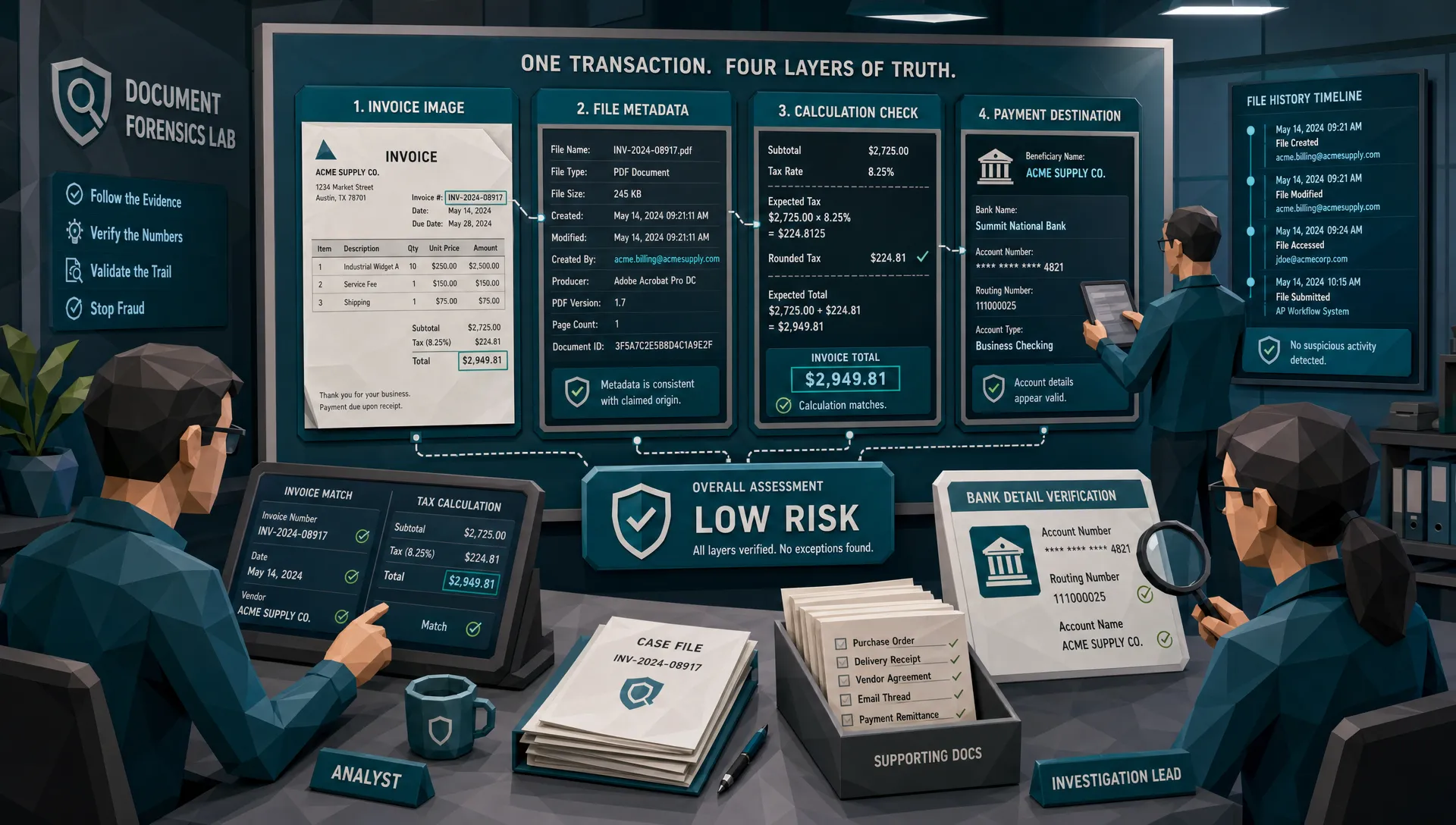

I have a slightly unpopular opinion after 10 years of looking at suspicious invoices, receipts, and claims documents: the cleanest-looking fraud is often the easiest to catch, if you stop treating the invoice as a single image.
A tampered invoice rarely fails in just one place. It fails in layers. The pixels whisper one thing, the metadata mutters another, the math looks too polished or not polished enough, and the payment details suddenly behave like someone wearing a fake mustache at their own birthday party.
That matters because many finance and claims teams still review invoices like they are checking homework. Is the vendor name there? Is the total plausible? Does the approver recognize the job? Fine, move it along. Fraud loves that rhythm. It only needs you to look at the part it edited, not the parts it forgot to make agree.
The single-red-flag mindset is too generous
Here is my hot take: if your process waits for one obvious smoking gun, it is already being too polite.
A tampered invoice should be treated like a story. Good stories have continuity. Bad ones have plot holes. The invoice number, bank account, file history, subtotal, tax, date, vendor identity, email trail, purchase context, and payment request all need to point in the same direction. When they do not, that mismatch is usually more useful than any one individual clue.
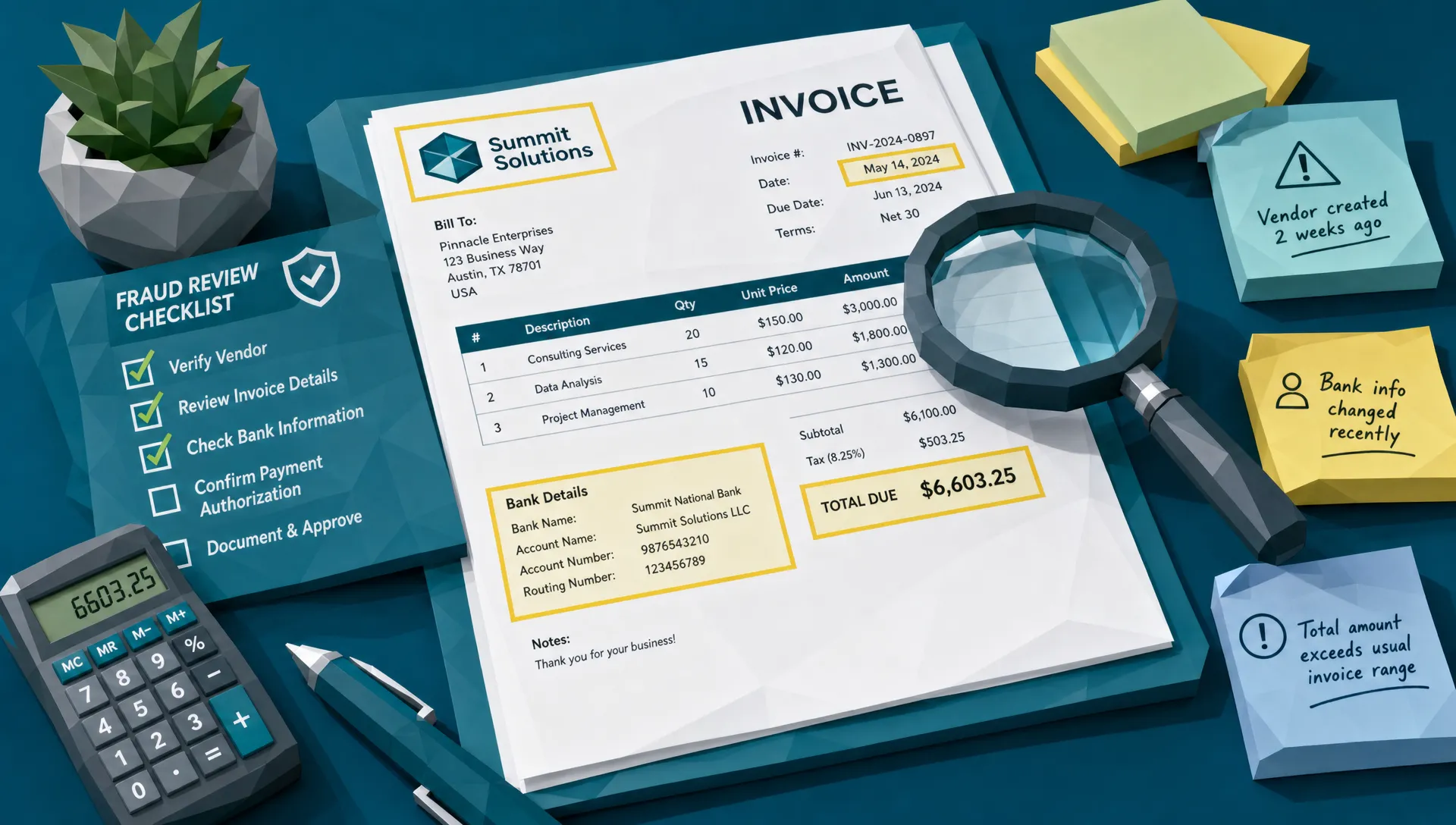
I once reviewed a facilities invoice where the total had been increased by a few hundred dollars. On the face of it, the edit was not dramatic. The font looked close enough, and the approver had worked with the vendor before. But the bank account had changed, the PDF creation date was later than the email timestamp, and the tax calculation rounded in a way the vendor had never used before. Any one of those could be explained away. Together, they were a marching band.
That is the pattern I keep seeing across accounts payable, insurance claims, warranty claims, and employee expenses. Fraudsters often focus on the visible edit. They change the amount, date, line item, or beneficiary details. But they rarely rebuild the whole document ecosystem around that change.
And that is where we have an advantage.
Why normal invoice checks miss the real problem
Most invoice systems were built to move work, not interrogate evidence. They extract fields, route approvals, match purchase orders, and keep audit trails. All useful. All necessary. But none of that automatically proves the document is authentic.
The AFP Payments Fraud and Control Survey has reported that payment fraud targets a large share of organizations, and invoice-related attacks remain a practical route because they sit inside normal business operations. Nobody needs to hack a bank vault when they can send a convincing PDF to a busy AP inbox at 4:57 p.m.
If your current tool mainly captures invoice data, it may never ask whether the invoice image was edited after creation, whether the metadata fits the vendor’s normal process, or whether the payment instruction belongs in the transaction. We have written about that workflow gap in more detail in why invoice tracking software misses tampering, but the short version is simple: speed and authenticity are different jobs.
This is especially important now that altered documents are easier to produce. A mediocre fraudster can change a date or amount. A slightly better one can clone a logo, clean up a background, and make a scanned invoice look believable. A very patient one can make the obvious parts look excellent. But the quiet parts are still hard to fake consistently.
Where a tampered invoice usually breaks
When I review a suspicious invoice, I do not ask whether it looks fake. That question is too narrow. I ask whether the document behaves like a real invoice created during a real transaction by a real vendor.
That means checking across several layers at once.
Layer of review   | Common failure                                                              | Why it matters
Visual evidence   | Font shifts, compression blocks, uneven spacing, copied backgrounds         | Edits often disturb the image even when the wording looks normal
Metadata          | Creation dates, editing tools, file history, device traces that do not fit  | The file’s history may contradict the claimed business timeline
Math              | Tax, discounts, totals, quantities, or rounding rules that do not reconcile | Fraudsters edit the number they care about and forget the arithmetic around it
Payment context   | New bank account, mismatched beneficiary, unusual payment route             | The document may be steering money away from the legitimate vendor
Vendor behavior   | Different invoice format, wording, address, or submission pattern           | Real suppliers tend to be boringly consistent, which is very helpful
Physical evidence | Cropped photos, glare, reprinted receipts, overwritten amounts | Many claim and expense documents still start as photographed paper For a deeper checklist, our guide to invoice fraud detection signals hidden in the document walks through the document-level clues that traditional data capture often skips.
Payment context is the part fraudsters underestimate
Payment details are where many altered invoices start sweating.
A fraudster may be able to make a PDF look tidy, but they still need the money to land somewhere. That creates a second trail. The beneficiary name, account location, vendor record, invoice history, claim history, and payment timing all become part of the review.
Take a simple facilities purchase. A legitimate invoice for custom neon signage should usually have product descriptions, delivery context, tax treatment, vendor identity, and payment instructions that fit a made-to-order signage purchase. If the invoice looks like signage but the payment details point to a personal account, the file metadata suggests a recent edit, and the amount does not match the approved quote, we no longer have one concern. We have a pattern.
This is why I am wary of basic image-real checks. Asking whether a document image looks authentic is useful, but it is not enough. The better question is whether the document, the transaction, and the payment destination agree with each other. A tampered invoice often survives a glance and fails a cross-examination.
The same trick appears in AP, claims, and expenses
The costumes change, but the fraud logic stays familiar.
In accounts payable, the tampered invoice might inflate a supplier bill, swap bank details, or turn a dormant vendor into a payment opportunity. In companies without clean purchase order discipline, especially multi-site organizations or fast-growing businesses, the invoice may be the main evidence that the work happened. That makes the document itself a tempting target.
In insurance claims, altered invoices and receipts are often used to increase the payout. A repair invoice gets a higher total. A replacement receipt gets a better model number. A contractor document gets reworked after the loss. The FBI’s insurance fraud overview notes that fraud raises costs for ordinary families, including an estimated additional premium burden of $400 to $700 per year. That is the human version of what looks like a small edit in a PDF.
The pressure is getting sharper because claim evidence is becoming easier to manipulate. Verisk’s 2025 fraud reporting points to growing concern around digitally altered evidence and increasingly sophisticated claims manipulation. I hear the same thing from claims teams: the old sniff test still matters, but it now needs backup.
Employee expenses have their own flavor. A receipt gets reused, a meal total gets padded, a hotel invoice gets adjusted, or a ride receipt is submitted twice with small edits. The ACFE Report to the Nations has long highlighted how occupational fraud can drain organizations before anyone notices. In expense review, the issue is rarely one huge fake receipt. More often, it is lots of small documents that look too minor to fight over, until the pattern becomes expensive.
One expense manager once told me that the most annoying fraud was not the person who submitted a wild fake. It was the person who submitted believable nonsense every month. I laughed because that is painfully accurate. The obvious fraud gives you a story for training slides. The boring fraud gives you leakage.
What I look for before I trust the invoice
I like boring invoices. Boring is good. Boring means the vendor format is familiar, the numbers reconcile, the payment account is expected, the file history makes sense, and the approval route matches the business reality.
Suspicious invoices usually make me ask simple questions. Did the invoice arrive through the normal channel? Does the vendor usually bill this way? Are the payment details already verified? Does the document’s timeline match the claim, purchase, or expense event? Do the totals recalculate cleanly? Does the image show signs of patching, cropping, re-saving, or physical alteration?
None of these questions is exotic. That is the point. Fraud detection does not need to feel like a spy movie. Most of the time, it is disciplined common sense applied consistently, at scale, before the money leaves.
The danger is that manual reviewers are tired, busy, and under pressure to keep operations moving. I have seen AP teams process invoices while answering vendor calls, claims teams juggle angry policyholders, and expense teams review receipts that look like they were photographed during an earthquake. Humans are good at judgment, but poor at staring at thousands of documents for tiny inconsistencies.
That is where automated document forensics earns its seat at the table. Not by replacing judgment, but by giving reviewers a better shortlist of documents worth slowing down for.
A better review process expects multiple failures
The strongest fraud programs do not rely on one control. They stack controls so a weak document has to pass visual inspection, metadata review, math validation, payment verification, and business context checks.
For a tampered invoice, that is a much harder exam. The fraudster must make the document look right, calculate correctly, fit the vendor’s history, match payment records, align with the business event, and survive forensic review. That is a lot of homework for someone trying to steal money with a PDF.
This is also why false positives matter. If every odd-looking invoice becomes a fire drill, teams stop trusting the alerts. A practical system should separate harmless weirdness from meaningful contradiction. A scanned invoice from a small contractor may have messy image quality. That alone is not fraud. But messy image quality plus changed bank details plus mismatched metadata plus a tax total that does not add up deserves attention.
My advice is simple: stop asking whether the invoice looks fake, and start asking whether the whole transaction makes sense. Fraud rarely wins because the document is perfect. It wins because we review it in pieces.
Frequently Asked Questions
What is a tampered invoice? A tampered invoice is a real or fake invoice that has been altered to change important details such as the amount, date, line items, vendor identity, bank account, or tax information. The manipulation may be digital, physical, or a mix of both.
Can a tampered invoice look completely normal? Yes. Many altered invoices look convincing during a quick review, especially when only the extracted fields are checked. The stronger clues often appear in metadata, image artifacts, payment details, arithmetic, and vendor history.
Why do workflow and OCR tools miss invoice tampering? Workflow and OCR tools are usually designed to capture information and route approvals. They may not inspect the original document for pixel-level edits, file history, physical manipulation, or contradictions between the invoice and payment context.
What should teams check before paying a suspicious invoice? Teams should verify the vendor, payment account, invoice math, purchase or claim context, document metadata, visual integrity, and approval path. The goal is to confirm that the document and the transaction tell the same story.
Catch the invoice before it becomes a loss
A tampered invoice rarely announces itself politely. It slips through when teams only check one layer and move on.
Docklands AI helps organizations inspect invoices and receipts for manipulated, photoshopped, and AI-generated documents before they create losses in claims, accounts payable, or employee expenses. It combines document forensics, metadata analysis, mathematical checks, physical manipulation detection, and payment context so reviewers can see the bigger fraud picture before approval.
If your workflow already moves invoices quickly, the next question is whether it knows when to slow down. Learn more at Docklands AI.
Request a Demo Today!
Book your demo below.