Where ML for Fraud Detection Breaks Down on Documents
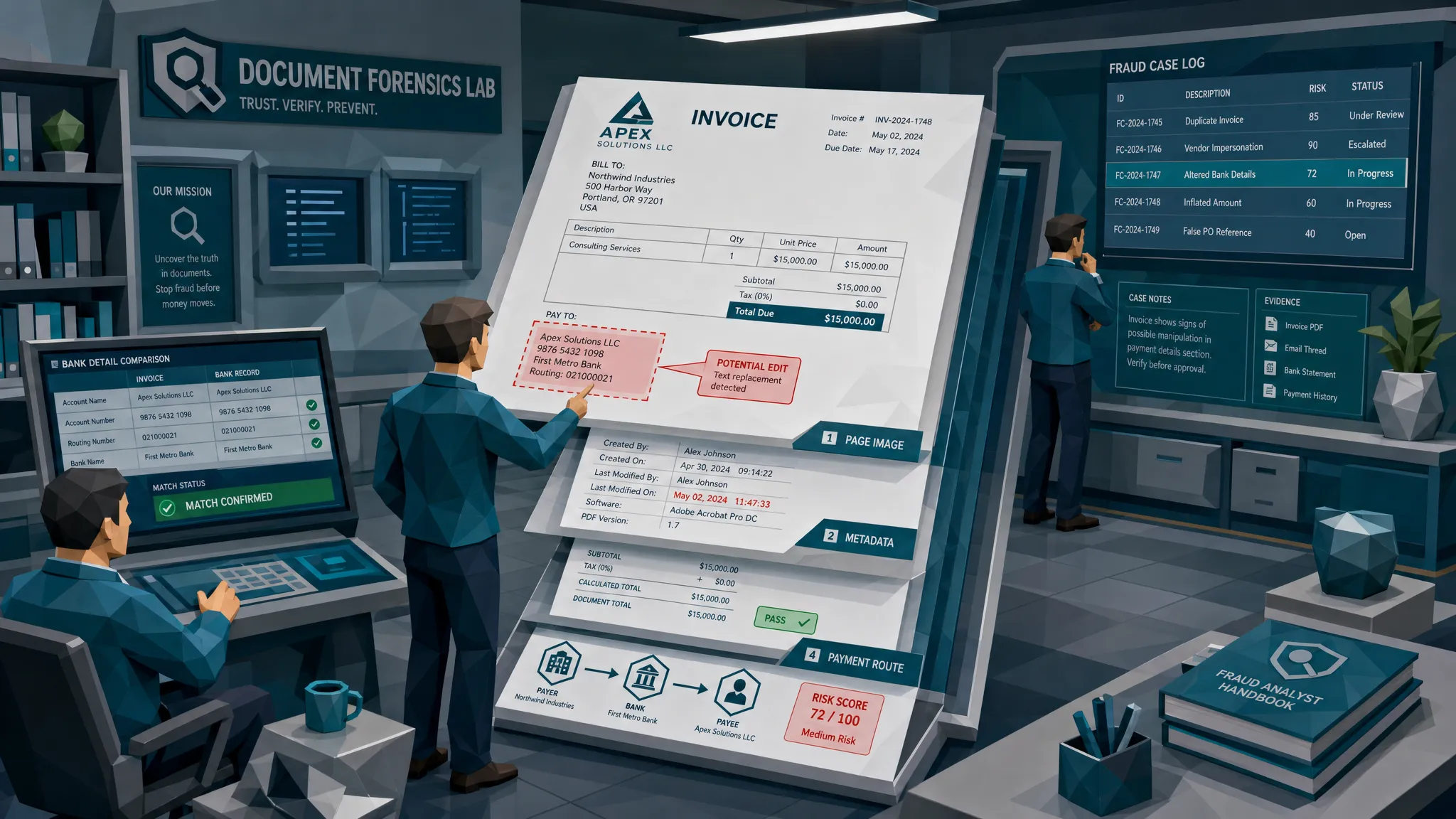

I have a hot take that tends to make fraud teams nod and software vendors shift in their chairs: ML for fraud detection breaks down fastest when the evidence is a document.
That does not mean machine learning is useless. Far from it. I have seen models catch patterns that no human reviewer would spot before lunch, such as a vendor that always submits invoices just under approval limits or a claimant whose repair estimates look unusually similar across unrelated incidents.
But invoices, receipts, estimates, medical bills, and claim photos are not ordinary data points. They are evidence. They have a visual surface, a file history, metadata, mathematical relationships, payment instructions, and a suspicious habit of arriving as screenshots of screenshots after someone “just converted it to PDF.”
If you ask a general fraud model to treat that as another row in a spreadsheet, you are asking a bloodhound to inspect a passport by sniffing the laminate. Cute, but not enough.
ML is good at patterns. Documents are good at lying.
Most fraud models are built to answer a probability question: does this claim, invoice, or expense look unusual compared with what we have seen before?
That is valuable. A model can compare transaction amounts, claim history, vendor behavior, employee patterns, geography, timing, approval routes, and past loss experience. In insurance, where the FBI estimates insurance fraud costs the United States more than $300 billion a year, pattern detection matters. In accounts payable, where payment fraud remains a board-level headache, it matters too.
The trouble starts when the model’s main view of the document is whatever survived extraction. In many workflows, the original invoice becomes OCR text, a few fields, and perhaps a thumbnail. The model sees “Vendor Name,” “Total,” “Date,” “Tax,” and “Bank Account.” It may never see the tiny blur around a changed digit, the pasted logo, the metadata showing three editing tools, or the fact that the subtotal was calculated by someone whose calculator apparently had a long lunch.
I once reviewed a receipt where the ML score was calm as a yoga instructor. The merchant existed, the amount was plausible, the employee had travel that week, and the date was in policy. But the receipt had one line item floating half a millimeter higher than the rest. That sounds laughably small until you zoom in and see the compression blocks around the altered amount. The model saw a normal expense. The document told a different story.
That is the core problem. Fraud models are often trained to spot suspicious behavior. Document fraud is often about suspicious evidence.
The first failure: OCR turns evidence into a summary
OCR is useful, but it is lossy. It turns a rich file into extracted text. That is like asking a witness to describe a crime scene, then throwing away the photos.
When a document is flattened, resized, compressed, converted, emailed, downloaded, re-uploaded, and run through OCR, the fraud clues can disappear. Pixel artifacts get smoothed. Layer history gets lost. Metadata is stripped. Fonts are normalized. Cropping marks vanish. The model receives a cleaned-up version of the document, which is exactly what many fraudsters want.
This is especially dangerous in high-volume workflows. Claims handlers, AP teams, and expense auditors are under pressure to move. The temptation is to extract fields, score the transaction, and push anything “low risk” forward. I understand why. Nobody wants to manually inspect 30,000 hotel receipts unless they have offended the finance gods.
But a document can be fraudulent even when its extracted fields look boring. In fact, the better the fraudster, the more boring the extracted fields look.
The second failure: labels teach the model yesterday’s fraud
Fraud models learn from past cases, and past cases are usually the cases someone caught.
That sounds obvious, but it creates a quiet bias. If your team historically caught duplicate invoices, inflated mileage, and forged repair estimates, the model learns those patterns. If your team missed AI-generated receipts, altered bank details hidden in invoice PDFs, or digitally manipulated claim images, those are underrepresented in the training data.
So when leaders ask, “Why didn’t the model catch this?” the answer is often, “Because your organization never taught it what this looks like.”
This is not a criticism of fraud teams. It is the reality of detection. We do not get a clean library of every fraud attempt, neatly labeled by type, quality, and intent. We get messy outcomes. Some fraud is confirmed. Some is suspected. Some is written off as “not enough evidence.” Some sails through and becomes a very expensive lesson six months later.
That is why I get nervous when teams treat model confidence as truth. A low-risk score can mean “this is probably fine.” It can also mean “this fraud looks different from the fraud we caught before.”
If you want a deeper version of this argument, Docklands has covered where fraud detection artificial intelligence falls short, especially when teams lean too heavily on scores without asking what evidence supports them.
The third failure: polished documents are no longer hard to make
A decade ago, a bad fake invoice often looked like a ransom note assembled in Microsoft Paint. Fonts changed mid-line. Logos were stretched. Dates used three formats. It was almost charming, in a felony-adjacent way.
Now, a polished fake can be generated or edited in minutes. Clean layouts, neat branding, realistic item descriptions, and professional-looking PDFs are no longer meaningful signals of authenticity.
Here is the uncomfortable bit: we humans are very easy to impress with visual consistency. If you look at the work of a serious branding and go-to-market agency, you see how quickly a coherent visual system creates trust. Fraudsters understand the same psychology. A crisp logo, a tidy footer, and a plausible invoice number can make a fake feel legitimate before anyone checks whether the supplier, payment details, and file history make sense.
This is where ordinary models struggle. If a fake document is designed to resemble the normal population, and the model mainly sees extracted fields, the fake may look wonderfully average. Average is dangerous when your controls are tuned to catch outliers.
The fourth failure: a risk score is not evidence
I have never seen a fraud investigation end well with the sentence, “The model said it was suspicious, so we denied it.”
For claims, expenses, and AP, you need to explain what happened. A risk score may help prioritize review, but it does not tell an adjustor, auditor, supplier manager, or CFO which part of the document is wrong. It does not show the altered pixels. It does not prove that metadata conflicts with the claimed creation date. It does not explain why the bank account on an invoice is inconsistent with past payment behavior.
That matters because fraud teams do not just detect fraud. They have to act on it.
An insurance carrier may need to challenge a claim. An AP manager may need to stop a payment without damaging a real supplier relationship. An expense team may need to confront an employee, which is always more fun in theory than in the actual HR meeting.
A good document review gives you reasons, not vibes. “The total looks suspicious” is weak. “The total field shows localized editing artifacts, the VAT calculation is inconsistent, and the file metadata indicates modification after submission” is much stronger.
The fifth failure: single-document checks miss payment context
Many document checks ask a narrow question: does this file look real?
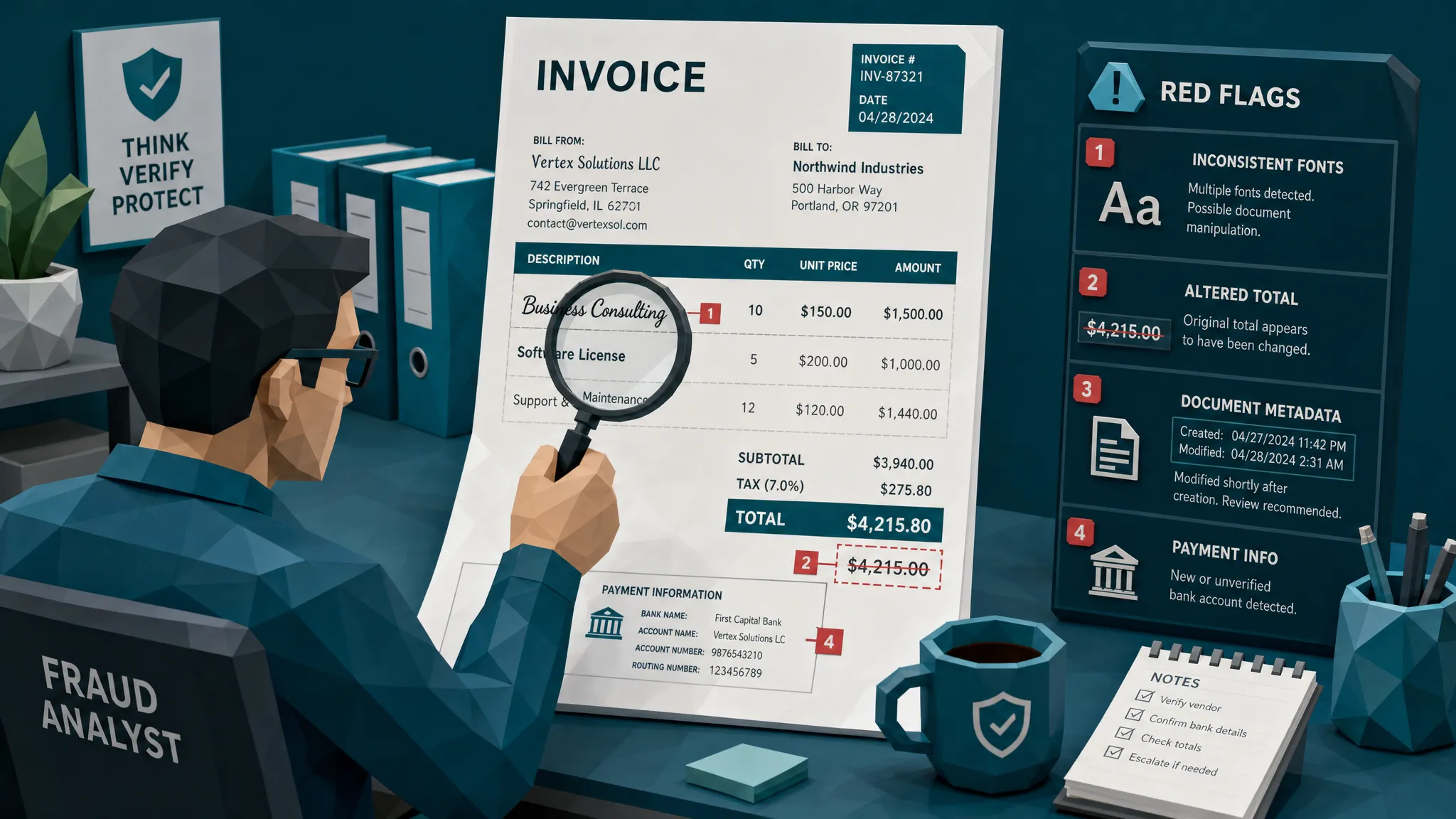
That is useful, but incomplete. A forged invoice can look visually clean. A real invoice can be redirected to a fraudulent bank account. A genuine receipt can be reused, edited, or submitted by the wrong person.
The payment context often decides whether the document is dangerous.
In AP, I want to know whether the bank details changed recently, whether the invoice sequence fits the vendor’s history, whether the purchase order relationship makes sense, and whether the payment instructions match prior behavior. In insurance, I want to compare the repair estimate, claimant history, image evidence, policy details, supplier patterns, and payout destination. In expenses, I want to know whether the receipt matches travel dates, merchant category, duplicates, and employee behavior.
This is why I like document forensics paired with transaction context. The document may whisper, “Something changed here.” The payment data may reply, “Yes, and the money is going somewhere new.” That is when the room gets interesting.
Docklands has a useful related piece on why insurance claim fraud detection models and document forensics both matter, because structured claim patterns and document-level evidence answer different questions.
The sixth failure: fraud adapts faster than static controls
Fraudsters read the room. If insurers tighten photo review, they improve photos. If AP teams add vendor checks, they compromise supplier emails. If expense teams audit hotels, they move to meals, rideshares, and smaller claims that feel too trivial to inspect.
The recent rise of synthetic and manipulated evidence has made this sharper. Verisk’s 2025 fraud report highlights growing concern around claim manipulation and the willingness of some consumers to use AI to alter evidence. The BBC also reported a sharp rise in fraudulent claims linked to AI-generated images and deepfakes, citing insurer experience in the UK market.
The exact numbers will vary by market and line of business, but the direction is not subtle. The tools for making convincing documents are getting easier to use.
This is where static model training becomes brittle. If a model is refreshed slowly, and fraud tactics change monthly, you end up with a very confident historian. Useful at parties, less useful when approving payments.
The seventh failure: false positives become operational debt
Fraud people love catching fraud. Business teams love not annoying customers, vendors, employees, and claims handlers. Both sides are right.
A model that flags too much becomes background noise. Reviewers stop trusting it. Managers create workarounds. High-risk queues grow stale. Eventually someone says, “We need to tune this down,” and the pendulum swings too far the other way.
I have seen teams celebrate a model that found “more suspicious documents,” only to discover it mostly found poor scans from one regional office. Congratulations, we have detected a dusty scanner.
The practical goal is not maximum suspicion. It is useful suspicion. That means fewer alerts with better reasons. A document should be escalated because there is reviewable evidence: tampering indicators, metadata conflicts, math errors, duplicate submission patterns, inconsistent payment details, or suspicious physical manipulation.
A model score can help route work. Document evidence helps reviewers make decisions.
What I would do instead
If I were designing fraud controls for invoices, receipts, or claim documents today, I would still use ML. I just would not let it sit alone at the grown-ups’ table.
The workflow should preserve the original file whenever possible. Do not rely only on OCR output. Keep the document, its metadata, its file history, and its visual structure available for inspection. Once you flatten everything into text, you may be deleting the very evidence you later need.
Then, combine three views of the submission.
First, look at the document itself. Does it show signs of editing, generation, compression mismatch, inconsistent fonts, copied regions, unnatural shadows, or altered totals? Are there mathematical irregularities between line items, tax, discounts, and totals?
Second, look at context. Does the invoice fit the vendor’s known behavior? Do the bank details align? Is the claimant using a supplier that appears repeatedly across suspicious claims? Is the employee submitting a receipt that resembles one already reimbursed?
Third, look at workflow evidence. Who submitted it? When? Through which channel? Was it resubmitted after rejection? Did the payment destination change just before approval?
This approach gives you something far better than a generic fraud score. It gives you an evidence trail.
For AP teams especially, Docklands has a practical breakdown of signals hidden in invoice documents rather than the data alone. That is the mindset shift I think more organizations need.
The boring controls still matter
I know this is an article about machine learning, but I would be a bad fraud professional if I did not defend boring controls for a moment.
Segregation of duties matters. Vendor verification matters. Purchase orders matter where they are practical. Approval limits matter. Employee policy clarity matters. Payment change callbacks matter. Audit trails matter.
ML does not replace those controls. It helps when those controls are incomplete, inconsistent, or overwhelmed by volume.
And many organizations are exactly there. Fast-growing companies often have messy AP processes. Multi-site groups inherit legacy systems. Insurance teams receive mountains of digital evidence from phones, portals, contractors, and third parties. Expense managers are asked to approve quickly while employees use increasingly creative definitions of “client entertainment.”
That is the real world. Controls are imperfect. Volume is high. Fraud is opportunistic. This is where document-level detection earns its keep.
My rule of thumb
Here is my simple test: if your fraud model cannot point to the evidence, do not treat it as the evidence.
Use ML to prioritize. Use document forensics to substantiate. Use payment and workflow context to understand intent and impact.
When those three line up, you have a case worth reviewing. When only the score is high, you have a lead. When the score is low but the document has forensic problems, you may have found the exact kind of fraud your model has not learned yet.
That is where a lot of losses hide.
Frequently Asked Questions
Why does ML for fraud detection struggle with documents? ML often works from extracted fields, historical patterns, or risk indicators. Documents contain visual, metadata, mathematical, and file-history evidence that may be lost during OCR or conversion. If the model cannot inspect those clues, it can miss tampering.
Is machine learning still useful for invoice or claims fraud? Yes. ML is very useful for prioritizing cases, finding behavioral patterns, and spotting anomalies across large volumes. The problem is relying on it alone. For documents, it should be paired with forensic checks and payment context.
What document clues do fraud models often miss? Common missed clues include localized editing artifacts, inconsistent fonts, mismatched compression, suspicious metadata, impossible calculations, reused receipts, altered bank details, and physical manipulation such as photographed printouts with changed information.
Should AP and claims teams review every document manually? No. Manual review of every submission is slow and expensive. A better approach is to use automated document forensics and fraud scoring to prioritize the highest-risk cases, then give reviewers clear evidence for why each item was flagged.
What is the best way to reduce false positives? Tie alerts to specific evidence. A generic “high risk” score is easy to ignore. A finding that shows altered pixels, metadata conflicts, duplicate document patterns, or payment inconsistencies gives reviewers a concrete reason to investigate.
Stop asking documents to behave like spreadsheets
Invoices, receipts, and claim documents are not passive attachments. They are where fraudsters make promises, hide edits, redirect money, and hope nobody zooms in.
Docklands AI helps teams detect manipulated, photoshopped, and AI-generated invoices and receipts using document forensics, fraud analysis, and payment context. If your current process relies heavily on extracted fields or generic risk scores, it may be time to inspect the evidence itself.
Visit Docklands AI to see how document-level fraud detection can strengthen claims, AP, and employee expense controls before bad documents become real losses.
Request a Demo Today!
Book your demo below.