Why a Printed Fake Receipt Still Gives Itself Away

Here is my hot take after a decade of reviewing questionable claims, invoices, and expenses: the printer is not a washing machine for evidence.
I know the logic. Someone creates or edits a receipt, prints it, folds it once or twice, maybe adds a coffee stain for theatrical effect, then photographs it on a kitchen counter. The hope is that paper makes the story feel more human. More believable. Less digital.
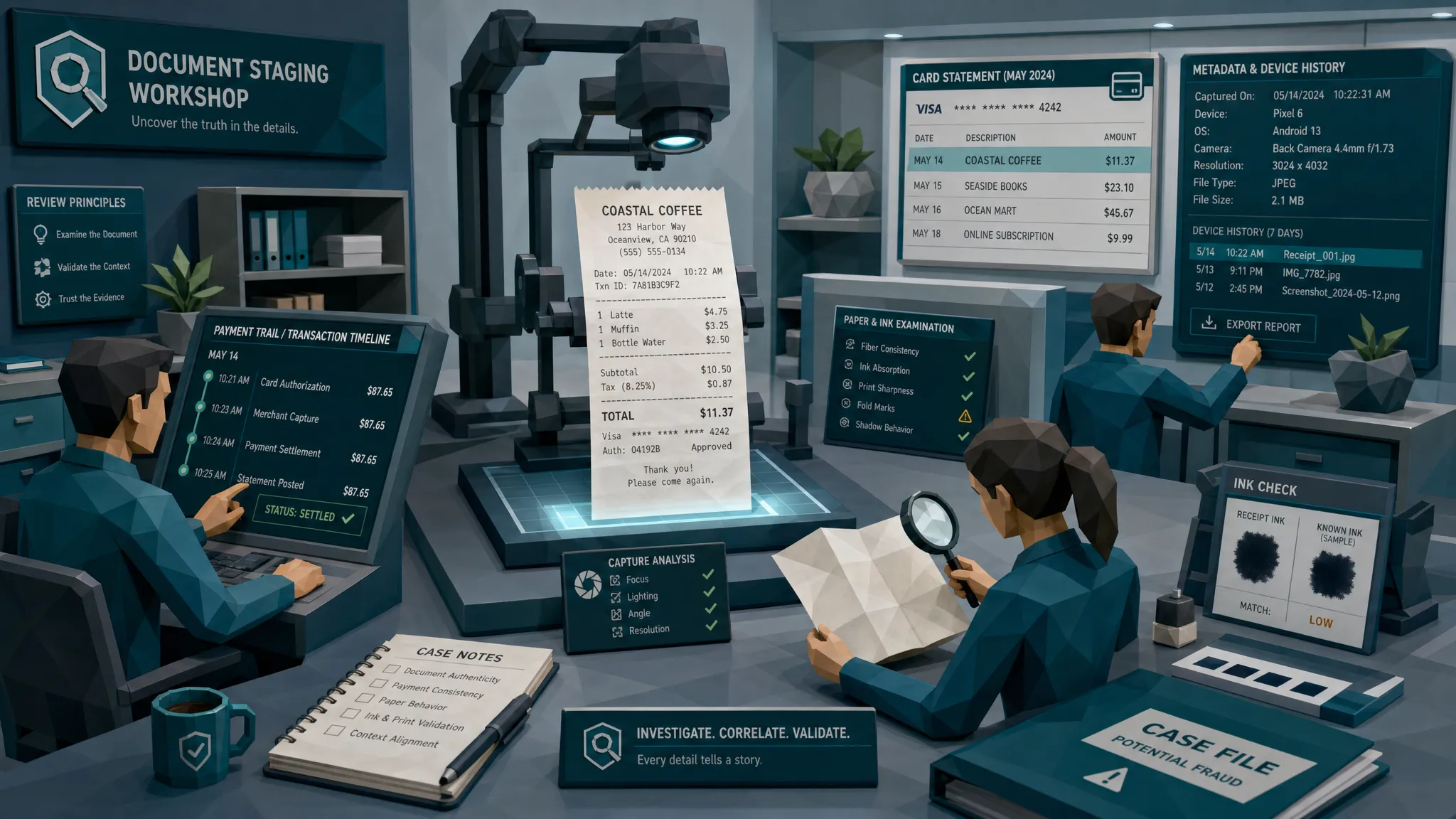
In practice, a printed fake receipt often gives reviewers more to work with, not less. The old print fake receipt trick creates another layer of evidence: paper behavior, ink behavior, shadows, camera artifacts, math, merchant context, and payment history. If the underlying story is weak, printing usually gives the lie more places to leak.
I once worked a travel expense case where the receipt looked beautifully boring. Slightly curled paper, decent shadows, a believable restaurant name. The thing that broke it was not a dramatic Photoshop scar. It was the payment trail. The employee claimed a client dinner, but the corporate card feed showed no matching authorization, the restaurant had closed before the timestamp, and the tip percentage was oddly perfect across three separate submissions. The receipt was dressed for court. The facts showed up in sweatpants and told the truth.
Why printing feels persuasive, and why that is dangerous
Humans trust paper. We have been trained to trust it since school forms, bank statements, and warranty cards. A paper receipt feels like something that came from a cash register, survived a pocket, and lived a normal little receipt life.
Fraudsters know that. So do tired reviewers.
The problem is that paper familiarity can lower scrutiny. In claims and finance operations, people see hundreds or thousands of documents. A receipt that looks crumpled and ordinary can slide through faster than a suspiciously clean PDF. That is exactly why printed fake receipts deserve a different kind of attention.
The stakes are not small. The FBI estimates insurance fraud costs the United States more than $308 billion each year, adding hundreds of dollars in costs for the average family. In payments, the Association for Financial Professionals has reported widespread targeting of organizations by payments fraud. And expense fraud is the sort of leakage that feels tiny line by line, until someone totals the year.
A printed receipt can be part of any of those worlds: a replacement phone claim, a hotel stay, a medical visit, a repair invoice, a meal expense, or a reimbursement request. The document type changes. The weakness stays familiar.
A printed fake receipt creates four layers of evidence
When a receipt is printed and photographed, I do not think of it as one document. I think of it as a stack of evidence layers. Each layer can support the story, or contradict it.
Evidence layer    | What reviewers are really checking                    | Why printed fakes struggle
Original document | Layout, totals, merchant details, receipt logic       | Templates often get spacing, tax, item codes, or register language wrong
Physical print    | Paper texture, ink, folds, shadows, alignment         | Paper adds physics that are hard to make consistent with the alleged origin
Recaptured image  | Camera metadata, compression, blur, lighting          | A photo introduces new traces and can expose unnatural editing or staging
Payment context | Card data, authorization, merchant descriptor, timing | A receipt can claim a payment happened, but payment systems are harder to flatterThis is also why simple image checks are not enough. A document can look real and still describe a transaction that never happened. On the other hand, a messy, low-quality image can be legitimate. The job is not to reward prettiness. The job is to decide whether the receipt belongs to the real world.
The clues are usually boring, which is why they work
If you are expecting every fake to announce itself with a neon typo, prepare to be disappointed. The obvious fakes exist, sure. I have seen receipts with impossible dates, broken totals, and merchant names that looked like they were invented during a lunch break. But the better fakes fail in quieter ways.
Paper physics leaves a story
A receipt photographed after printing should behave like paper in a real environment. Folds should affect shadows. Curled edges should change focus slightly. A crease should interact with text and light. If the document has been assembled digitally and then printed, those physical cues can look strangely disconnected from the printed content.
This does not mean every odd shadow proves fraud. Please do not become the person who accuses someone because their kitchen light is ugly. But when the paper texture, lighting, and printed content seem to belong to different universes, I start asking questions.
Ink and toner do not age on command
Thermal receipt paper has a very particular look. Office printer output has another. A printed image of a receipt has another. When someone prints a receipt that supposedly came from a point-of-sale terminal, the texture and density can feel off, especially around logos, barcodes, and small text.
Again, this is not about one magic clue. It is about consistency. If the merchant normally issues thermal receipts, but the submitted image looks like a screenshot printed on bright office paper, that does not prove fraud by itself. It does justify a closer review.
Typography survives printing, but rhythm does not
Fonts are not the whole story. Receipt text has rhythm: spacing, alignment, line breaks, item descriptions, tax labels, abbreviations, and the little awkward conventions real POS systems use. Fake receipt tools can copy the broad appearance while missing that rhythm.
We see similar issues in generated digital receipts, where the output looks plausible at first glance but falls apart when checked against math, merchant behavior, and payment details. I wrote more about those tells in our guide to what fake receipt generator output reveals instantly.
Math is still wonderfully unforgiving
I love math checks because they have no sense of humor. Subtotals, tax, discounts, tips, reimbursements, and currency rounding all need to agree. When they do not, the receipt may be altered, poorly generated, or simply misread. Either way, it should not sail through.
Tax is especially useful because it connects the receipt to a location and type of purchase. A meal, a repair, a pharmacy item, and a hotel stay do not follow identical tax logic. Fraudsters often focus on the visible total because that is the number they want reimbursed. Reviewers should care about how the total was born.
Metadata can disappear, but absence is not innocence
Printing can strip away the original digital metadata. That is part of the appeal. But the new photo has its own history: device information, timestamps, compression patterns, editing traces, and file handling behavior. Sometimes the most interesting thing is not what the metadata says. It is what the metadata refuses to explain.
A word of caution: missing metadata is not automatically suspicious. Many apps remove it. Some claim portals compress images. Email and messaging tools can change files. Treat metadata as one witness in the room, not the judge.
The payment trail is where the receipt usually confesses
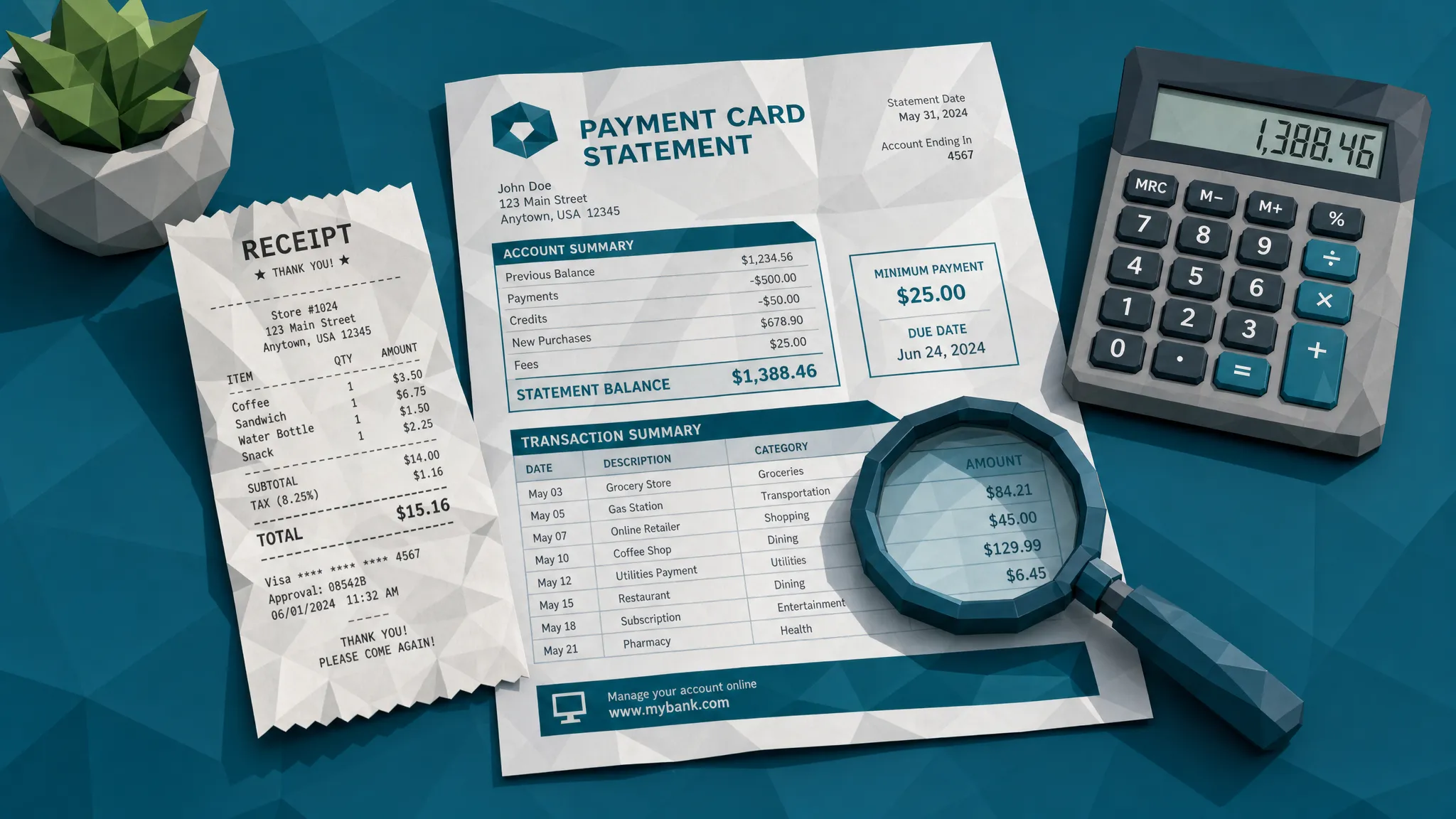
If I could give every claims adjuster, AP manager, and expense reviewer one habit, it would be this: stop asking only whether the receipt looks real. Ask whether the transaction behaves like it happened.
A printed fake receipt can imitate a merchant name. It can imitate a total. It can imitate a timestamp. But it struggles when compared with the surrounding financial trail.
Card last four digits, authorization timing, merchant descriptors, bank account changes, vendor history, purchase orders, travel itinerary, claim date, service location, and reimbursement policy all add context. A fake receipt may pass one check. It rarely enjoys being cross-examined by ten quiet facts.
This is why printed receipt fraud is not only a document problem. It is an investigation problem. The document is the doorway. The payment context is the room.
At Docklands AI, that is the philosophy behind connecting document forensics with payment and claim context. Pixel-level analysis helps identify manipulation, but the bigger fraud picture comes from comparing the receipt to the story it is trying to support.
Why printed receipts fool good teams
Good teams miss bad receipts for very normal reasons. They are overloaded. They are trained to avoid friction. They do not want to accuse honest customers, employees, or vendors. They may also be working inside systems that treat document review as a quick checkbox instead of a risk decision.
The rise of better manipulation tools has made this harder. Verisk’s 2025 fraud report found that many carriers believe claims manipulation has become more sophisticated. The BBC also reported a sharp rise in fraudulent claims at Admiral, with fabricated and manipulated visual evidence becoming a bigger part of the problem.
My view is simple: the best fraud controls in 2026 will not be the loudest ones. They will be the controls that quietly compare the receipt, the payment, the policy, the person, and the timing before money leaves.
A printed fake receipt is designed to win a glance. It is much less comfortable under comparison.
Different teams should look at different context
The same receipt can mean different things depending on where it appears. A hotel receipt in an employee expense report is not reviewed the same way as a hotel receipt in an insurance displacement claim. A medical receipt in a health claim has different context than a restaurant receipt from a sales trip.
Team              | What the printed receipt is trying to prove           | Context that should be checked
Insurance claims  | A loss, repair, replacement, or service occurred      | Claim date, loss location, vendor legitimacy, payment method, policy coverage
Employee expenses | The employee paid a reimbursable business cost        | Corporate card feed, travel calendar, policy limits, attendees, duplicate submissions
Accounts payable  | A vendor delivered goods or services worth paying for | Vendor master data, PO status, bank details, invoice history, delivery evidence
Warranty claims   | A covered item was purchased or repaired              | Product serials, purchase date, retailer patterns, service timeline
Health insurance | A patient received eligible care from a real provider | Provider identity, service date, location, eligibility, billing consistency That does not mean reviewers should play internet detective on every claim. It means high-risk receipts deserve context. If a provider’s address, specialty, operating hours, and payment story all disagree with the receipt, the paper is no longer doing much for the claimant.
The printer can also expose old edits
Printing does not erase manipulation. Sometimes it makes manipulation easier to see.
A receipt altered before printing may show subtle inconsistencies after recapture: different sharpness around one total, odd spacing in a date, a pasted logo that prints differently from surrounding text, or blur that does not match the rest of the image. These clues are familiar in digital edits too. We cover that more directly in our article on how receipt Photoshop leaves clues reviewers can still catch.
The funny part is that fraudsters often print because they want to hide the edit. But printing is a translation. And translations introduce errors. A clean digital manipulation may become less clean once paper, ink, lighting, and camera compression all take a turn.
A practical control I wish more teams used
If I were building a receipt review workflow from scratch, I would not start with suspicion. I would start with comparison.
Control                                   | Why it helps
Preserve the submitted file               | Keeps metadata, compression, and handling history available for review
Compare document math to transaction data | Catches totals, tax, tip, and reimbursement mismatches
Link receipts to payment evidence         | Separates documents that look real from transactions that behave real
Score risk instead of using one red flag  | Reduces false accusations and focuses human review where it matters
Track repeat patterns | Finds employees, vendors, providers, or claimants who reuse tactics over timeThe goal is not paranoia. The goal is proportionate skepticism.
Frequently Asked Questions
Can a printed fake receipt be detected after it has been photographed? Yes. Printing and photographing can remove some original digital traces, but they also create new evidence in the paper, lighting, image file, math, and payment context. The strongest reviews combine document analysis with transaction verification.
Does printing a fake receipt remove metadata? It may remove metadata from the original edited file, but the photographed submission can have new metadata and compression history. Missing metadata alone should not be treated as proof of fraud, since many apps and portals strip it automatically.
What is the biggest red flag in a printed fake receipt? The biggest red flag is usually a context mismatch. If the receipt total, date, merchant, location, card data, or claim story does not line up with payment evidence, the receipt deserves closer review.
Are paper receipts safer than digital receipts? Not automatically. Paper receipts can be legitimate, but they can also be staged, printed from templates, altered before printing, or reused. The format matters less than whether the receipt matches the surrounding facts.
How should teams review printed receipts without slowing everything down? Use risk-based review. Low-risk, low-value receipts can move quickly, while higher-risk submissions should be checked against payment data, metadata, duplicate patterns, math, and policy context.
Bring the receipt and the payment story together
A printed fake receipt is trying to look ordinary. That is the whole performance. But ordinary-looking documents can still carry extraordinary inconsistencies.
If your team reviews claims, expenses, invoices, or reimbursements, the next step is not to stare harder at paper. It is to connect document forensics with the payment story behind it.
Docklands AI helps organizations detect manipulated, photoshopped, and AI-generated invoices and receipts using forensic analysis, metadata review, mathematical checks, and payment-context signals. If printed receipts are slipping through your workflow, we can help you find the clues before the payout happens.
Request a Demo Today!
Book your demo below.