Fraud outlook Q4 2026: fewer fraudulent claims, bigger and better-made fakes
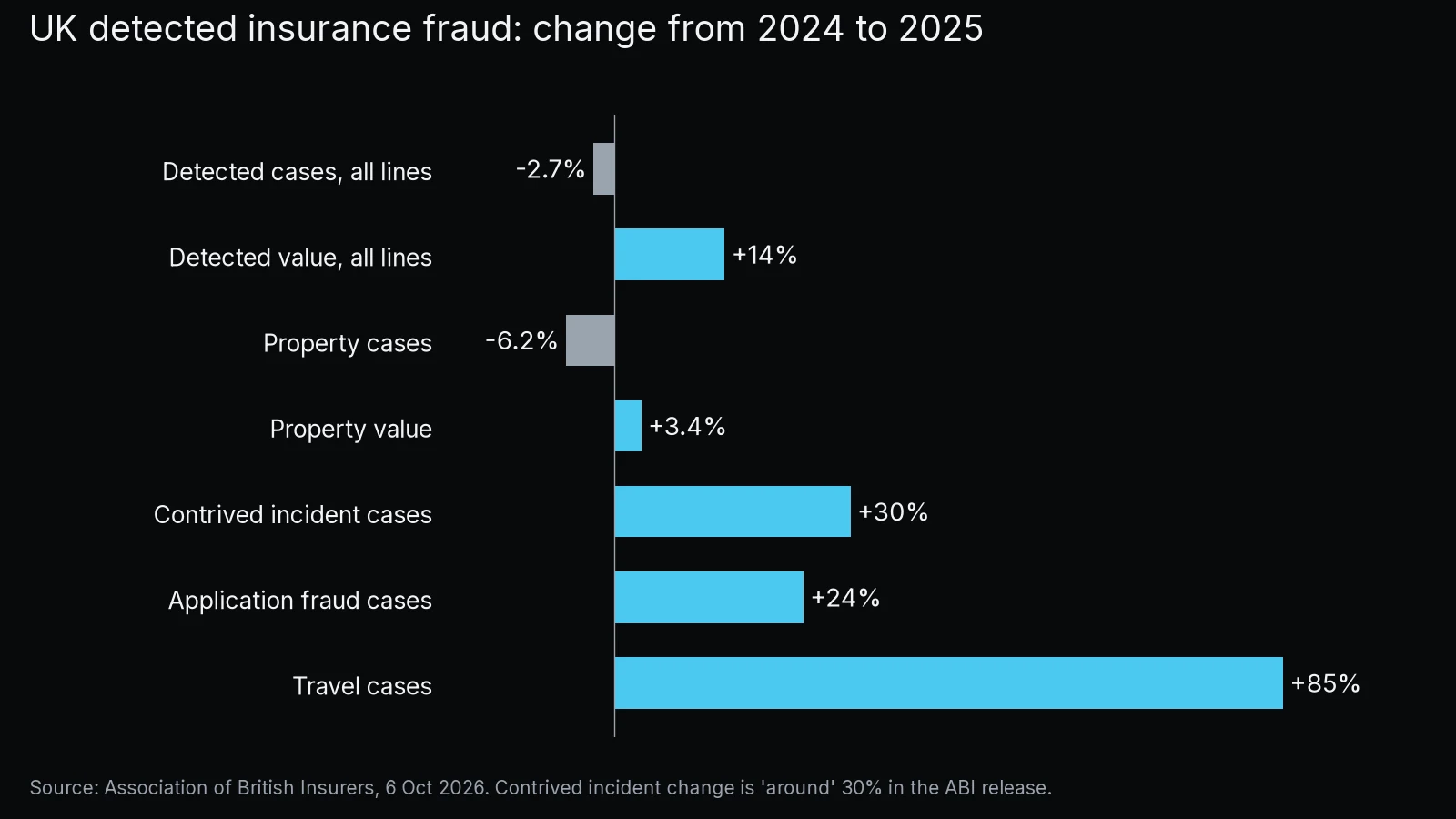
Summary and thesis (opinion). The public data from the last quarter points one way: fraud is becoming less frequent and more expensive per case, and it is moving from force to paperwork. UK insurers detected 2.7% fewer fraudulent claims in 2025 but 14% more value [1]. Canadian auto thefts fell 18% in 2025 and another 10.1% in the first half of 2026, while vehicle finance fraud detected at the ports of Montreal and Halifax rose 72% [3][4]. Business email compromise cost US victims $3.05 billion in 2025, according to complaints to the FBI [2]. My view: 2027 will be the year generated and altered documents become the default tool for professional fraud in claims and payments, and the teams that win will be the ones that check documents against what was actually paid, not against what a genuine document usually looks like.
What you can do about this
For executives. Fewer but larger fraud cases mean the losses you do not catch are concentrated. Track detected fraud by value, not by count, and set review thresholds by claim severity. The average detected UK fraudulent claim is now £14,300 [1], so each missed case weighs more.
For claims and fraud teams. Expect storm and catastrophe paperwork to dominate the first quarter in the US Southeast. Florida carriers reported about 68,000 claims and $736 million of losses five weeks after Hurricane Isaias [7]. The repair invoices, estimates and contents receipts behind those claims arrive over the next months, which is when inflated and fabricated documents appear.
For underwriting and risk teams. Treat proof of insurance, proof of income and proof of identity as documents to verify, not boxes to tick. Both Florida and Ontario saw fake proof of insurance this quarter, one through fake certificates and one through a website selling pink slips [5][6].
For finance teams. Business email compromise generated 24,768 complaints to the FBI in 2025 [2]. Supplier bank detail changes and invoices that arrive from a known vendor's name but a new account are where it starts.
Key findings
- Executive. UK detected insurance fraud rose 14% in value to £1.34 billion in 2025 while cases fell 2.7% [1].
- Executive. The FBI's Internet Crime Complaint Center recorded $20.877 billion of reported losses in 2025, up 26%, across 1,008,597 complaints; business email compromise alone accounted for $3.05 billion [2].
- Underwriting. Application fraud is growing faster than claims fraud in the UK: detected cases rose 24%, and insurers prevented £1.8 billion of fraudulent applications [1].
- Claims. In Canada, theft volumes are falling but only 51% of vehicles stolen in Ontario were recovered in 2025, and Équité estimates the cost of auto theft at about $900 million a year [3].
Scorecard
This is the first Docklands quarterly outlook, so there are no earlier predictions to score. From the next edition, each prediction below will be marked right, partly right or wrong, with the evidence.
Five predictions for the next quarter and 2027
1. Average detected fraud value keeps rising while case counts stay flat
The next annual UK figures will again show detected value growing faster than detected cases.
- Indicators to watch
- The average detected claim value and the contrived incident count in the ABI's next release [1].
- What would prove it wrong
- A fall in the average detected claim, which would suggest fraud is fragmenting into smaller claims rather than concentrating.
2. Fake proof of insurance becomes an online product in more markets
More regulators will issue warnings like FSRA's about websites selling proof of insurance with no cover behind it [5].
- Indicators to watch
- Regulator consumer alerts and fraud bureau warnings that mention certificates, ID cards or pink slips.
- What would prove it wrong
- No new warnings outside Ontario and Florida by mid-2027.
3. Catastrophe fraud shows up in repair and contents documents, not in first notice
Fraud linked to Hurricane Isaias will surface over the next two quarters in contractor invoices and contents receipts, as Florida's DFS has already deployed strike teams to the affected areas [7][9].
- Indicators to watch
- DFS arrest announcements that cite storm repairs or assignment of benefits.
- What would prove it wrong
- Enforcement actions after Isaias that rely mainly on staged losses rather than documents.
4. Vehicle crime shifts further from theft to finance and identity fraud
Theft volumes keep falling in North America while document-based vehicle fraud grows. NICB counted Florida among the top states for vehicle theft even as national thefts fell [8], and Équité reports a 72% rise in finance fraud detected at ports [3].
- Indicators to watch
- Équité's 2026 full-year report and any NICB data on fraudulently obtained vehicles.
- What would prove it wrong
- A rebound in theft counts with no matching rise in finance fraud.
5. Payment redirection fraud follows business email compromise into claims payouts
The techniques behind $3.05 billion of reported business email compromise losses [2] will be used more against claim payments: changed bank details, fake payee confirmations and altered proof of payment.
- Indicators to watch
- The FBI's 2026 report and insurer or regulator warnings about payout redirection.
- What would prove it wrong
- Flat or falling business email compromise losses in the 2026 report.
Opinion: check the payment, not the paper
For years, document fraud detection meant asking whether a document looked genuine: the right fonts, a clean layout, plausible metadata. That question is losing its value. A convincing receipt or invoice can now be generated in seconds, and the cases regulators announced this quarter show that the documents that fooled people were not crude. The Florida case involved an altered Florida Highway Patrol crash report and altered medical records [6]. The pink slips in Ontario carried a real insurer's brand [5].
The better question is whether a document agrees with the money. Was this amount actually paid, to this business, on this date? Does this repair invoice match the payment behind it, and does that payment match the rest of the claim? A forger can make a document look right. Making it agree with a bank record, a vendor's history and every other claim that touches the same account is far harder.
That is also how you avoid the trap that kills most fraud programmes: false positives. Flagging every document that looks slightly unusual buries investigators and delays honest customers. Anchoring on the payment and reading the whole claim lets the genuine claims through fast and leaves investigators with the few that actually disagree with the money.
My expectation for 2027 is that fraud teams will split into two groups: those still trying to spot fakes by eye, and those verifying every payout against the payment behind it. The data above suggests the second group will be the one whose loss ratio holds.
How Docklands automates this
Docklands is built on deep proof-of-payment verification: every receipt, invoice and payment confirmation is checked in detail, then read against the full claim, so a document that disagrees with what was actually paid stands out. Reviewing the whole claim, not one file, is what keeps false positives down. Fraud Networks connect a document to every other claim that shares its vendor, bank account, phone or device, and vendor blocklists stop known bad suppliers before payment. Each verdict comes back in under 60 seconds. To see how this would work on your own claims or payments, book a call.
Methodology
This outlook uses public sources only, listed below, and no Docklands customer data. Likelihood tags are the author's judgement: likely means more probable than not, possible means close to a coin flip, unlikely means less probable than not. Predictions are opinion and are scored in the next edition.
Sources
- Association of British Insurers, Fraudsters target bigger payouts as insurers detect £1.34 billion of bogus claims, press release, 6 Oct 2026. www.abi.org.uk
- Federal Bureau of Investigation, Internet Crime Complaint Center, 2025 Internet Crime Report. www.ic3.gov
- Équité Association, 2025 Auto Theft Trend Report, news release, 11 Feb 2026. www.equiteassociation.com
- Équité Association, First Half of 2026 Auto Theft Trend Report, news release, 11 Aug 2026. www.equiteassociation.com
- Financial Services Regulatory Authority of Ontario, Fake auto insurance website could cost consumers, announcement, 10 Nov 2026. www.fsrao.ca
- Florida Department of Financial Services, arrest after fraudulent insurance claims filed with altered medical records and an altered crash report, press release, 5 Nov 2026. www.myfloridacfo.com
- Insurance Journal, Five weeks after Isaias, 68,000 claims and $736M in losses, Florida carrier data show, 10 Nov 2026. www.insurancejournal.com
- National Insurance Crime Bureau, U.S. vehicle thefts experience historic decline, news release. www.nicb.org
- Florida Department of Financial Services, Hurricane Isaias response efforts, press release, 13 Oct 2026. www.myfloridacfo.com
Fraud Trends by email