Insurance and payments fraud, November 2026: fewer cases, bigger payouts, forged documents
Summary. The clearest fraud signal this month came from the UK: insurers detected £1.34 billion of fraudulent claims in 2025, up 14% on 2024, even though the number of detected cases fell 2.7% to 93,900 [1]. Fraud is getting bigger per claim, not more frequent. In North America, the enforcement actions announced between mid-October and mid-November all turned on a document that did not match the facts: an altered crash report, certificates for policies that never existed, hidden payroll and a website selling fake proof of insurance [2][3][4][5]. Every figure below comes from a public source, listed at the end.
What you can do about this
For executives. The ABI's numbers put the average detected fraudulent claim at £14,300, the second-highest on record [1]. When fraud concentrates in fewer, larger claims, each missed case moves the loss ratio more, so the value of checking the documents on high-severity claims goes up even if case counts look flat.
For claims and fraud teams. Each of the North American cases this month turned on a document that did not match its source: an altered crash report, certificates the named insurer confirmed were never active, declared payroll that did not match payments [2][3][4]. Checking a document against what was actually issued or paid is the control that matters.
For underwriting and risk teams. Application fraud is rising faster than claims fraud in the UK figures: detected application fraud cases rose 24% year on year, and insurers prevented £1.8 billion of fraudulent applications [1]. Proof documents at onboarding deserve the same scrutiny as proof documents at claim.
Key findings
- Executive. UK insurers detected £1.34 billion of fraudulent claims in 2025, up 14%, while case numbers fell 2.7% [1].
- Claims. Contrived incident and loss fraud rose about 30% to around 5,600 cases, the largest increase of any fraud type the ABI tracks [1].
- Claims. A Florida claimant allegedly altered a Florida Highway Patrol crash report and medical records to support accident claims; $18,520 had already been paid [2].
- Underwriting. Fake proof of insurance turned up in two places: certificates of insurance for policies that were never active in Florida, and a website selling Ontario pink slips with no cover behind them [3][5].
The month in fraud
UK: £1.34 billion of detected claims fraud, concentrated in motor
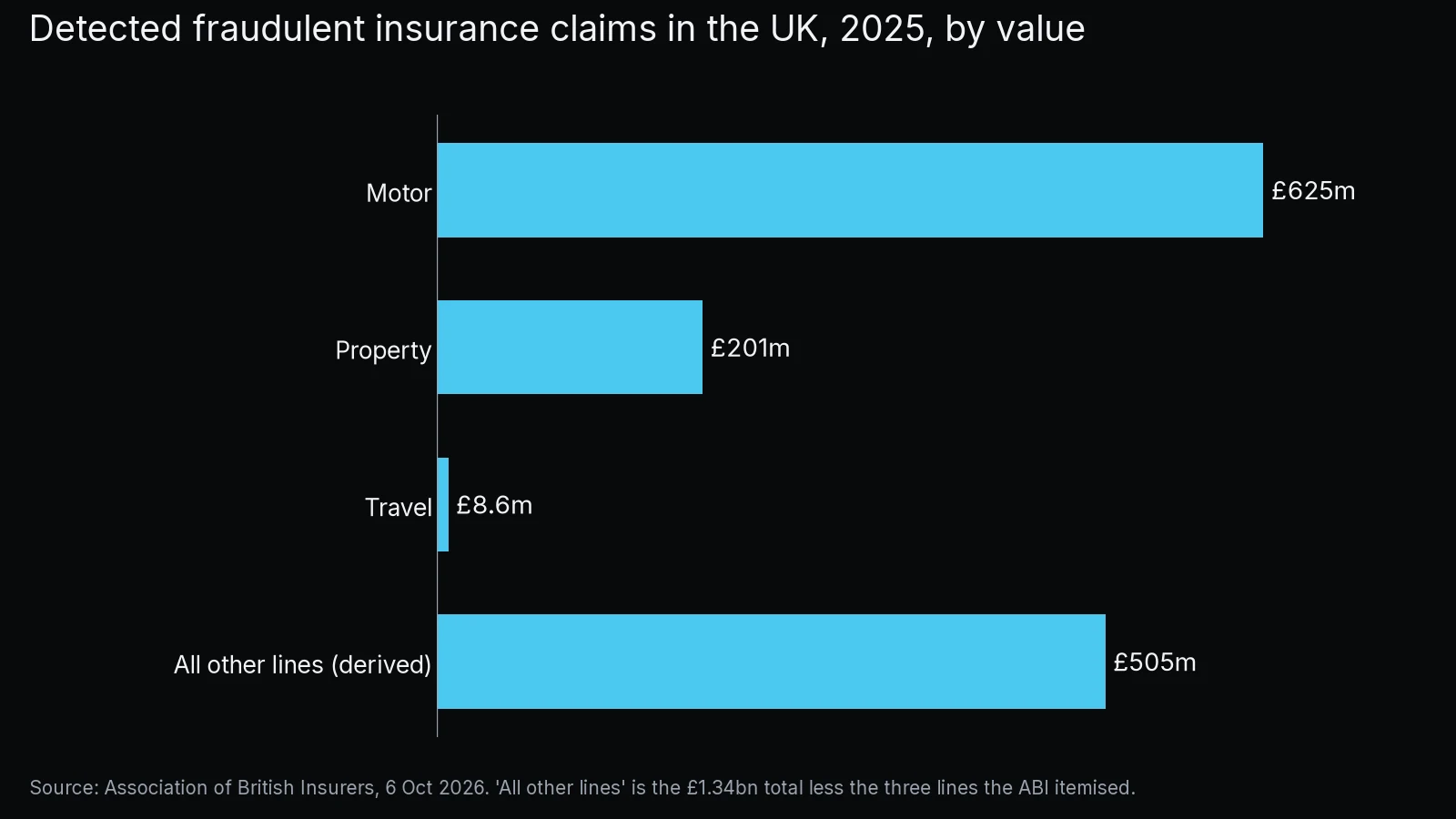
The Association of British Insurers (ABI) published its annual fraud figures on 6 October [1]. Motor accounted for 55% of detected cases: 51,900 claims worth £625 million, with the average detected motor fraud claim at £12,000 [1]. Property cases fell 6.2% to 17,700 while their value rose 3.4% to £201 million, a record average of £11,400 [1]. Travel showed the sharpest rise in volume, up 85% to 4,500 cases [1]. One of the ABI's case studies was a £300,000 travel insurance scam built on fake identities, fabricated medical documents and websites [1].
Why it matters for document checks: exaggerated loss was again the most common type, with 26,900 cases [1]. Exaggeration lives in the documents: an invoice that is higher than the payment behind it, a receipt for something that was never bought.
Florida: an altered crash report and medical records
On 5 November, Florida's Department of Financial Services (DFS) announced an arrest over claims on a supplemental accident policy [2]. Investigators found claims for the claimant's son and three other children without their parents' knowledge, with $18,520 paid out, and a further $11,700 sought for an alleged crash supported by an altered Florida Highway Patrol crash report and altered medical records [2].
Why it matters: crash reports and medical records are the documents a claims team trusts most. A complete-looking file is not the same as a genuine one.
Florida: certificates of insurance for policies that never existed
On 27 October, DFS announced the arrest of an unlicensed agent and an accomplice after a construction company submitted two certificates of insurance that the named insurer confirmed were never active, although the company had paid $10,500 in premium [3].
Why it matters: a certificate is a summary, not the policy. It only means something when it is checked against the issuer's records.
Florida: hidden payroll in workers' compensation
On 10 November, DFS announced an arrest in a premium fraud case. Investigators found $968,278.71 of unreported payroll exposure and a premium loss of $100,565.57 [4].
Why it matters: the evidence was in the payments. Declared figures that are never compared with payment records are an open door.
Ontario: a website selling fake pink slips
On 10 November, the Financial Services Regulatory Authority of Ontario (FSRA) warned about a website that sold pink slips, Ontario's proof of auto insurance card, for a flat fee without any coverage, using the brand of a legitimate licensed insurer [5]. The site has been taken down [5].
Why it matters: proof of insurance is now a product that criminals sell. Any process that accepts a pink slip or certificate at face value inherits that risk.
Catastrophe fraud after Hurricane Isaias
After Hurricane Isaias, DFS deployed Disaster Fraud Action Strike Teams to storm-hit areas to help stop fraudsters preying on homeowners [6]. Post-storm periods bring a surge of contractor invoices, estimates and assignment paperwork, much of it produced quickly and checked lightly.
Regulation and enforcement watch
- Ontario. FSRA's proposed guidance on automobile insurance fraud reporting lists the categories insurers should report, including repair shops and tow operators that inflate costs or bill for work not needed, practitioners billing for care never given, and re-VINing of stolen vehicles [8].
- Canada. Équité Association published its 2025 Top 10 Most Stolen Vehicles lists on 10 November and called for updated anti-theft standards, which it says were last updated in 2007 [7].
- UK. The ABI warned that fraudsters will look for new ways to exploit AI as it becomes more widely available, and called for closer collaboration between industry and law enforcement [1].
How Docklands automates this
Docklands starts where the cases above were broken: the proof of payment. Every receipt, invoice or payment confirmation is verified in depth, then read alongside the rest of the claim, so a crash report, estimate or certificate that does not fit the payment behind it stands out. Reviewing the whole claim rather than one file is also what keeps false positives down. Fraud Networks link a document to every other claim that shares its vendor, bank account, phone or device, and vendor blocklists stop known bad suppliers before payment. A verdict comes back in under 60 seconds, so checks run as claims arrive rather than after the money has gone. To see it on your own documents, book a call.
Sources
- Association of British Insurers, Fraudsters target bigger payouts as insurers detect £1.34 billion of bogus claims, press release, 6 Oct 2026. www.abi.org.uk
- Florida Department of Financial Services, arrest after fraudulent insurance claims filed with altered medical records and an altered crash report, press release, 5 Nov 2026. www.myfloridacfo.com
- Florida Department of Financial Services, arrest of an unlicensed insurance agent and accomplice, press release, 27 Oct 2026. www.myfloridacfo.com
- Florida Department of Financial Services, arrest after a $100,000 workers' compensation fraud scheme, press release, 10 Nov 2026. www.myfloridacfo.com
- Financial Services Regulatory Authority of Ontario, Fake auto insurance website could cost consumers, announcement, 10 Nov 2026. www.fsrao.ca
- Florida Department of Financial Services, Hurricane Isaias response efforts, press release, 13 Oct 2026. www.myfloridacfo.com
- Équité Association, Honda CR-V is #1 on Équité Association's annual Top 10 Most Stolen Vehicles list, news release, 10 Nov 2026. www.equiteassociation.com
- Financial Services Regulatory Authority of Ontario, Proposed Guidance: Automobile Insurance Fraud Reporting. www.fsrao.ca
Fraud Trends by email