AI and Fraud: Why Pretty Fakes Still Fail Review
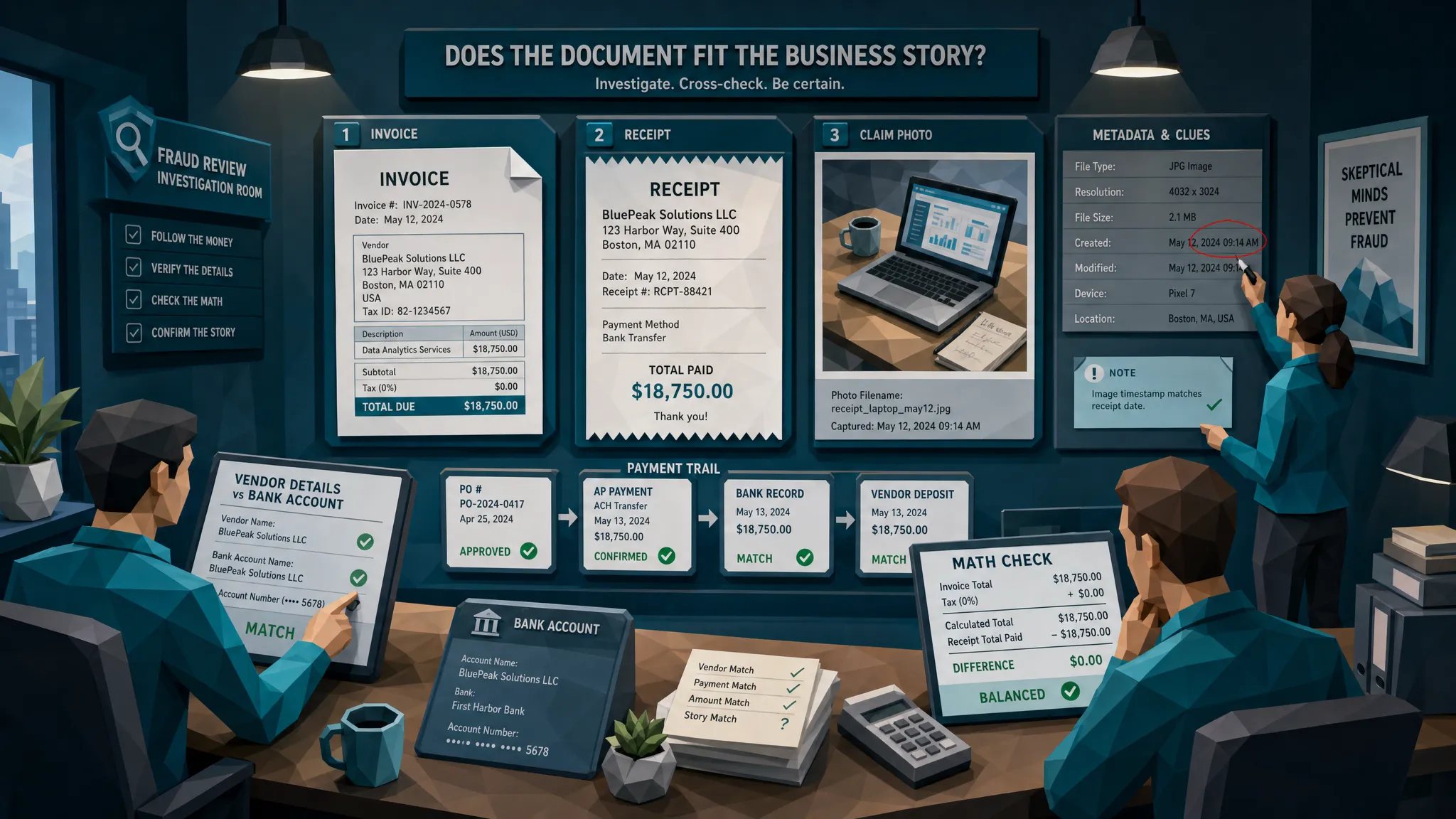

Ten years in fraud review has taught me a deeply unglamorous lesson: the fake that looks perfect is usually still held together with duct tape somewhere else.
The conversation around AI and fraud often starts with the scary part. A fake receipt can look crisp. A forged invoice can have the right logo, spacing, tax line, and polite little thank-you note at the bottom. A claims photo can look like it came from a normal phone camera. Fine. I agree. The surface has improved.
But review is not a beauty contest. Review is cross-examination.
When I look at an invoice, a receipt, or a claim document, I am not asking whether it looks nice. I am asking whether it belongs in the world. Did this vendor exist at that time? Does the math behave? Does the bank account make sense? Was the file edited in a suspicious way? Does the purchase fit the employee, the claim, the job site, the policy, or the approval trail?
My hot take: AI has made fraud prettier, but not necessarily smarter. It has lowered the cost of making a believable-looking document. It has not removed the need for a coherent story.
The fake document has improved. The surrounding evidence has not.
Fraud has always borrowed credibility from ordinary business paperwork. The invoice looks dull, therefore it feels safe. The receipt has a familiar font, therefore it feels routine. That is exactly why this category is so expensive.
The FBI notes that non-health insurance fraud alone costs more than $40 billion per year in the United States, raising premiums for the average family by hundreds of dollars annually. In payments, the Association for Financial Professionals has reported that a majority of organizations are targeted by payments fraud. And in occupational fraud, the ACFE Report to the Nations continues to show how long schemes can run before anyone catches them.
Now add cheap, fast document generation to that mess. A fraudster no longer needs to be a Photoshop hobbyist with too much free time. They can produce a good-looking draft in minutes, then tweak the vendor name, amount, date, and line items.
That sounds bad because it is bad. But here is where I get a little optimistic, which is rare for someone who has spent a decade staring at receipts. The fake still has to survive contact with payment data, business logic, file history, and real-world timing. That is where pretty fakes get sweaty.
Payment details are where the plot usually falls apart
If I could give one piece of advice to claims, AP, and expense teams, it would be this: stop treating the document as the whole story.
A clean invoice that says ABC Roofing is not very useful if the payment account belongs to a newly created LLC with no obvious relationship to ABC Roofing. A hotel receipt with a perfect logo does not help much if the card details, traveler name, and expense policy trail do not line up. A claim estimate that looks professionally formatted still has to match the claimant, the property, the date of loss, and the payment destination.
I once reviewed a supplier invoice that looked like it had been born in a compliance seminar. Perfect layout. Perfect logo placement. Perfect little payment terms box. The giveaway was not visual. The bank account had changed from the prior month, the contact email had a one-letter domain difference, and the invoice number sequence jumped like it had seen a ghost. The PDF was wearing a tuxedo. The payment trail was in flip-flops.
This is why document-only checks can be too shallow. A fraudster can make a receipt look real. It is much harder to make the receipt, claimant, vendor, math, metadata, payment account, and approval history all agree with one another.
At Docklands AI, this is a core point of view: document fraud detection gets stronger when the payment information around a claim, expense, or payable is part of the review. We want the boring context, because boring context is where fraud gets clumsy.
Math is still a brutal reviewer
AI-generated documents often look confident. Confidence is not arithmetic.
I still see invoices where the subtotal and tax do not add up, mileage claims that imply a sales rep drove like a Formula 1 driver between meetings, and receipts where the tip, total, and card charge are three separate works of fiction. The more the fraudster edits, copies, regenerates, or stitches together a document, the more chances they create for math to misbehave.
This is especially common in employee expenses and small vendor invoices. A person starts with a real receipt, changes the total, then forgets the tax. Or they create a fake repair invoice and use a tax rate that does not apply in that state. Or they duplicate an old receipt but adjust only the visible amount, leaving a hidden total or metadata clue behind.
The funny thing about math is that it has no sympathy for design. A beautiful receipt with a bad total is still a bad receipt.
If your review process only samples a few documents manually, these issues slip through because no one wants to recalculate every line. I get it. Nobody joined finance to become a human calculator with trust issues. But automated mathematical irregularity checks can flag the documents that deserve a closer look, especially when paired with payment and vendor context.
Metadata remembers what people forget
Metadata is the quiet witness in the room. It does not always prove fraud by itself, but it often tells you where to look next.
A receipt submitted as a screenshot may have passed through editing software. A PDF may show odd creation dates, missing camera data, inconsistent compression, or signs that objects were layered after the fact. A claim image may carry clues about whether it was captured naturally or processed in ways that deserve scrutiny.
Of course, metadata is not magic. Files get compressed by email systems, expense apps, scanners, and phones. A missing field is not an automatic guilty verdict. This is where experienced review matters. The question is not whether one signal looks odd. The question is whether several signals point in the same direction.
That is also why I am allergic to fraud systems that hand you a score and then wander off. A score can help prioritize work, but it cannot explain a denial, support an investigation, or help an adjuster have a defensible conversation. I have written before about why AI-powered fraud detection earns trust when the evidence is visible, and I stand by it. Give reviewers the reason, not just the red light.
The real world leaves crumbs
One of my favorite fraud checks is painfully simple: does the document match the world outside the document?
A real vendor usually leaves some trail. A contractor has licenses, reviews, old invoices, phone numbers, service areas, and customers. A medical provider has billing patterns and identifiers. A real estate-related charge, relocation reimbursement, or property service fee should connect to a business that makes sense in that region. For example, a legitimate brokerage such as NetRealtyNow's flat-fee MLS listing service clearly states where it operates and what it offers, while a fake vendor often has a name that exists only on a PDF and nowhere else useful.
The same logic applies to claims evidence. If a roof repair invoice is dated before the storm, we have a problem. If a restaurant receipt was supposedly created at 11:47 p.m. but the location closes at 9:00 p.m., we have a problem. If an employee submits a rideshare receipt in Chicago while their calendar and badge data show them in Dallas, we have a problem and probably an awkward meeting.
This is not glamorous work. It is not the stuff of crime dramas. But fraud review is often won by asking extremely boring questions with unreasonable persistence.

The best fakes still repeat old human mistakes
Here is the part that makes me slightly less worried about the future: fraudsters are still people. People rush. People reuse templates. People forget what they changed. People submit the same receipt twice and hope nobody notices. People create a fake vendor name that sounds professional but has the online footprint of a houseplant.
AI may improve the first draft, but many schemes still fail because the operator gets lazy. I have seen the same gas receipt submitted by two different employees, with the same timestamp and a different total. I have seen invoices from allegedly separate vendors that used the same formatting quirks, the same phone number style, and the same suspicious payment routing. I have seen receipts so unnaturally clean that they looked less like a photo and more like a stock image of financial regret.
This is why near-duplicate detection matters. Fraud is often repetitive because repetition is efficient. If someone finds a template that works once, they try it again. If a claimant learns that one kind of photo passes review, they reuse the trick. If a vendor fraud scheme gets paid through one entity, another entity appears with a similar invoice structure.
Our job is to make repetition risky.
For AP teams, this is especially important because fake invoice generators can create variety on the surface while keeping the same underlying mistakes. If that is your world, this related breakdown of what a fake invoice generator still cannot fake well goes deeper on the invoice-specific clues that survive cosmetic polish.
Why review teams should stop chasing the perfect detector
Another hot take: the goal is not to find one perfect fraud signal. The goal is to assemble enough evidence that the review decision becomes obvious, defensible, and fast.
A pixel-level tampering clue is useful. Metadata is useful. Math checks are useful. Payment mismatch is useful. Duplicate detection is useful. But each one has limits. The strength comes from combining them.
In insurance claims, that means looking at uploaded photos, estimates, receipts, policy context, and payment details together. In accounts payable, it means connecting the invoice image to vendor history, bank account changes, purchase order gaps, approval behavior, and duplicate patterns. In employee expenses, it means comparing the receipt to the trip, merchant, card charge, policy, and prior submissions.
This is where AI and fraud detection can actually help reviewers instead of replacing their judgment. The useful system does the tedious inspection at scale, then surfaces the suspicious details in plain language. It should show the reviewer why the document deserves attention. It should not ask the reviewer to worship a mysterious number.
A fraud manager once told me, after a very long meeting about risk scoring, that what she really wanted was a system that could say, in effect, this receipt is suspicious because the total was altered, the tax does not add up, and the same image appeared in another claim last month. That is not flashy. It is better than flashy. It is usable.
A practical review pattern for 2026
If you manage claims, expenses, payroll reimbursements, or payables, I would build review around a simple rhythm.
First, preserve original files whenever possible. Screenshots and forwarded PDFs strip away useful evidence. Make it easy for employees, claimants, vendors, and adjusters to upload originals.
Second, compare the document to the payment path. Who is being paid? Has the account changed? Does the payee match the vendor, claimant, employee, provider, or contractor? If payment details look odd, do not let a pretty PDF calm you down.
Third, check the internal logic. Totals, tax, dates, invoice sequences, mileage, policy limits, service descriptions, and duplicate submissions are still some of the most reliable fraud tells.
Fourth, make the review explainable. If a claim or payment is stopped, your team should be able to point to the evidence. A black-box score makes everyone nervous, including the honest people.
Finally, keep feedback moving. When reviewers confirm fraud, near fraud, or false alarms, feed that learning back into your process. Fraud changes quickly. Your controls should not age like unrefrigerated seafood.
Frequently Asked Questions
How does AI and fraud change invoice or receipt review? AI makes it easier to create convincing-looking invoices, receipts, and claim images. Review teams need to move beyond appearance and test the document against payment details, metadata, math, vendor identity, timing, and duplicate patterns.
Can a perfect-looking fake document still be detected? Yes. Many fake documents fail outside the visual layer. A receipt may look real but have impossible tax, suspicious editing history, a duplicate image, or payment details that do not match the claimed merchant or vendor.
Should fraud teams rely on risk scores? Risk scores are useful for prioritizing work, but they should not be the whole decision. Reviewers need clear evidence, such as what was altered, which details conflict, and how the document compares with prior submissions or payment history.
What are the strongest clues in AI-generated document fraud? The strongest clues usually come from combinations of signals. Payment mismatches, mathematical errors, metadata anomalies, duplicate submissions, vendor inconsistencies, and timing conflicts become much more powerful when they appear together.
Where does Docklands AI fit into this process? Docklands AI helps teams detect manipulated, photoshopped, and AI-generated invoices and receipts using document forensics, payment context, mathematical checks, and reporting workflows for claims, AP, and expense review.
Pretty is not proof
Fraudsters have better tools now. We should be honest about that. But better-looking fakes still have to survive better review.
The winning approach is not panic. It is disciplined evidence gathering. Look at the pixels, yes. Then look at the payment. Look at the math. Look at the metadata. Look at the vendor. Look at the timing. Pretty fakes fail when we stop admiring the document and start interrogating the story.
That is the kind of review I trust, and it is the kind of review fraudsters hate.
Request a Demo Today!
Book your demo below.