AI Image Fraud Gets Exposed by the Rest of the File
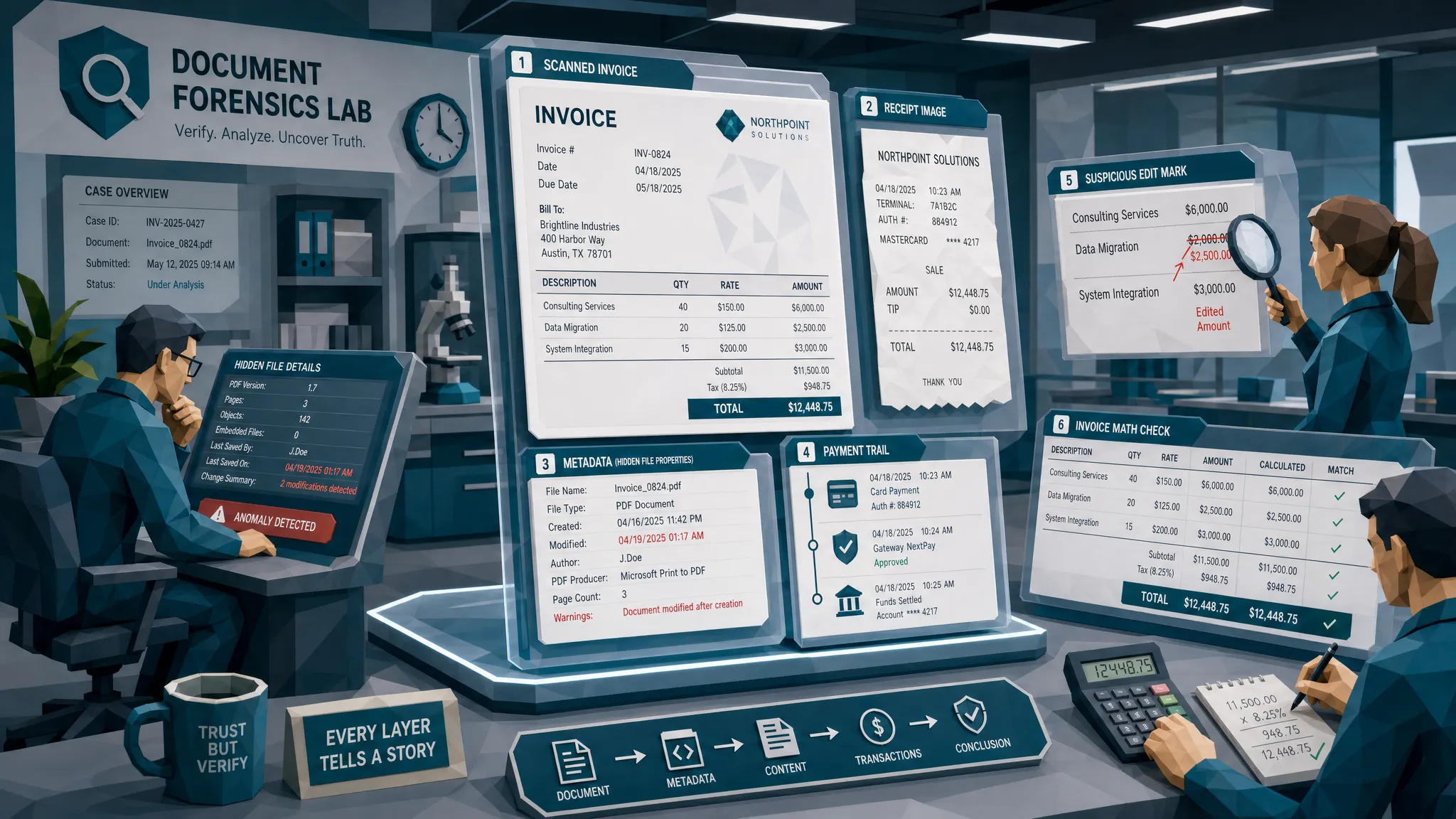

Here’s my slightly unpopular opinion after 10 years around fraud reviews: the fake photo is usually not the cleverest part of the fraud. It is the part everyone stares at, so it becomes the part fraudsters polish until it shines. The sloppy part is usually hiding in the rest of the file.
That is why AI image fraud is such an interesting problem. The image may look convincing. The roof damage may look real. The receipt may have the right logo, the right paper texture, even the right little coffee stain in the corner. But the file around it still has to tell the same story.
And files are terrible liars.
If you work in insurance claims, accounts payable, employee expenses, warranties, or health reimbursements, you already know this pattern. A document can pass the first human glance and still feel off. Maybe the total is too neat. Maybe the repair date is odd. Maybe the bank account was changed right before payment. Maybe the receipt is perfect in a way no airport receipt has ever been perfect in the history of airports.
The hot take: the best way to expose a fake image is often to stop looking only at the image.
The fake image is only the front door
When people say AI image fraud, they usually mean a generated or altered picture. A damaged bumper. A flooded kitchen. A medical invoice. A hotel receipt. A supplier invoice that looks like it came from a real vendor. But in real review work, that image is only the front door into the file.
Behind it, you have metadata, document history, payment details, invoice math, vendor records, submission timing, file format behavior, and the claimant or employee’s past pattern. That surrounding material is where many fakes start to wobble.
I once reviewed a batch of expense receipts where one receipt looked absolutely believable at first glance. Logo, tax line, merchant address, even the tiny thermal-printer blur. Lovely work, honestly. Then we noticed the receipt timestamp was after the merchant had closed, the card digits did not match the employee’s usual payment pattern, and the same terminal number appeared on three supposedly unrelated receipts from different cities. The image had done its homework. The file had not.
That is the lesson. Fraudsters optimize for what they think reviewers will inspect. If your process is mostly visual, they will make better visuals. If your process checks the whole file, they have a much harder exam.
Why the rest of the file talks
A digital file is not a flat piece of paper. It carries hints about how it was created, changed, compressed, exported, uploaded, and sometimes re-uploaded after someone panicked and tried again.
Metadata can show whether a file came from a phone camera, a scanner, a design tool, a PDF editor, or a screenshot. It can reveal creation and modification dates that disagree with the claimed event date. It may show software fingerprints that make no sense for a supposedly original receipt. None of these clues prove fraud by themselves, and I would never recommend treating them that way. But they are excellent reasons to ask the next question.
Then there is the structure of the document. Invoices and receipts have internal habits. Tax rates should calculate correctly. Line items should add up. Discounts should behave like actual discounts, not like someone typed a friendly number into a box. Invoice numbers should follow some kind of sequence. Vendor bank details should match historical records, unless there is a documented change. Dates should make sense in the life of the claim or purchase.
This is where AI image fraud often gets exposed. The picture may be persuasive, but the surrounding evidence has to agree in a dozen small ways. Fraudsters are good at making the thing look right. They are less good at making the whole story behave.
In insurance, the image must agree with the claim
Insurance is where the image problem gets especially spicy. Claims teams have always dealt with staged damage, exaggerated repairs, and recycled photos. Now they also have to deal with generated images and manipulated evidence that can be produced faster than a claims manager can say deductible.
The financial pressure is real. The FBI notes that non-health insurance fraud costs more than $40 billion a year in the United States, adding an estimated $400 to $700 annually to the average family’s premiums. And the tools available to fraudsters have improved quickly. BBC reporting on Admiral described a sharp rise in fraudulent claims involving AI-generated images and deepfakes, while Verisk’s 2025 fraud report found that many carriers see claims manipulation becoming more sophisticated.
But sophistication in the image does not guarantee sophistication in the claim.
A generated photo of roof damage still has to match the weather history, the property type, the repair timeline, the policy details, and the invoice that follows. A photoshopped motor claim still has to agree with the vehicle history, the repair estimate, the parts used, the garage payment details, and the claimant’s narrative. A warranty claim for a broken appliance still has to make sense against the serial number, purchase date, retailer receipt, and service record.
This is why I get nervous when claims teams treat image inspection as a standalone task. The adjuster can debate whether shadows look odd, but the payment destination either matches the approved vendor or it does not. The photo may be debatable. The file history is often less dramatic, and much more useful.
In AP and expenses, the money trail is where the fake sweats
Accounts payable teams have a different version of the same problem. A fake supplier invoice can look tidy, branded, and painfully normal. The fraudster may copy a real vendor’s format or use generated artwork that looks like a modern invoice template. At a glance, it is beige enough to be trusted, which is exactly the point.
The weakness is usually in the context. Did the bank account change? Did the invoice number duplicate a previous one with tiny differences? Does the supplier normally bill this entity, location, or cost center? Does the invoice reference a purchase order that exists? If there is no purchase order process, does the service history support the charge? Is the payment request arriving with unusual urgency?
Payments fraud remains a serious operational risk. The Association for Financial Professionals has consistently reported widespread exposure to payments fraud across organizations, and the FBI’s IC3 reports continue to show how costly business email compromise can be for finance teams. Fake invoices do not need to fool everyone. They only need to slip through once at the wrong moment.
Employee expenses are messier because the amounts are smaller and the volume is higher. That is fertile ground for receipt manipulation. One doctored dinner receipt is not the end of civilization, but a repeated pattern across a large sales team, consulting bench, or field workforce becomes real money. ACFE’s Report to the Nations is a useful reminder that occupational fraud often hides for months before anyone sees the full pattern.
This is also where I see a lot of misplaced confidence. A manager approves a receipt because it looks like a receipt. But receipts are not rare artifacts. They are templates with totals. If someone can generate or edit the image, the real test becomes whether the receipt agrees with the merchant, card data, travel schedule, policy limits, and prior submissions.
For a deeper dive on this AP angle, we have covered supplier invoice fraud involving duplicate, altered, and AI-generated invoices in more detail. The short version is simple: supplier fraud rarely lives in one field. It spreads across the document, the vendor record, and the payment instruction.

The clues I trust more than a perfect-looking image
I do not trust any single clue on its own. That includes metadata, image artifacts, risk scores, and gut instinct. Especially gut instinct, which is sometimes just coffee wearing a detective hat.
What I do trust is agreement across independent signals. If the image looks altered and the metadata is odd, that is interesting. If the invoice math is wrong and the payment account changed, that is more interesting. If a receipt looks generated, the merchant time is impossible, and a near-duplicate appears in another employee’s report, now we have a review worth escalating.
The strongest signs usually come from places the fraudster did not think to edit. Payment details are a favorite. A fake invoice may copy the vendor’s branding but route funds to a new account. A claim document may show a real repairer’s name but include payment details that have no relationship to that repairer. An expense receipt may show a familiar merchant but fail to match the employee’s location or card trail.
Math is another wonderfully boring witness. Real invoices can have mistakes, of course. I have seen legitimate invoices with tax errors, rounding differences, and line-item weirdness that would make an accountant stare into the middle distance. But when mathematical irregularities cluster with file manipulation clues, they become hard to ignore.
File history matters too. If a document supposedly came straight from a merchant but shows signs of editing, exporting, recompressing, or conversion through design software, that does not automatically mean fraud. It may mean a user resized a file, merged documents, or saved it badly. But in a high-risk claim or payment, it deserves attention.
This is why I like evidence-led review. A good fraud process should show reviewers why something is suspicious, not just bark a score and walk away. We have written before about why fraud detection with AI works best when evidence leads, and that principle is even more important as fake images improve.
Pure image checks are becoming a comfort blanket
I know that sounds harsh, but I mean it kindly. Pure image checks can help. Pixel-level analysis can reveal tampering, inconsistent compression, cloning, suspicious edges, unusual lighting, or generated artifacts. Those are valuable signals.
The problem is when teams stop there.
A clean image does not mean a clean claim. A suspicious image does not always mean fraud. Screenshots strip useful metadata. Messaging apps compress files. Some legitimate documents get passed through PDF tools before upload because real life is chaotic and people are not preserving evidence like museum curators.
That is where a lot of fraud detection programs stumble. They overtrust one type of signal, then create false positives that annoy honest customers, vendors, and employees. Or worse, they miss fraud because the manipulated image is good enough to pass a visual scan.
If you want my blunt view, fraud review should work more like a case file than a beauty contest. The question is not whether the image is pretty. The question is whether the evidence agrees.
I am also wary of any system that produces a mysterious risk score without showing its working. Claims managers and AP leaders need something they can act on, defend, and explain. A reviewer should be able to say, this was escalated because the file metadata, payment details, invoice arithmetic, and submission history conflict. That is much stronger than saying, the software had a bad feeling.
For the same reason, it is worth understanding where fraud detection artificial intelligence falls short. The goal is not to worship automation. The goal is to catch more fraud with clearer evidence and fewer pointless escalations.
How to build a review process that looks beyond the pixels
The first practical step is to preserve original files whenever possible. If your process encourages screenshots, forwarded images, or compressed uploads, you may be throwing away useful evidence before review even starts. Original files carry more context. They may not tell the whole truth, but they usually tell more truth than a flattened screenshot in a shared inbox.
Second, connect document review to payment context. In claims, that means looking at who gets paid, how payment details were supplied, whether the payee matches the claimed service, and whether the history supports the request. In AP, it means tying invoices to vendor master data, prior payments, purchase records, and bank account changes. In expenses, it means comparing receipts to policy, card feeds, travel records, and duplicate patterns.
Third, treat anomalies as leads, not verdicts. This matters culturally. If reviewers believe every metadata mismatch is fraud, they will burn trust quickly. If they ignore those mismatches, they will miss avoidable losses. The right posture is professional suspicion, not courtroom drama.
Finally, make the review explainable. When you escalate a suspicious claim or invoice, show the evidence chain. A claims adjuster should understand why the roof image, repair invoice, and payment data do not line up. An AP manager should understand why the invoice looks plausible but the vendor and payment context do not. An expense manager should understand why a receipt is inconsistent with the employee’s journey.
That is how you turn AI image fraud from a scary headline into a manageable review problem.
Where Docklands AI fits
At Docklands AI, we focus on invoices, receipts, and claim documents where manipulated, photoshopped, and AI-generated evidence can create real financial loss. The key is not treating the uploaded image as the whole case.
Docklands combines document and image forensics with checks across metadata, mathematical irregularities, physical manipulation signs, and payment information. That payment context matters because fraud often lives where the document meets the money. A fake invoice may look convincing, but if the payee details, totals, timing, or file history disagree, the review team needs to know before the payment goes out.
For insurance teams, that can mean catching suspicious claim evidence before settlement. For AP teams, it can mean spotting altered or generated invoices before funds move. For expense teams, it can mean identifying manipulated receipts before bad behavior becomes a pattern.
The point is not to slow honest people down. The point is to stop making honest reviewers fight polished fakes with tired eyes and a zoom button.
Frequently Asked Questions
What is AI image fraud? AI image fraud is the use of generated or digitally altered images to support a false claim, invoice, receipt, or expense. In practice, it often appears as fake damage photos, manipulated repair invoices, fabricated receipts, or altered supporting evidence.
Can metadata alone prove a document is fraudulent? No. Metadata is a signal, not a verdict. A file may have unusual metadata because it was compressed, converted, or merged for legitimate reasons. The strongest fraud reviews combine metadata with payment details, math checks, visual forensics, and submission history.
Why do fake images get exposed by the rest of the file? Fraudsters often focus on making the image look convincing, but they may overlook timestamps, invoice totals, vendor details, bank accounts, duplicate submissions, or policy context. Those surrounding signals can contradict the image.
Should claims and finance teams still use image analysis? Yes, but image analysis should not work alone. Pixel-level tampering checks are useful, especially when combined with file metadata, document consistency checks, and payment context.
How can teams reduce false positives when reviewing suspected AI image fraud? Teams should avoid relying on one clue. A suspicious image should be reviewed alongside the original file, payment data, claim or invoice history, and business context. Clear evidence chains reduce unnecessary escalations and make decisions easier to defend.
Let the whole file testify
If your team is still reviewing uploaded images in isolation, fraudsters have a comfortable job. They only need to fool the eye. Once you review the image, metadata, math, payment details, and history together, the work gets much harder for them.
Docklands AI helps teams detect manipulated and AI-generated invoices, receipts, and claim documents before they become losses. If you want to see what the rest of the file is saying, start with Docklands AI and put the evidence back at the center of review.
Request a Demo Today!
Book your demo below.