Fraud Detection Using AI Should Start With Originals
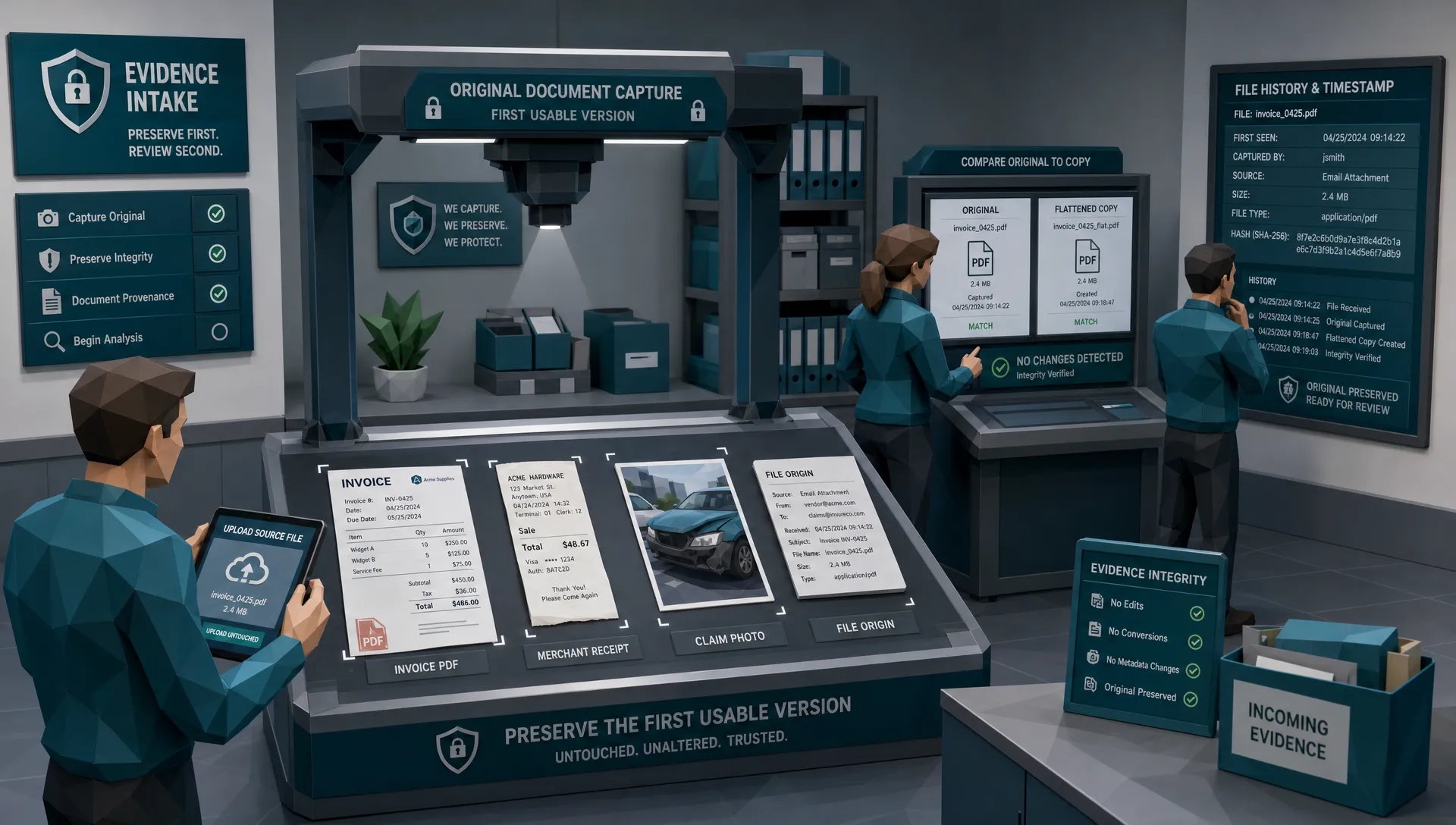

Here is my mildly unpopular view: the biggest miss in fraud detection using AI is not the software. It is the evidence we feed it.
I have seen smart claims teams, careful AP teams, and experienced expense reviewers make the same mistake. They ask a tool to judge a screenshot, a flattened PDF, or a photo of a printout, then act surprised when the answer feels mushy. That is like asking a mechanic to diagnose a car after someone has removed the engine, washed the parts, and sent over a postcard.
Screenshots are the laundromat of document fraud. They make things look tidy while washing away the grime we actually needed.
If we want better fraud decisions, especially on invoices, receipts, repair estimates, and claim documents, we need to start with originals. Not because originals are magical. They are not. But they preserve the tiny, boring clues that often separate a genuine document from a convincing fake.
What do I mean by “original”?
An original is the earliest usable version of the evidence you can get your hands on. In an insurance claim, that might be the first photo taken at the loss site, the invoice PDF sent by a contractor, or the receipt exported from a vendor system. In accounts payable, it might be the invoice attachment as received from the supplier, before someone printed it, scanned it, renamed it, and dragged it through six shared folders. In employee expenses, it might be the receipt image from the merchant app, not a screenshot of the image sitting in a phone gallery.
The original does not always mean “perfect.” Real files are messy. They have compression, odd margins, weird scanner artifacts, and sometimes no useful metadata at all. That is normal. In fact, perfection is often more suspicious than mess.
What matters is that the original gives us more to test. A screenshot gives us the visible surface. An original can also preserve file history, compression patterns, editing traces, creation timestamps, embedded objects, camera behavior, and sometimes the dull but useful metadata that fraud reviewers quietly love.
If you have ever watched a claims adjuster zoom into a receipt photo until the pixels look like Minecraft, you know the feeling. We are not trying to be dramatic. We are trying to see whether the paper, the numbers, the file, and the story all agree.
Why this matters more in 2026
A decade ago, the fake receipt in an expense report usually had the charm of a school project. Wrong font, crooked totals, a restaurant address that led to a parking lot. I once reviewed a fuel receipt where the tax calculation was off by exactly one dollar on every line, which was considerate of the fraudster because it saved us time.
Today, fakes look better. Generative tools have lowered the effort required to create a polished invoice, a plausible receipt, or a convincing claim image. The economics have changed. The scary part is not that every fraudster is suddenly a genius. The scary part is that a mediocre fraudster can now produce ten cleaner fakes before lunch.
The broader fraud environment is already expensive enough. The FBI’s insurance fraud guidance says non-health insurance fraud costs more than $40 billion per year in the United States and can add hundreds of dollars to the average family’s premiums. On the payments side, AFP’s payments fraud research continues to show how persistent fraud attempts are for finance teams.
And claims manipulation is getting weirder. The BBC reported that insurer Admiral saw a sharp rise in fraudulent claims, with AI-generated images and deepfakes among the drivers. I do not bring that up to scare anyone into buying shiny tools. I bring it up because the first defense against synthetic evidence is not panic. It is disciplined evidence handling.
Fraud detection using AI should not begin with “What score did we get?” It should begin with “Did we preserve the file well enough for the score to mean anything?”
The clues originals can still reveal
When a real invoice, receipt, or claim document is available, the review becomes less about vibes and more about evidence. That is where the work gets interesting.
The pixels have a memory
Edited documents often leave visual oddities behind. A date pasted from somewhere else may have a different blur pattern than the rest of the receipt. A total may sit slightly too high on the baseline. A repair line item may look sharp while the surrounding text is soft. A logo may be clean in a way that the rest of the scan is not.
None of these clues proves fraud by itself. I have seen legitimate invoices that looked like they were assembled during a thunderstorm. But when pixel-level inconsistencies line up with other issues, such as a new payment account or a mismatched vendor name, they become much more useful.
Metadata can support or challenge the story
Metadata is not a truth serum. Let’s get that out of the way. Some systems strip it. Some scanners overwrite it. Some phone apps remove it for privacy. Absence of metadata is not a confession.
But when metadata exists, it can be helpful. A claim photo supposedly taken at a property on Monday might have file data suggesting it was created from an edited export on Thursday. An invoice may show signs of being generated by a design tool rather than an accounting platform. A receipt image might have a history that does not fit the employee’s explanation.
Good review treats metadata like a witness, not a judge. It can be credible, confused, incomplete, or irrelevant depending on context.
Math is still gloriously unforgiving
Fraudsters can make a document look polished and still get the arithmetic wrong. Tax rates, subtotals, discounts, hourly rates, quantities, and invoice sequencing are boring, which is exactly why they catch people.
In AP, a manipulated invoice may have a believable total but line items that do not foot. In insurance, a repair estimate may include quantities that do not match the photographed damage. In expenses, a meal receipt may show a tip percentage that makes no sense for the final amount. AI can help check these patterns quickly, but again, it works better when it has the original document rather than a blurred copy pasted into a case note.
Payment context often tells the louder story
This is the part many “is this image real?” checks miss. A document can look fine while the payment information smells like week-old fish.
A vendor name, bank account, routing detail, beneficiary, address, invoice sequence, claim number, and prior payment history all matter. When the document evidence and the payment evidence disagree, I pay attention. A beautiful invoice tied to a suspicious payment destination is not beautiful anymore. It is well dressed.
That is why I like evidence-led fraud detection more than score-led review. A score can triage. Evidence can explain.
The first-touch rule: collect originals before the case gets messy
Fraud teams often ask for originals too late. By then the claimant, employee, vendor, broker, branch manager, or field adjuster has already converted the file into something more convenient and less useful.
Convenience is the enemy here. Not because people are careless, although some are. It is because every system wants to “help.” Email clients compress. portals resize. phones save screenshots. collaboration tools preview documents. AP workflows turn attachments into flattened PDFs. Expense apps crop receipt images until the merchant name is hanging on for dear life.
The better habit is simple: ask for original files at the front door, as a normal business requirement, not as an accusation. “Please upload the original receipt or invoice file where available” sounds a lot calmer than “We think your receipt is fake, please explain yourself.”
Here is a simple property claim example. A water-damage claim may include photos, drying logs, mold remediation paperwork, and an invoice from a licensed contractor such as Banner Environmental Services. The vendor name alone does not prove anything either way. What helps is the original packet: the invoice file, the payment instructions, the timestamps, the claim photos, and the sequence of documents. If the only thing preserved is a screenshot of a PDF preview, the reviewer loses useful context before the review even starts.
I have watched this happen in AP as well. One finance team I worked with had a suspicious invoice, but the original attachment was gone. The only surviving copy was a JPEG someone had pasted into a chat thread. By the time we saw it, all we could confidently conclude was that the document had once existed near a phone camera and that someone’s thumb had enjoyed a cameo.

A practical intake policy that does not annoy everyone
I know what some readers are thinking: “Great, now fraud wants to slow down every claim and every payment.” Fair complaint. Nobody wants a process so pure that the business stops breathing.
The trick is to make original collection standard and quiet. Do it at intake, then escalate only when the evidence or payment context justifies it.
For insurance claims, that means asking for original photos and original invoices where possible, especially on high-value repairs, supplemental estimates, warranty claims, medical bills, and property losses with third-party vendors. If the claimant only has a screenshot, accept it, but label it for what it is: lower-quality evidence.
For accounts payable, preserve the supplier’s original invoice attachment before OCR, routing, approval stamping, or file conversion. If your process requires a working copy, fine. Use one. Just keep the untouched original alongside it. This matters most in non-PO environments, construction, multi-site businesses, care groups, clinics, and fast-growing companies where vendor controls are still catching up with the pace of spend.
For employee expenses, set expectations clearly. A receipt screenshot may be acceptable for low-risk items, but higher-risk submissions should require the original receipt image or merchant-issued PDF where available. I would rather explain that policy once than spend six months chasing duplicate hotel receipts across a sales team.
The policy should also separate the original from the review artifacts. OCR text, case notes, annotated PDFs, and investigator comments are useful, but they are derivatives. Keep them. Just do not confuse them with the evidence.
What good AI should do with originals
When I evaluate fraud detection using AI, I want to know how it handles the real file, not just how confidently it labels it. Confidence is cheap. Explanation is harder.
A good system should inspect the document itself, including signs of tampering, AI generation, physical manipulation, metadata issues, and mathematical irregularities. It should also compare the document against the payment context, because many bad submissions fail outside the pixels. A fake invoice may look credible until the bank account, vendor history, or claim timeline enters the room.
The output should be usable by a reviewer. “High risk” is not enough. Tell me why. Show me the suspicious total. Show me the edited region. Show me the metadata conflict. Show me the payment mismatch. If the tool cannot explain the evidence, the fraud team still has to do the real work by hand.
This is also where false positives get reduced. Plenty of genuine documents are ugly. A wrinkled receipt, a badly scanned invoice, or a contractor’s PDF exported from ancient software can look suspicious to a shallow check. Originals help reviewers distinguish messy-but-real from clean-but-wrong.
And yes, AI has limits. I have written before about where fraud detection artificial intelligence falls short, and I still believe the biggest danger is overtrusting a neat score. The better approach is boring and effective: preserve the best evidence, compare multiple signals, and make decisions a human can defend.
Originals also protect honest customers and employees
This part gets missed. Better evidence collection is not only about catching bad actors. It also protects legitimate people from being dragged into unnecessary reviews.
If a genuine claimant submits a real repair invoice, the original file may help clear concerns quickly. If an employee’s receipt looks odd because the merchant app exports strange PDFs, preserving the original can prevent a silly escalation. If a supplier’s invoice template is ugly but consistent across years of payments, the original plus vendor history can save everyone a headache.
Fraud controls work best when honest people move through quickly and suspicious cases get the right scrutiny. Starting with originals helps both sides.
My hot take: originals are the cheapest fraud upgrade most teams have not made
Everyone wants the dramatic fraud solution. The dashboard. The alert. The futuristic demo where a fake invoice bursts into flames. I like a good demo as much as anyone, but the operational win is usually less glamorous.
Ask for originals. Preserve them. Keep derived copies separate. Compare the document to the payment context. Make the AI show its work.
That will not catch every fraud. Nothing will. But it will make your fraud detection program more defensible, more accurate, and less dependent on guesswork. In a world where fake documents are getting prettier, the original file is still one of the best places to find the ugly truth.
Frequently Asked Questions
What counts as an original invoice or receipt? An original is the earliest available file from the source, such as the supplier’s PDF invoice, the merchant-issued receipt, or the first photo taken for a claim. A screenshot, printout, scan of a printout, or forwarded image may still be useful, but it usually contains fewer forensic clues.
Should we reject screenshots completely? Not always. For low-value, low-risk transactions, screenshots may be acceptable under your policy. For high-value claims, unusual vendors, changed payment details, duplicate submissions, or suspicious expenses, you should request the original file where available.
Can AI detect fraud from a copy? Sometimes, yes. A copy can still reveal visual tampering, math errors, duplicate patterns, or suspicious payment details. But copies often remove metadata and file-history clues, so the review may be less reliable.
Is missing metadata proof of fraud? No. Many legitimate systems strip metadata for privacy, security, or file-size reasons. Missing metadata should be treated as one signal among many, not as proof on its own.
Why does payment information matter in document fraud detection? Because a fake or manipulated document often breaks when compared with the payment story. Vendor identity, bank details, invoice history, claimant behavior, and prior payments can reveal inconsistencies that the document image alone may not show.
Start with the evidence before the score
If your claims, AP, or expense workflow is asking AI to judge flattened files and screenshots, you are leaving good evidence on the floor.
Docklands AI helps teams examine invoices, receipts, and claim documents for manipulation, AI-generated content, metadata issues, mathematical irregularities, physical tampering, and payment-context red flags. Start with originals, then let the evidence lead the review.
Request a Demo Today!
Book your demo below.