Gen AI Claims Fraud Loves Clean Documents and Bad Stories
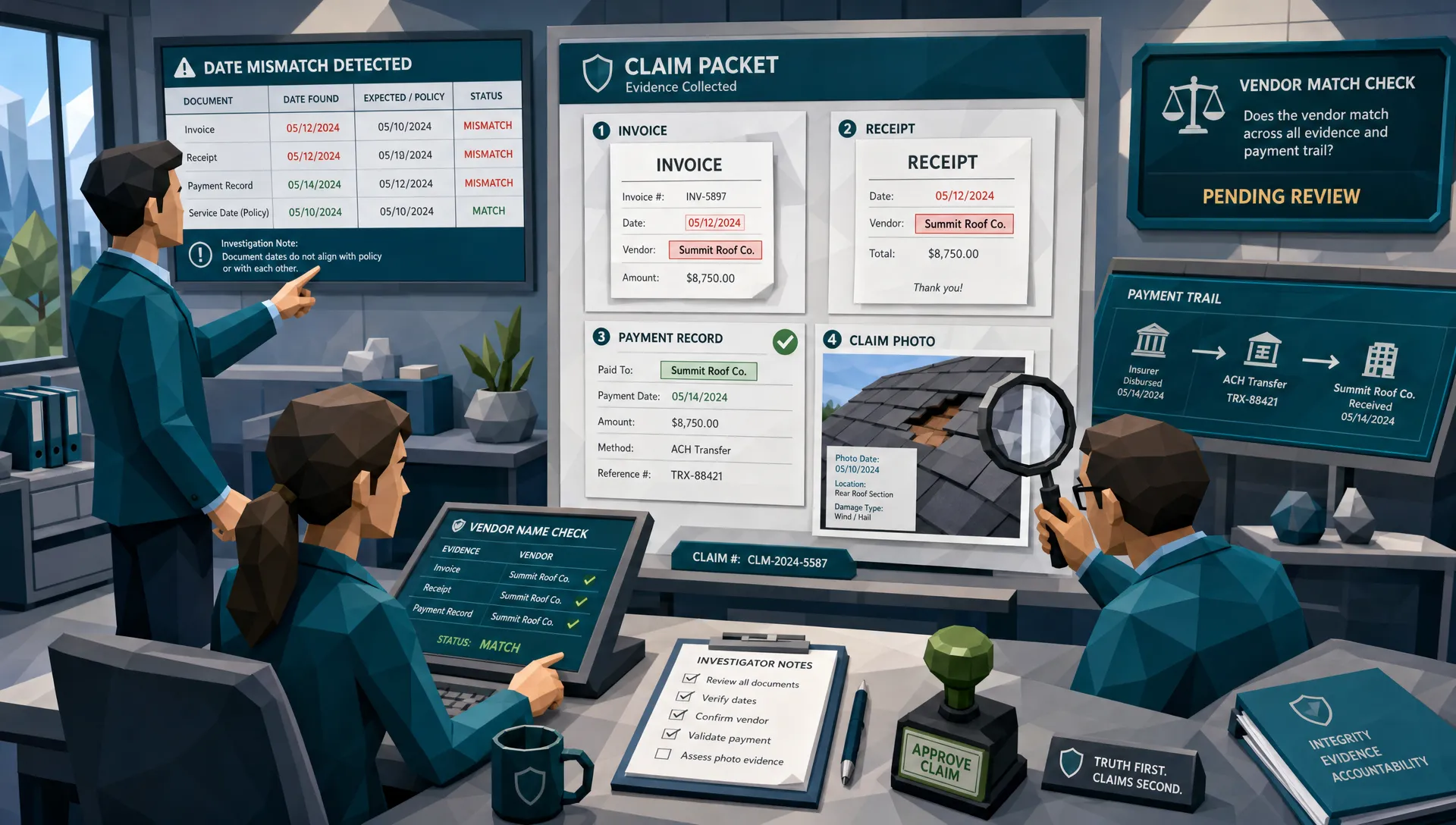

Gen AI claims fraud has a funny habit. It walks into the room wearing a freshly pressed suit, then tells a story that does not survive the first follow-up question.
I have spent enough time around claims, expenses, invoices, and receipts to develop one deeply unfashionable opinion: the cleaner the document, the less impressed I am. Not because clean documents are bad. Plenty of legitimate suppliers, repair shops, clinics, and policyholders produce neat paperwork. But in 2026, clean is cheap. A fraudster no longer needs Photoshop skills, a scanner, or a cousin who “knows design.” They need a prompt, a template, and enough confidence to hope your team is too busy to ask why the dates, payments, and story do not line up.
That is the real lesson for claims teams. Gen AI claims fraud often wins the beauty contest and loses the cross-examination.
My hot take: the document is no longer the main event
For years, fraud training taught people to look for messy edits: crooked logos, mismatched fonts, weird shadows, and totals that looked like they had been pasted in during a lunch break. Those clues still matter. I love a suspicious pixel as much as the next fraud person. But the game has shifted.
The most convincing fake claim documents now arrive looking calm, centered, branded, and boring. They look like they passed through a design department. That polish lowers the reviewer’s guard, especially in high-volume claims queues where the goal is to move quickly and avoid annoying honest customers.
Here is a composite example I use when training newer reviewers. A homeowner submits a water damage claim with a plumber invoice, photos of a soaked cabinet, and a card receipt. The invoice looks immaculate. The receipt looks fresh. The photo has good lighting. Nothing screams fake.
Then we ask boring questions. Why was the invoice issued three hours before the reported incident? Why does the plumber’s payment reference resolve to a different trading name? Why does the photo metadata suggest the image was created after the receipt? Why does the invoice number sit inside a sequence we have already seen on two unrelated claims?
That is not a document problem. That is a story problem.
Why clean documents work so well on busy claims teams
Fraudsters understand something uncomfortable about operations: people trust tidy paperwork. We all do. Clean documents feel competent. Messy ones feel suspicious, even when the messy one is real.
Good presentation is normal in legitimate business. A salon, contractor, or solo professional might have a polished booking flow and branded receipts because they invested in a proper site from someone like Raine Archer, who builds warm, conversion-focused websites for small businesses. The point is not that polish is suspicious. The point is that polish is no longer proof.
This matters because claims teams are under pressure from every side. Customers want speed. Regulators expect fairness. Executives want leakage reduced without turning the claims process into airport security. Meanwhile, fraud tools that only ask “does this image look real?” can be too narrow for the problem now sitting in the queue.
The costs are not theoretical. The FBI has warned that insurance fraud costs billions and adds hundreds of dollars to the average family’s annual premiums. In the UK, BBC reporting on Admiral described a sharp rise in fraudulent claims linked to AI-generated fake images and deepfakes. Verisk’s 2025 work on fraud attitudes also found that younger consumers were more willing than older groups to consider using AI to alter claim evidence, according to its 2025 Fraud Report.
If you manage P&C claims, warranty claims, health claims, or any workflow that depends on submitted evidence, this is the awkward takeaway: your fraud controls may be calibrated for yesterday’s ugly fake.
Gen AI claims fraud fails when the story gets tested
The clean document is the front door. The story is the whole house. If the house is built badly, you can usually hear the floorboards creak.
A fake invoice might show a repair date that falls before the reported loss. A receipt might list a card payment, but the payment reference or merchant category does not fit the vendor. A medical bill might have the right patient name but a provider address that does not match the clinic’s actual billing setup. A warranty claim might include a photo of a damaged appliance, but the EXIF data, lighting, and submission history suggest the image was recycled or generated.
I once reviewed an expense case where the receipt looked beautiful, almost too beautiful. The logo was crisp, the tax math worked, and the restaurant name existed. The problem was that the employee claimed dinner in Chicago while their corporate card was used in Denver an hour later. Unless they had borrowed a fighter jet, something was off.
That is why I like story-first fraud review. We should still inspect the document, but we should not stop there. A claim is a chain of assertions: who did what, when, where, for how much, and how they were paid. Gen AI can help make one link shiny. It struggles when every link has to carry weight.
We wrote about this in more detail in our piece on how insurance claims AI fraud still leaves paper trails, and I keep coming back to the same point: the surrounding evidence often tells on the fake.
The strongest signals are usually boring
Fraud teams sometimes chase exotic clues because exotic clues feel clever. I get it. There is a certain drama in spotting a synthetic image or a manipulated PDF layer. But the dull signals are often where the money is.
Payment details are one of my favorites. Who was paid? Does the beneficiary match the supplier? Has the same account appeared across unrelated claims? Does the routing, merchant name, or payment reference fit the document? Fraudsters can create a clean invoice in seconds. Building a believable payment trail across systems is harder.
Math is another quiet witness. Totals may add up, but line-item logic often does not. Labor hours may exceed the service window. Tax may be applied where it should not be. Discounts may appear after the total. In health claims, procedure combinations can make little sense. In property claims, parts and labor can tell different stories about the same repair.
Then there is time. Timelines are wonderfully unforgiving. A claim submitted too quickly, a quote issued before the incident, a receipt generated after reimbursement, a photo created after the alleged inspection, these are not glamorous findings. They are better than glamorous. They are explainable.

Why “real or fake image” checks are not enough
A lot of teams still think of gen AI claims fraud as an image problem. I understand why. Fake crash photos, fabricated property damage, staged medical evidence, and synthetic repair images are visually striking. They make good conference slides.
But the operational question is broader. Even if an image looks real, does it belong to this claim? Even if a receipt has no obvious visual tampering, does it match the payment trail? Even if an invoice passes a layout check, does the vendor behavior make sense?
This is where I see many fraud programs stumble. They buy or build a model that produces a risk score, then treat the score like a verdict. A score can help prioritize work. It cannot replace evidence. If an adjuster, claim manager, or SIU investigator cannot explain why a claim was escalated, you have a governance problem waiting to happen.
That is why I prefer evidence-led review. In our article on why evidence-led fraud detection works better, we make the case that the best systems surface the clues behind the concern. The reviewer should see the suspicious metadata, manipulated regions, odd payment details, inconsistent totals, or timeline gaps. Otherwise, you are asking people to trust a black box with someone else’s money and someone else’s customer relationship. That rarely ends well.
What I would change in claims review tomorrow
If I were dropped into a claims operation tomorrow, I would not start by telling everyone to become a digital forensics expert. That is a nice way to get ignored before lunch.
I would start with intake hygiene. Preserve original files where possible. Screenshots and forwarded images strip away useful context. Ask for documents through controlled channels, not endless email chains. Keep the first version of every submitted file, because “updated” documents have a funny way of becoming cleaner after questions are asked.
Next, I would connect document review to payment review. This is where too many workflows split the baby. One person checks the invoice. Another team handles payment. A third team looks at the claim narrative. Fraud loves that separation. A manipulated receipt is more meaningful when the payment information does not support it. A suspicious invoice is more actionable when the supplier, bank details, and claim history all point in the same direction.
Then I would train reviewers to ask one simple question: what would have to be true for this claim to be legitimate? If the answer requires three coincidences, a time machine, and a plumber who invoices before emergencies happen, escalate it.
Finally, I would measure false positives with the same seriousness as fraud catches. Honest customers should not get dragged into a paperwork swamp because a system dislikes a font. A good fraud process protects the business and the customer experience. That balance matters, especially in insurance, where trust is the product long before a claim is filed.
Where Docklands AI fits into this problem
At Docklands AI, we focus on the evidence inside and around invoices, receipts, and claim documents. That includes signs of AI-generated documents, Photoshop or tampering, metadata issues, mathematical irregularities, and physical manipulation. We also care about payment information because it gives the document a reality check.
That last part is important. A fake can look fine in isolation. Once you compare it with payment details, claim timing, vendor behavior, and the broader case context, it has to work much harder. Most fraud does not enjoy hard work.
For claims teams, the goal is not to accuse more people. The goal is to stop paying the claims where the evidence does not hold together, while moving legitimate claims faster. If your current process treats a clean invoice or receipt as a comfort signal, gen AI claims fraud will happily exploit that habit.
Frequently Asked Questions
What is gen AI claims fraud? Gen AI claims fraud involves using generative AI tools to create, alter, or improve claim evidence, such as invoices, receipts, photos, repair estimates, medical documents, or supporting images. The documents may look convincing, but the surrounding story often contains inconsistencies.
Why do clean claim documents deserve extra scrutiny? Clean documents are easier to produce than ever. A polished invoice or receipt may be legitimate, but appearance alone no longer proves authenticity. Claims teams should compare the document against dates, payment details, vendor records, metadata, and the claim narrative.
What clues often expose AI-generated or manipulated claim evidence? Common clues include mismatched timelines, unusual metadata, payment details that do not match the vendor, repeated invoice patterns, suspicious image history, odd tax or total calculations, and documents that appear too polished for the described situation.
Should claims teams rely on risk scores? Risk scores can help prioritize review, but they should not be treated as final decisions. Reviewers need clear evidence they can understand, explain, and defend, especially when a claim is delayed, escalated, or denied.
How can insurers reduce false positives while catching more fraud? The best approach is to combine document forensics with claim context. Reviewing pixels, metadata, math, payment information, and story consistency together helps teams avoid overreacting to harmless quirks while identifying stronger fraud patterns.
Stop letting clean fakes tell bad stories
Gen AI claims fraud is not going away, and it will not politely announce itself with crooked logos and obvious edits. The next wave of fraud will often look tidy. It will sound confident. It will arrive with documents that make a busy reviewer want to move on.
That is exactly why the story matters.
If your team reviews invoices, receipts, claim photos, or payment documents, Docklands AI can help surface the forensic and payment-level evidence that clean documents try to hide. The prettiest fake in the queue should still have to explain itself.
Request a Demo Today!
Book your demo below.