Health Insurance Fraud Clues Hidden in Submitted Bills
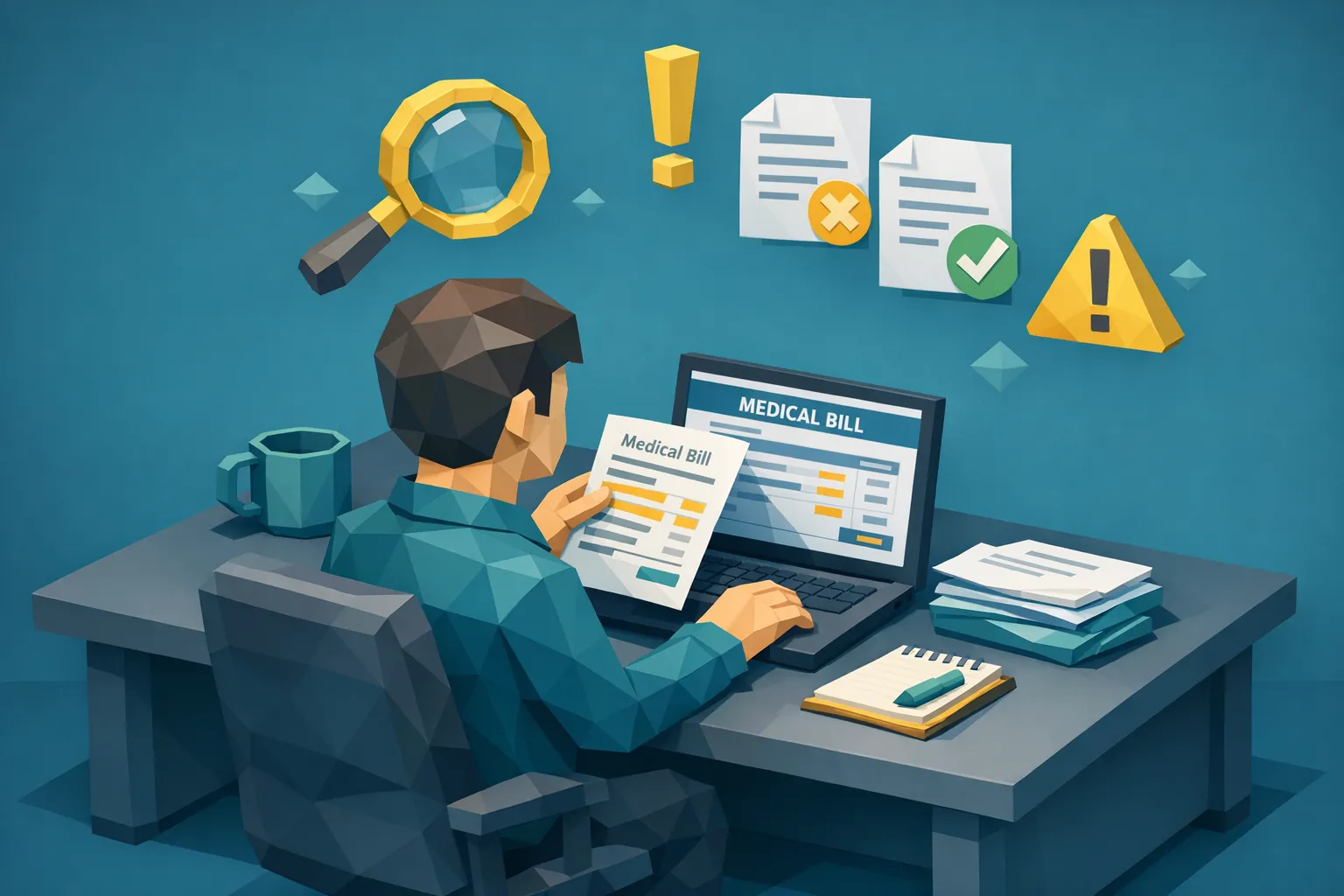

Submitted medical bills often look routine: a provider header, a table of line items, a balance due, and a “please remit” section. That familiarity is exactly why they are effective vehicles for health insurance fraud. The manipulation is rarely obvious at a glance. It hides in small inconsistencies that slip past OCR, rules-based checks, and busy claim queues.
For claim managers, adjusters, and SIU teams, the goal is not to become a forensic analyst. The goal is to know where the highest-signal clues live inside a submitted bill, and how to operationalize those clues into fast triage.
Why bills are a high-yield surface for health insurance fraud
Health insurance workflows sit at the intersection of structured data (member info, codes, dates) and unstructured evidence (PDFs, scans, photos, emailed attachments). Fraudsters take advantage of that gap.
Common reasons submitted bills are vulnerable:
- Low provenance: a bill can arrive via portal upload, email, fax, or a photo from a phone. Each channel strips context differently.
- Easy edits: amounts, dates, and patient details are simple to alter with basic tools, and even easier with generative AI.
- Legitimate-looking templates: real provider formats are easy to copy, especially when old statements and sample PDFs circulate.
- High reviewer load: even strong teams end up sampling instead of screening every document.
Insurers widely cite meaningful fraud rates across lines. Many estimates put overall insurance claims fraud in the 8% to 12% range, translating to hundreds of billions in losses globally. In health specifically, the documents are plentiful, standardized enough to fake, and time-sensitive enough to pressure approvals.
Health insurance fraud clues hidden in submitted bills (and how to read them)
The most reliable signals tend to fall into three buckets:
- Document integrity clues (what the file and pixels reveal)
- Arithmetic and consistency clues (what the numbers reveal)
- Context clues (what payment, provider, and timing reveal)
Below are the most common high-signal indicators to look for during intake and review.
1) Provider identity details that do not “line up”
Fraudulent bills often reuse a real clinic name while altering contact or remittance details.
Look for:
- Provider name spelling variations across pages (including subtle punctuation changes)
- Address formatting changes (suite numbers, ZIP codes, abbreviations) that differ from prior bills
- A phone number that does not match historical documentation for that provider
- Provider identifiers presented inconsistently (for example, different IDs in the header vs footer)
Even when the claim system has a clean provider record, the submitted bill may embed a different “pay this account” identity.
2) Remit-to and payment instructions that feel “bolted on”
In many bill manipulation cases, the clinical portion is copied from a legitimate statement, but the remittance section is altered.
Watch for:
- A remit-to block that uses different font, spacing, or alignment than the rest of the page
- Payment instructions that appear as an image pasted on top of the document
- Bank or payment details that are inconsistent with the provider’s known behavior
This is where combining document forensics with payment context becomes especially valuable. A bill can be “visually convincing” while still directing funds to the wrong destination.
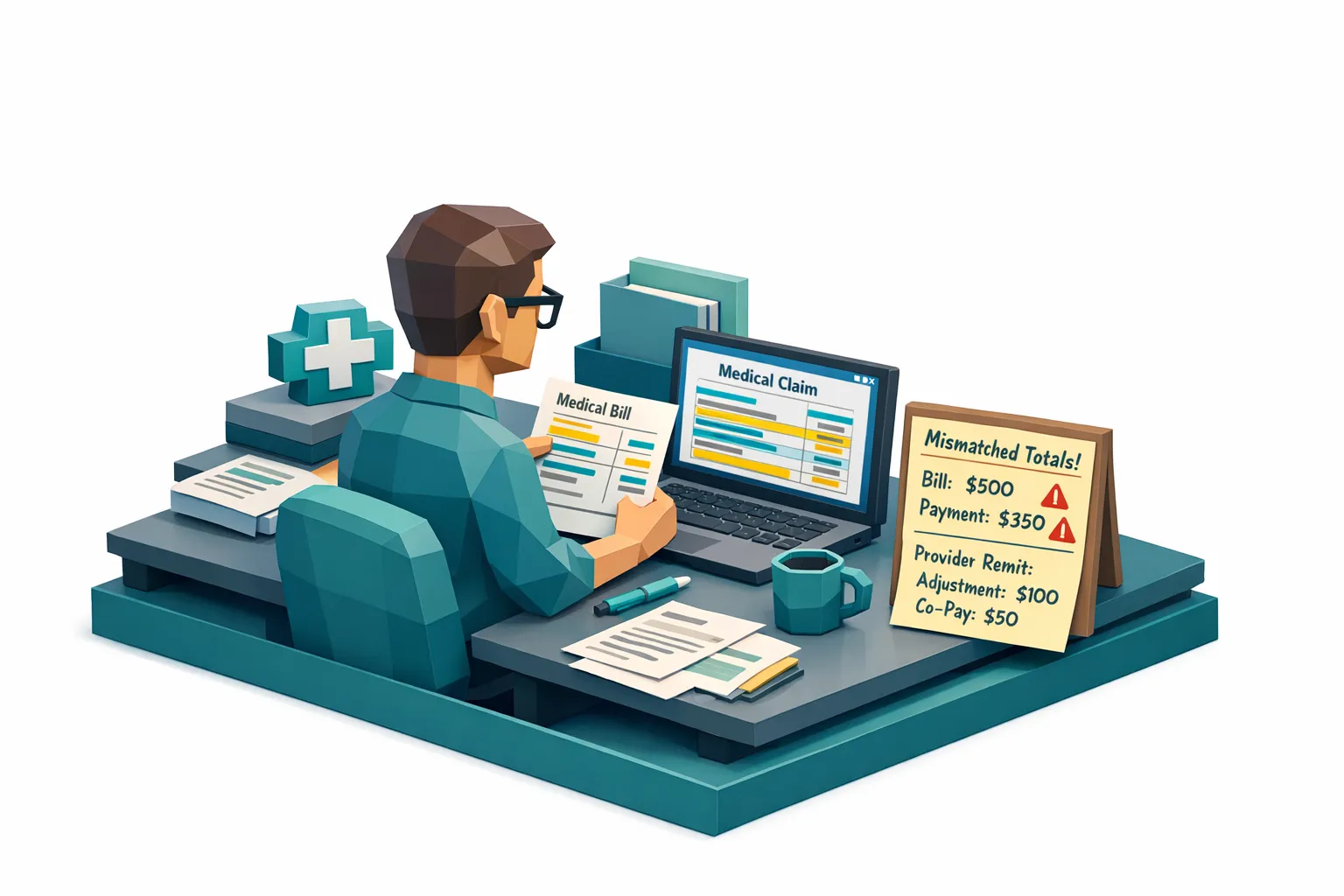
3) Line-item math that is technically plausible but internally inconsistent
Many reviewers check whether totals “look right.” Fraud often survives because the totals are close enough to avoid suspicion.
Better checks:
- Do the line items sum exactly to the subtotal?
- Do adjustments and patient responsibility reconcile cleanly?
- Are units multiplied correctly (quantity x unit price)?
- Are taxes, discounts, or write-offs applied in a consistent pattern across the document?
Mathematical irregularities are especially useful because they are hard to maintain across multiple edits.
4) “Too clean” PDFs, or suspiciously uniform noise in scans
Modern synthetic documents can look cleaner than real ones.
Red flags include:
- A PDF that claims to be scanned (or appears like a photo) but has no natural skew, blur, or lighting variation
- Repeated texture/noise patterns that look algorithmic rather than camera-induced
- Perfectly crisp edges around numbers that should be part of the same print layer
These cues matter more in 2026 than they did a few years ago, because AI-generated bill layouts can be visually polished.
5) Font and typography inconsistencies in high-value fields
Edits frequently target:
- Total due
- Date of service
- Patient name
- Account number
In manipulated bills, those fields may show subtle typography drift:
- Slightly different font family or size
- Misaligned baselines (numbers “float” higher or lower)
- Kerning that differs from surrounding text
Humans often miss this during fast review, but pixel-level analysis is strong at spotting it.
6) Copy-paste artifacts around numbers and dates
When someone changes a date of service or amount, they often overwrite a region and paste in new text.
Common artifacts:
- A faint rectangle of different background shade
- Edges that look sharper than nearby areas
- Compression halos around edited text
Even if the document was re-exported, these regions can retain inconsistent compression signatures.
7) Metadata that contradicts the story the bill tells
Metadata is not always present (many systems strip it), but when it exists it can be decisive.
Look for mismatches such as:
- A “created” date that post-dates the alleged billing cycle in an implausible way
- Editing software traces that conflict with the submission narrative
- Multiple save events or generators that suggest reconstruction
Metadata alone should not be your only reason to deny or escalate, but it is excellent for triage and prioritization.
8) Physical manipulation clues in photographed bills
Health claims still involve photos: paper statements captured on a phone, mailed letters photographed for speed, or printouts.
Signs of physical manipulation:
- Cut-and-paste seams in paper texture
- Uneven shadows around the altered region
- “Wavy” paper distortion that disappears only around the total due area
This is a separate class of signal from Photoshop-style edits, and it often appears in high-volume environments.
9) Duplicate and near-duplicate bill reuse across claims
One of the most operationally useful clues is reuse.
Patterns include:
- The same bill submitted for multiple members
- The same layout and amounts with only the patient name changed
- A prior bill resubmitted with a slightly modified date of service or total
Simple “exact duplicate” checks are not enough. Fraudsters intentionally introduce small changes so hashes and OCR matching fail.
10) Inconsistencies between the bill and the claim’s payment context
A bill can be internally consistent yet still wrong for the claim.
High-signal context mismatches:
- Provider on the bill does not match the network relationship implied by the claim history
- Payment recipient differs from the provider identity the insurer has on record
- Unusual payment routing patterns for that provider category
- Timing anomalies (for example, the bill appears after an implausible delay, or multiple “final notices” appear too quickly)
This is where fraud detection becomes more accurate: you validate the document and you validate how it connects to the payment reality.
A practical triage workflow: screen bills early, escalate with evidence
The goal is to keep clean claims moving while routing high-risk submissions to the right queue with defensible evidence.
A workable workflow for health insurance operations:
Step 1: Preserve originals at intake
- Store the original file (not a re-saved version)
- Keep submission channel details (portal, email, fax)
- Avoid manual “print to PDF” steps that destroy metadata and provenance
Step 2: Run automated document integrity screening
A strong screening layer should evaluate:
- AI-generated or synthetic document likelihood
- Photoshop and tampering artifacts
- Metadata and provenance anomalies
- Mathematical consistency across line items and totals
- Physical manipulation signals (when the submission is a photo)
This is the fastest way to get beyond “does it look normal?” and into “does the file behave like a real bill?”
Step 3: Enrich with payment and provider context
Document checks become higher precision when paired with context:
- Known provider identity and historical bill patterns
- Expected remittance destinations
- Claim history and timing patterns
Docklands AI is designed around that idea: using payment information on a claim, expense, or payment to build a deeper fraud picture, rather than relying only on generic “is this image real” scoring.
Step 4: Route by confidence, not by hunch
Operationally, this usually means:
- Low risk: pass through
- Medium risk: request clarification or supporting documentation
- High risk: route to SIU or a senior review queue with the forensic indicators attached
Step 5: Capture outcomes to reduce repeat work
When reviewers confirm fraud or clear a case, store that outcome so your screening can:
- Reduce false positives over time
- Spot repeat entities, reused templates, and recurring manipulation patterns
How this connects to compliance and audit readiness
Health insurance fraud controls increasingly intersect with compliance obligations: documentation, consistent handling, and traceable decisions.
If your compliance team is modernizing how it manages regulatory obligations and evidence trails, it can help to align fraud triage artifacts (alerts, reviewer notes, proof) with broader compliance workflows. Tools like Naltilia’s AI for compliance teams are built to streamline compliance processes, which can complement fraud programs that need clean documentation and follow-through.
Where Docklands AI fits for health insurance teams
Most claim platforms are built to capture fields and route work. They are not built to verify whether a submitted bill has been altered, synthesized, or reconstructed.
Docklands AI adds a document-integrity screening layer to help health insurance teams detect manipulated, photoshopped, and AI-generated invoices and receipts before payment or reimbursement decisions are finalized.
Relevant capabilities for bill screening include:
- AI-generated document detection
- Photoshop and tampering detection
- Metadata forensics analysis
- Mathematical irregularity checks
- Physical manipulation detection
- Real-time reporting and analytics
- API and webhook integration (to fit into existing claim intake and triage flows)
If you want a deeper comparison between medical billing fraud and document manipulation fraud, see Docklands’ explainer on medical billing fraud vs claim invoice fraud. For an operational view of how to add screening before funds move, this guide on screening invoices and receipts before you pay is a helpful next read.
Frequently Asked Questions
What is the fastest way to spot health insurance fraud in submitted bills? Focus on high-signal inconsistencies: remit-to/payment details, line-item math, metadata contradictions, and tampering artifacts in totals and dates. Automating these checks at intake is typically the fastest operational win.
Do OCR and rule checks catch most altered medical bills? They catch many formatting and field-validation issues, but they often miss document integrity problems like Photoshop edits, AI-generated bills, and near-duplicate reuse with slight modifications.
What parts of a medical bill are most commonly manipulated? Totals and balances, dates of service, patient identifiers, account numbers, and remittance instructions are frequent targets because they directly influence payment outcomes.
Is metadata reliable evidence for fraud decisions? Metadata is strong for triage and prioritization, but it should be used alongside other indicators. Metadata can be stripped or changed, and absence of metadata does not prove legitimacy.
How do you reduce false positives when screening bills? Combine multiple signals (visual tampering, metadata anomalies, math inconsistencies, and payment context). Escalate based on confidence scoring and preserve reviewer feedback to improve precision over time.
Screen submitted bills before they turn into paid losses
If your team is dealing with rising document manipulation, synthetic PDFs, or suspicious remittance edits, adding a document-integrity checkpoint can reduce leakage without slowing clean claim throughput.
Learn how Docklands AI can help you detect manipulated and AI-generated bills earlier in the workflow at Docklands AI.
Request a Demo Today!
Book your demo below.