Warranty Claim Fraud Often Hides in Routine Paperwork
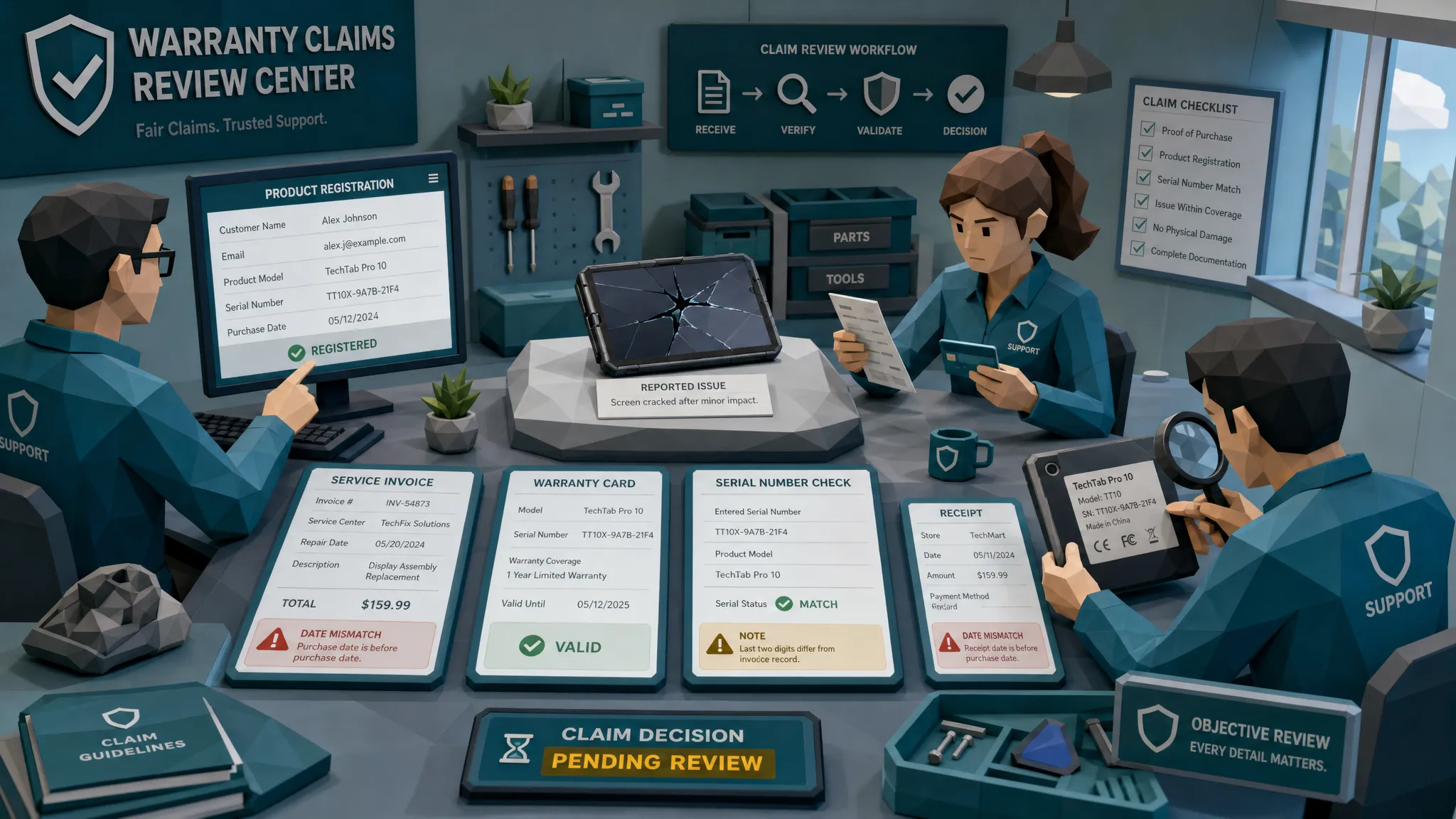

Here is my slightly uncomfortable opinion after a decade around claims fraud: the loudest fraud cases are rarely the most expensive ones.
The expensive ones are the boring ones. The warranty claim that looks like every other warranty claim. The appliance repair invoice that lands on a Tuesday afternoon. The phone replacement receipt with a total that seems plausible enough. Nobody kicks down a door. Nobody wears a fake mustache. Somebody changes a date, nudges a model number, reuses a receipt, or submits a service invoice that was “helpfully” edited before upload.
That is why warranty claim fraud is so easy to underestimate. It hides in routine paperwork because routine paperwork is where humans, quite reasonably, start to skim.
And in 2026, skimming is a luxury most claims teams do not have.
Why warranty claim fraud loves ordinary documents
Warranty claims sit in a strange corner of the fraud world. They often involve lower individual payouts than major property or casualty claims, but they come in high volume. That combination is catnip for fraudsters.
If a fraudulent home insurance claim is a bank robbery, a warranty scam is closer to someone taking a few extra items through self-checkout every week. Each incident may look small. Over time, the loss becomes very real.
The broader insurance fraud environment gives us the context. The FBI estimates insurance fraud costs the United States more than $308 billion each year, adding hundreds of dollars to the average family’s premiums. Warranty claims are only one part of that picture, but they share the same weakness: a claim often gets paid because the supporting documents look complete, not because they have been deeply verified.
I once reviewed a batch of warranty claims for consumer electronics where nearly every file had the required attachments: receipt, device photo, repair note, and customer statement. On paper, the compliance rate was beautiful. Too beautiful, actually. A closer look showed that a handful of receipts had the same odd spacing between the subtotal and tax line. Different customers, different stores, same little formatting hiccup. That was not a smoking gun. It was more like a smoldering toaster, which felt appropriate given the claims category.
The lesson stuck with me: fraud does not always fail because the document looks fake. It often fails because the document does not behave like it belongs in the claim.
The paperwork stack where warranty fraud usually hides
A warranty claim usually feels simple. A customer bought something, something broke, and now they want repair, replacement, or reimbursement. But the paperwork stack behind that simple story can be surprisingly rich.
You may see proof of purchase, repair invoices, diagnostic reports, shipping receipts, technician notes, product photos, serial number images, payment confirmations, and communication logs. Each document adds context. Each also gives a fraudster a place to manipulate the story.
In my experience, the most abused documents tend to be the ones reviewers are most tired of seeing. Receipts are a prime example. A receipt can be altered to bring a product inside the warranty period, increase the purchase price, change the retailer, or swap the model. A repair invoice can be inflated with labor that never happened, parts that were never ordered, or taxes and fees that do not match the jurisdiction.
This is the same pattern we see across claim types. As we covered in our piece on how fraud in claims often starts with document manipulation, the paperwork often tells the truth long before the claimant does.
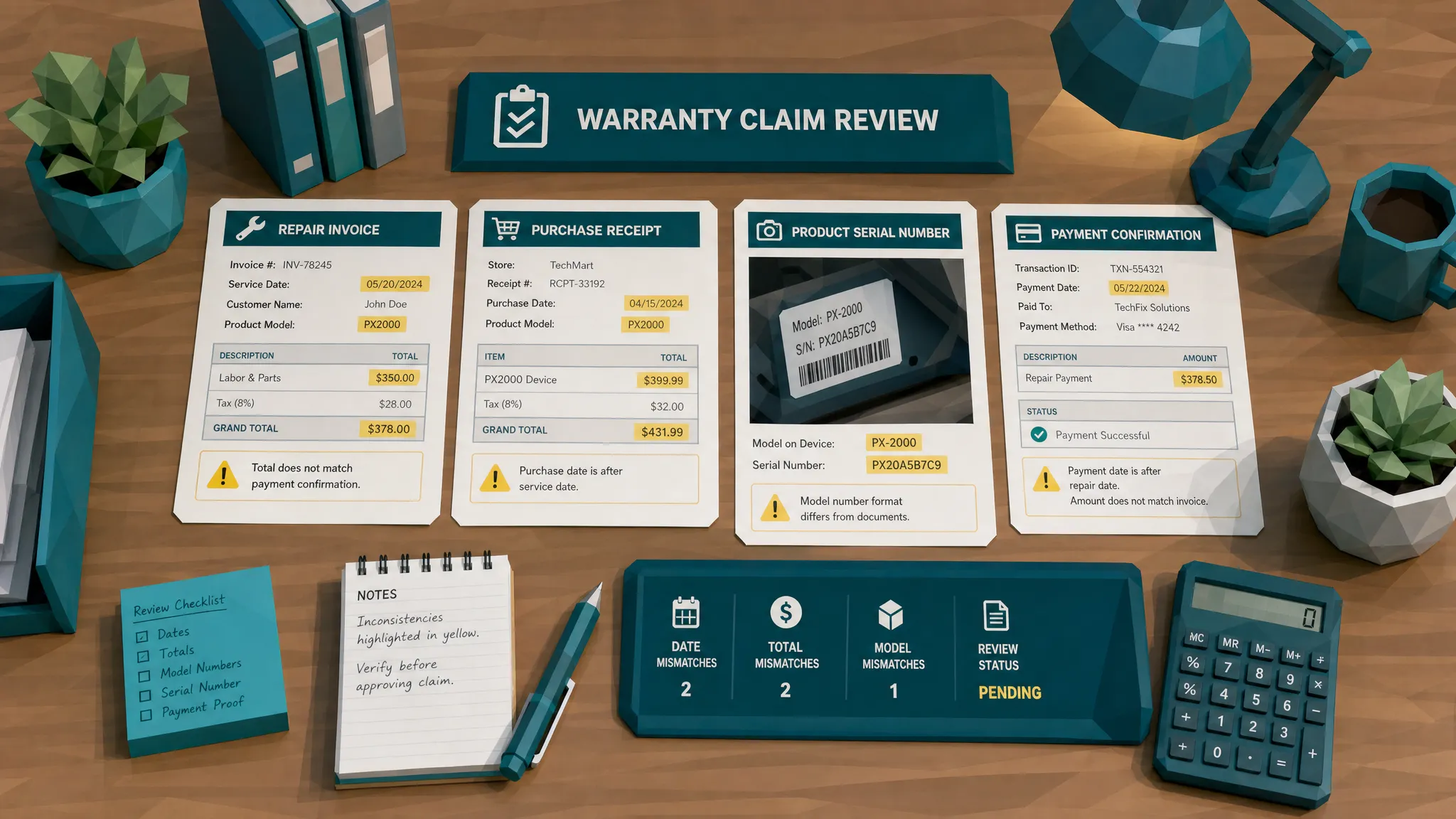
Warranty claim fraud is rarely about one document in isolation. The trick is comparing the receipt to the repair estimate, the serial number to the product photo, the payment method to the customer record, and the date sequence to the coverage terms. That is where the story starts to wobble.
The red flags that deserve a second look
I am cautious about calling anything a “classic fraud indicator” because honest customers create messy paperwork too. People lose receipts. Repair shops make typos. Phones take blurry photos. Life is not a controlled audit sample.
Still, certain patterns should make a reviewer slow down.
- Purchase dates that sit conveniently just inside the warranty window
- Receipts with font changes, spacing shifts, or totals that look pasted over
- Serial numbers that match the claimed product family but not the exact model
- Repair invoices with rounded labor hours across many claims
- Photos that show a product but not enough surrounding context
- Vendor names that are similar to legitimate repair shops but not quite right
- Payment details that do not align with the claimant, merchant, or claimed purchase date
- Multiple claims using invoices with nearly identical formatting from unrelated customers
The date issue is especially common. If a warranty expired on May 31 and the receipt says May 29, I am not accusing anyone. But I am paying attention. Fraudsters love the edge of eligibility. They do not usually move a purchase date by three years. They move it by three weeks, because three weeks feels boring.
Boring is where the money leaks.
The new problem: fake documents are getting cleaner
A few years ago, many manipulated receipts were laughably bad. Wrong tax rate, weird font, merchant address in three different styles. I once saw an invoice where the word “diagnostic” was spelled three different ways. That is not fraud investigation. That is proofreading with a badge.
Today, the documents are cleaner. Generative tools, template marketplaces, image editing apps, and better consumer software have lowered the effort required to create a plausible invoice or receipt. The result is not always perfect, but it is often good enough to survive a fast review.
This is not paranoia. Claims manipulation is becoming more sophisticated across the industry. Verisk’s 2025 Fraud Report found that 76% of carriers said claims manipulation became more sophisticated in the past year. The BBC also reported on a sharp rise in fraudulent claims linked to fake images and deepfakes, citing insurer concerns about how quickly these tactics are spreading.
Warranty teams should care because fraudsters reuse methods. A person who learns to generate a convincing repair photo for one insurance claim can apply the same skill to a cracked screen warranty, appliance failure, tire-and-wheel plan, or extended service contract.
The document may look normal. The question is whether it is normal for that claimant, that product, that vendor, that payment trail, and that timeline.
Why manual review misses routine fraud
I have a lot of respect for claims adjusters and warranty reviewers. They are asked to be fast, accurate, empathetic, skeptical, compliant, and cheerful, preferably before lunch. That is an impossible combination on a bad day.
Manual review misses warranty claim fraud for three very human reasons.
First, volume creates familiarity. After you have reviewed 200 refrigerator compressor claims, the 201st can blur. Your brain looks for missing fields, not pixel-level edits.
Second, many review systems reward completeness. If all required documents are attached, the file moves forward. That makes sense operationally, but fraudsters know how to satisfy checklists.
Third, traditional document tools often read text without understanding manipulation. OCR can extract the invoice total. It may not tell you that the total was edited, that the metadata conflicts with the upload story, or that the payment information points somewhere odd.
This is why I think the industry needs to retire the phrase “document verification” when all we mean is “the document opened and the fields were readable.” That is not verification. That is a PDF with good manners.
Real verification asks harder questions. Was the receipt altered? Does the math work? Does the image contain signs of editing? Do metadata and timestamps make sense? Does the claimed payment line up with the vendor and amount? Has this repair provider appeared in suspicious clusters before?
Those are the questions that catch fraud hiding in plain sight.
Payment details are the underrated fraud signal
Here is another hot take: payment information is one of the most underused signals in warranty claim fraud.
Most document checks focus on whether the uploaded receipt or invoice looks authentic. That matters, of course. But a manipulated document often starts to fall apart when you compare it with payment context.
For example, imagine a claimant submits a receipt for a laptop bought at a major retailer, then files a warranty replacement claim eight months later. The receipt image looks fine. The total is plausible. The warranty period checks out. But the payment trail shows a different merchant category, or a mismatch between the claimed total and the actual transaction amount, or no matching transaction at all.
That does not automatically mean fraud. It does mean the claim needs more scrutiny before money or replacement stock leaves the building.
This is one reason document-only checks can be too shallow. Fraud is a story, and payments are part of the plot. A good warranty fraud process connects the document, the timeline, the product, the vendor, and the money.
Docklands AI was built around that idea. The platform analyzes invoices and receipts for manipulation, including photoshopped documents, AI-generated paperwork, metadata issues, mathematical irregularities, and physical tampering. It also uses payment information from a claim, expense, or payment workflow to build a deeper fraud picture than a simple “does this image look real?” check.
That distinction matters. A fake document may pass a visual sniff test. It has a harder time surviving cross-checks against the wider claim record.
How warranty teams can tighten controls without punishing honest customers
Nobody wants a fraud process that treats every customer like a suspect. That is how you turn a warranty program into a complaint factory. The goal is not maximum friction. The goal is targeted friction.
In practice, I like a layered approach. Let low-risk claims move quickly when the documents, payment details, serial numbers, and vendor history all align. Slow down claims where the paperwork carries small but meaningful contradictions.
A few practical moves help:
- Compare purchase date, failure date, repair date, and submission date as one sequence
- Validate serial numbers against product family, model, and warranty coverage
- Look for document edits at the image level, not only in extracted text
- Check invoice math, tax rates, and labor patterns for unusual consistency
- Review vendor history for repeat anomalies across unrelated claimants
- Use payment information to confirm that the claimed transaction makes sense
I would rather hold five suspicious claims for a sensible second look than delay 500 honest customers with blanket requirements. Good fraud control should feel almost invisible to legitimate claimants.
This mirrors what we see in other insurance categories. In auto claims, for example, routine repair paperwork can reveal inconsistencies that photos alone miss, which is why we often say insurance fraud in car accident claims leaves paper clues. Warranty claims are no different. The claim file has a memory. You just have to read it carefully.
What to do when a warranty claim looks suspicious
The worst move is to jump from “odd document” to “fraud denial” in one breath. That is tempting, especially when the edit looks obvious, but it creates legal, regulatory, and customer experience risk.
A better first step is clarification. Ask for the original receipt, a bank or card statement showing the transaction, a clearer photo of the serial number, or confirmation directly from the repair provider. If the claimant is honest, they can often resolve the issue quickly. If the claim is fraudulent, the story usually gets more complicated.
I also like preserving the document trail. Keep the uploaded file, record the review findings, and capture why the claim was escalated. If you later identify a broader vendor or claimant pattern, those early notes become valuable.
The key is consistency. Fraud teams should define escalation rules in advance so reviewers are not relying on gut feel alone. Gut feel has its place. I have trusted mine many times. But gut feel plus documented indicators is much easier to defend when someone asks why a claim was delayed, referred, or denied.
The future of warranty claim fraud detection is quiet
The future will not be one magical fraud score that tells everyone what to do. I know that is less exciting than the conference booth version, but it is true.
The better future is quieter. It is a workflow where suspicious warranty documents are automatically checked for tampering, metadata conflicts, math issues, and payment inconsistencies before a reviewer spends time on them. It is a dashboard that helps managers see patterns across vendors, claimants, products, and locations. It is an API or webhook that lets fraud checks happen inside the systems teams already use.
Most importantly, it is a process that respects honest customers while making routine paperwork much harder to abuse.
Warranty claim fraud will keep hiding in invoices, receipts, repair notes, and serial number photos because those documents are ordinary. Our job is to stop treating ordinary as harmless.
Frequently Asked Questions
What is warranty claim fraud? Warranty claim fraud happens when someone misrepresents a purchase, product defect, repair, ownership, date, cost, or supporting document to receive a replacement, repair payment, refund, or other warranty benefit they are not entitled to.
Why does warranty claim fraud often involve receipts and invoices? Receipts and invoices decide eligibility, timing, repair cost, and reimbursement value. A small edit to a purchase date, model number, or invoice total can change whether a claim is approved and how much is paid.
Can genuine customers have suspicious-looking paperwork? Yes. Honest customers lose receipts, upload poor photos, receive messy invoices, and make mistakes. Suspicious paperwork should trigger review, not automatic denial. The best process verifies context before taking action.
How can insurers and warranty administrators detect manipulated documents faster? They can combine image tampering checks, metadata analysis, math validation, vendor pattern review, serial number checks, and payment verification. Looking at the full claim context is much stronger than reviewing the document alone.
Make routine paperwork harder to exploit
If warranty claims are moving through your workflow based mostly on whether the right documents are attached, fraudsters have room to work.
Docklands AI helps teams detect manipulated, photoshopped, and AI-generated invoices and receipts before they turn into paid losses. By combining document forensics with payment context, Docklands gives claims, fraud, and operations teams a clearer view of which warranty claims deserve a closer look.
Request a Demo Today!
Book your demo below.