Why Warranty Claims Fraud Is Rising in 2026
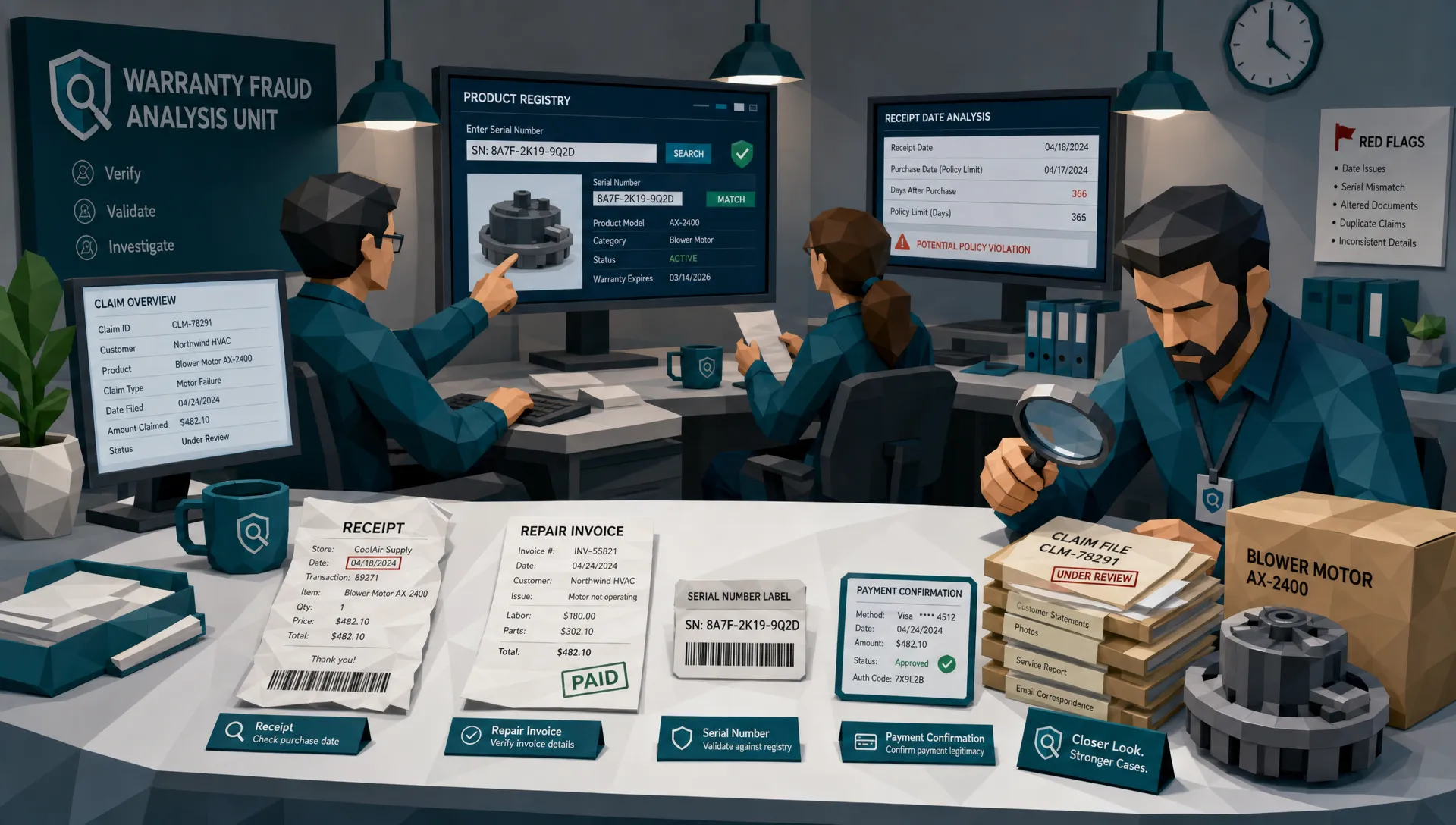

Warranty teams have always had a fraud problem. In 2026, the problem feels different because the fake evidence is cleaner, the approval windows are shorter, and the fraudster no longer needs to be particularly clever.
That is my slightly grumpy hot take after a decade around claims fraud: warranty claims fraud is rising because we made the process beautifully convenient, then treated uploaded paperwork as if it still carried the same trust value it had ten years ago.
I am not arguing against fast claims. Customers hate friction, and rightly so. If someone’s HVAC system dies in July or their phone screen fails two weeks before a business trip, they do not want a forensic interrogation. But we have to be honest about the trade-off. A photo of a receipt, a repair invoice, a serial number label, and a technician note are now cheap to alter, cheap to generate, and easy to submit at scale.
The result is a strange new world where many fraudulent warranty claims look boring. No dramatic scam. No villain in a hoodie. Just a neat PDF, a reasonable repair amount, and a claim that fits the policy by half an inch.
The big shift: fraudsters learned to look normal
The old warranty fraud playbook was clumsy. People reused the same receipt, changed a purchase date with a bad font match, or submitted a repair estimate that looked like it had been assembled in a hurry. You could often spot the problem by zooming in and letting your inner skeptic stretch its legs.
That still happens, but it is no longer the main event.
Today’s fake claim evidence is more polished because the tools are better. Image editing is simpler. Document templates are everywhere. Generative tools can produce receipts, repair notes, damage descriptions, and plausible customer narratives in seconds. Even when the final document is not perfect, it is usually “good enough” for a rushed review queue.
This is not paranoia. Broader insurance fraud data is already flashing red. The FBI estimates insurance fraud costs the United States more than $300 billion each year, with honest families paying hundreds of dollars more in premiums as a result. In the UK, BBC reporting on Admiral described a 71% rise in fraudulent claims in 2025, driven partly by AI-generated fake images and deepfakes. Warranty claims sit inside that same behavior pattern, even when the products are different.
And here is the awkward bit: the cleaner the evidence looks, the more likely a busy claims operation is to wave it through.
Why warranty claims fraud is rising in 2026
The reasons are not mysterious. They are operational. They sit in the gap between customer experience, document trust, and review capacity.
1. Remote-first claims created a perfect evidence gap
Most warranty programs now depend on remote submission. That makes sense. It reduces cost, speeds up turnaround, and avoids forcing customers into unnecessary inspections.
But remote-first claims also mean the claim file becomes the battlefield. If the file says the dishwasher failed within coverage, the repair invoice looks real, and the receipt date falls inside the warranty period, the claim may move forward without anyone touching the appliance, meeting the technician, or seeing the original document.
I once reviewed a small appliance claim where the uploaded receipt looked spotless. The store name was right. The tax was plausible. The customer story was painfully ordinary. The issue was the payment reference. It did not match the purchase pattern on the receipt, and the timing lined up too neatly with the warranty expiration date. Nothing screamed fraud. It merely hummed it quietly in the corner.
That is where a lot of 2026 fraud lives: in the quiet mismatches.
2. Fake receipts and repair invoices are now the easiest part
For warranty fraud, the receipt is often the key that unlocks the claim. Change the date, swap the model number, inflate the repair amount, add a diagnostic fee, and suddenly a rejected claim becomes payable.
The most common problem is not always a fully fake document. Often it is a real document with one or two important edits. A genuine repair invoice becomes a larger repair invoice. A real receipt for a cheaper model becomes proof for a pricier one. A valid purchase date moves forward by eight months, because apparently time travel is now a customer service feature.
If this sounds familiar, we have written more specifically about how warranty claim fraud often hides in routine paperwork. That is still the core issue, but in 2026 the paperwork is better disguised.
3. Generational attitudes toward claim evidence are changing
This is the part many fraud teams whisper about but do not always say out loud. Some consumers see claim evidence as negotiable.
The Verisk 2025 Fraud Report found that 55% of Gen Z respondents would consider altering claim evidence with AI, compared with 12% of boomers. That does not mean most young customers are dishonest. It means the moral barrier around “enhancing” evidence is weaker for a noticeable slice of the market.
In warranty claims, this can look like a customer “clarifying” a blurry serial number, “recreating” a lost receipt, or “fixing” the date on a document because they believe they deserve coverage. Fraud professionals know intent matters legally and operationally, but the payment outcome is the same if the claim is approved on false evidence.
4. Warranty fraud has become more organized
A single customer altering a receipt is annoying. A repair network, reseller, or serial offender doing it repeatedly is expensive.
In vehicle service contracts, electronics protection, home warranties, appliance coverage, and equipment warranties, fraud can involve repeat vendors, staged repairs, inflated parts, recycled serial numbers, and claims tied to items that were already damaged before coverage began. Organized warranty abuse tends to hide behind normal business volume.
The irritating thing is that organized fraud does not need a perfect story. It only needs a story that is slightly less suspicious than the queue average.
5. Social platforms spread the playbook faster than policy teams can rewrite rules
Fraud tactics used to move through small circles. Now they travel through forums, short videos, private groups, and comment threads. Some of it is framed as “consumer tips.” Some of it is blatant abuse advice with nicer lighting.
Warranty teams should not obsess over every online complaint, but they should understand how people talk about claim loopholes. I have seen policy gaps show up in customer forums months before they show up in internal fraud reports. For teams that want to listen without doom-scrolling all afternoon, tools that monitor high-intent conversations on Reddit and X can be useful for spotting what people are asking, sharing, and testing in the wild.
6. Legacy rules catch yesterday’s fraud
Many warranty claim systems still rely heavily on thresholds and rules: claim amount too high, frequency too high, vendor on watchlist, customer submitted too soon, customer submitted too late.
Rules are necessary. They are also predictable.
A fraudster who understands the warranty policy can stay under the threshold, spread claims across identities, choose common failure types, and submit documents that look ordinary. The strongest warranty fraud controls in 2026 are not merely checking whether a document “looks real.” They compare the document, the payment details, the vendor behavior, the claim timing, and the physical reality implied by the evidence.
2026 fraud driver       | What it looks like in warranty claims                                  | Why old controls struggle
Easier document editing | Altered receipt dates, inflated repair invoices, swapped model numbers | Manual review focuses on obvious visual errors
Faster digital claims   | Low-touch approvals based on uploaded evidence                         | Less time to verify source documents
Generative tools        | Plausible narratives, clean receipts, synthetic damage photos          | The claim looks normal at first glance
Organized abuse         | Repeat vendors, recycled serials, staged repairs                       | Each claim may appear low-risk alone
Social playbooks | Customers sharing loopholes and claim scripts | Policy updates lag behind emerging tactics 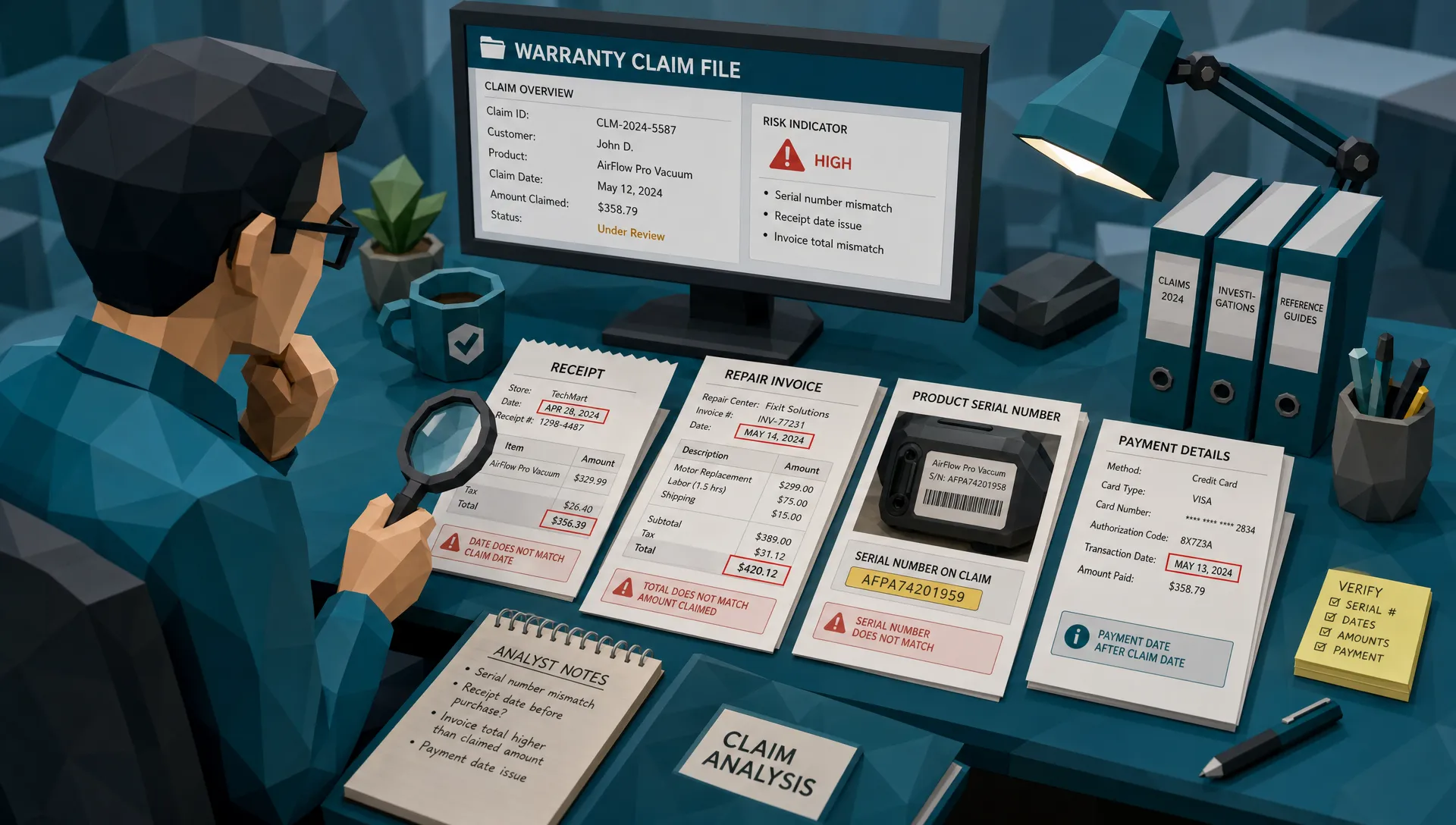
What warranty claims fraud looks like now
The most dangerous warranty fraud in 2026 is rarely theatrical. It usually falls into a few plain-looking patterns.
A customer submits a receipt for a covered product, but the date has been changed to keep the item inside warranty. The edit is clean, the font is close, and the store logo is genuine because the base receipt was real.
A repair shop submits an invoice for a legitimate customer, but the labor hours and parts cost are padded. The customer may not even know the invoice is inflated. In some cases, the shop learns exactly where the warranty provider’s review threshold sits and prices the job just below it. Subtle. Greedy. Annoyingly effective.
A claimant uses a serial number from one item and photos from another. This is especially common where products are resold, refurbished, gifted, or purchased through marketplaces. The serial number photograph becomes a prop, not proof.
A synthetic or edited image shows damage, missing parts, or physical failure. In broader claims fraud, manipulated visual evidence is growing quickly. Verisk reported that 76% of carriers said claims manipulation became more sophisticated in the past year. Warranty teams should assume the same visual tricks will hit product claims, repair claims, and replacement claims.
A claimant submits the same underlying expense in multiple ways. One version goes to the manufacturer warranty program. Another goes to a retailer protection plan. Another becomes part of a card benefit or insurance claim. The document may be real, but the reimbursement pattern is not.
This is why I get nervous when someone says, “The document passed OCR, so we are fine.” OCR reads text. Fraud lives in context.
The real weakness is over-trusting the claim packet
Here is another hot take: warranty programs often treat the claim packet like a witness. It is not a witness. It is a bundle of assertions.
The receipt asserts the item was bought on a certain date. The invoice asserts a repair happened. The photo asserts damage exists. The serial number asserts the product is the covered product. The payment details assert money changed hands.
Good fraud review asks whether those assertions agree with each other.
A repair invoice dated two days before the diagnostic note is not automatically fraud, but it deserves a look. A receipt total that does not match the tax rate or payment split is not proof of fraud, but it is a signal. A serial number photo with inconsistent lighting, compression, or label geometry is not a conviction, but it may tell you the image has been manipulated.
This is also where warranty fraud overlaps with other claims environments. In insurance, McKinsey has noted that carriers lose tens of billions annually to claims fraud and detect only a fraction of it. The warranty world has its own workflows, but the lesson is shared: if you only review the obvious high-risk files, the quiet files will eat your lunch.
And lunch is expensive now.
How to reduce warranty fraud without punishing honest customers
The answer is not to make every customer upload seventeen documents, provide a blood sample, and swear loyalty to the claims department. That would reduce fraud and also reduce every customer’s will to live.
The better answer is targeted friction. Let clean claims move. Slow down the claims where the evidence disagrees with itself.
That starts with document forensics. Warranty teams need to know whether receipts, invoices, serial number photos, and repair documents show signs of tampering, physical manipulation, metadata mismatch, mathematical irregularities, or synthetic generation. Pixel-level clues matter because modern edits can look fine to the human eye.
It also requires payment context. A warranty claim becomes much clearer when you compare what the document says with how payment supposedly happened. Does the amount match? Does the timing make sense? Is the payee consistent? Does the same repair vendor appear across suspiciously similar claims? A generic “is this image real?” check will miss much of that.
This is where platforms like Docklands AI fit into the control stack. Docklands analyzes invoices and receipts for signs of manipulation, AI generation, metadata issues, mathematical inconsistencies, and physical document tampering, while using payment information to build a deeper fraud picture. For warranty teams, that context is often the difference between “looks fine” and “hold on a minute.”
A practical control model looks something like this:
Control layer            | What it checks                                                    | Why it helps warranty teams
Document integrity       | Edits, metadata anomalies, image manipulation, synthetic evidence | Finds altered receipts and repair invoices before payout
Mathematical consistency | Totals, tax, discounts, labor, parts, rounding                    | Catches sloppy or inflated financial details
Claim context            | Dates, coverage period, failure type, serial number, prior claims | Spots evidence that conflicts with the warranty story
Payment context          | Payee, amount, transaction timing, reimbursement patterns         | Separates real expenses from manipulated proof
Network behavior | Repeat vendors, linked claimants, recurring document templates | Identifies organized abuse hiding in normal volume If you want a broader view of timing and payment red flags, the same logic appears in claims fraud signals that appear before payout. Warranty teams can borrow a lot from insurance claims discipline without turning the process into a courtroom.
The KPI most teams underuse: prevented loss by evidence type
Many teams track fraud by claim count, dollar amount, product category, or vendor. Useful, yes. But in 2026, I would add one more: prevented loss by evidence type.
In plain English, ask which piece of evidence most often carried the fraud. Was it the receipt date? The repair invoice? The serial number photo? The damage image? The payment proof?
This matters because it tells you where your process is being attacked. If most bad claims involve altered purchase receipts, tighten receipt verification and retailer validation. If repair invoices are the issue, focus on vendor behavior and invoice forensics. If serial numbers are messy, improve product identity controls.
I once saw a team spend months debating customer identity checks when the real problem was a handful of repair documents that used the same invoice layout, the same phrasing, and suspiciously similar labor charges. The fraud was not hiding in who submitted the claim. It was hiding in what they submitted.
That distinction saves time.
What I would change first in 2026
If I were running warranty fraud controls this year, I would start with three changes.
First, I would stop treating clean-looking documents as low-risk by default. Clean is no longer reassuring. Sometimes clean simply means the fraudster used better tools.
Second, I would connect document analysis with claim and payment data. A receipt, repair invoice, and payment record should tell one coherent story. When they do not, the file should earn a second look.
Third, I would create a feedback loop between investigators and automation. When a human reviewer confirms a manipulated invoice or fake receipt, that pattern should improve future detection. Fraudsters share tactics. Fraud teams should share learning faster.
Warranty claims fraud is rising in 2026 because the economics favor it. The tools are cheap, the process is remote, the evidence is digital, and many programs still review documents like it is 2014. The good news is that the defense does not need to be clumsy. You can protect the book without turning honest customers into suspects.
You just have to stop letting the prettiest PDF in the room win by default.
Frequently Asked Questions
Why is warranty claims fraud rising in 2026? Warranty claims fraud is rising because claim submission is increasingly remote, digital evidence is easier to alter or generate, and many review processes still rely on manual checks or predictable rules. Fraudsters can now create cleaner receipts, repair invoices, and product photos with less effort.
What are the most common warranty fraud red flags? Common red flags include altered purchase dates, inflated repair invoices, inconsistent serial number photos, mismatched payment details, repeated use of the same vendor, suspiciously similar claim narratives, and documents that conflict with the coverage timeline.
Can AI-generated receipts and invoices be detected? Often, yes. Detection usually depends on a combination of image forensics, metadata analysis, mathematical checks, document layout review, and comparison against payment and claim context. A visual review alone is no longer enough for high-volume warranty programs.
How can warranty teams reduce fraud without slowing every claim? The best approach is targeted friction. Low-risk claims should move quickly, while claims with document, payment, vendor, or timing inconsistencies should be routed for deeper review. This protects honest customers while giving investigators better leads.
Is warranty fraud the same as insurance fraud? They are not identical, but they share many tactics. Both rely on claim evidence, payment documents, photos, repair records, and timing. Warranty teams can learn a lot from insurance fraud controls, especially around document manipulation and pre-payout risk signals.
Make the claim file prove itself
Warranty fraud in 2026 is not going away because the incentives are too attractive. But you can make it harder, less profitable, and easier to catch before payout.
If your warranty program relies on receipts, repair invoices, serial number photos, or payment evidence, Docklands AI can help identify manipulated, photoshopped, and AI-generated documents before they become losses. Use stronger document forensics, richer payment context, and real-time reporting to separate genuine claims from polished fraud.
Start with the claim file. Make every document earn your trust.
Request a Demo Today!
Book your demo below.