How to Spot a Fake Printable Receipt Fast
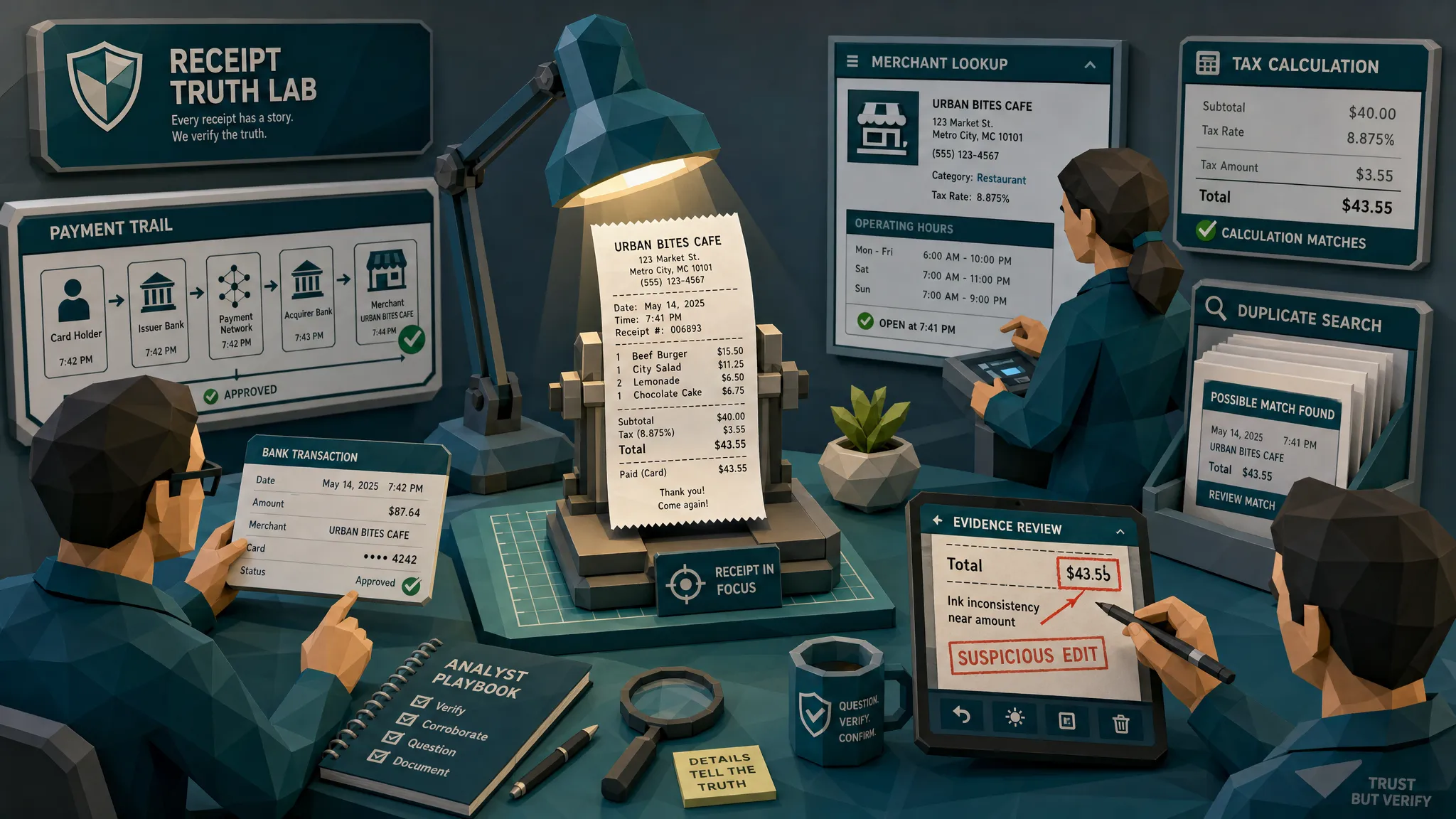

Here is my slightly unfashionable fraud opinion: most fake receipts are not caught because the logo looks weird. They are caught because the story around the receipt refuses to behave.
A fake printable receipt is especially slippery because it borrows credibility from the real world. Someone fills in a template, prints it, folds it, photographs it on a kitchen counter, and suddenly it feels more believable than a clean PDF. I have seen reviewers relax the moment a receipt has a crease in it. That crease can be theatre.
In claims, accounts payable, and employee expenses, the goal is not to become a graphic designer. The goal is to decide quickly whether the receipt deserves normal processing, a second look, or a hard stop. After a decade of reviewing suspicious documents, my best advice is simple: stop staring at the logo first. Start with the payment story.
Why fake printable receipts work so well
Printable receipts exploit a human habit I call paper trust. We grew up treating paper as the boring, official version of reality. A printed receipt on thermal paper, a wrinkled hotel folio, or a photo of a hardware store receipt feels like evidence because it looks inconvenient to fake.
That used to be partly true. Now, anyone can produce a plausible receipt in minutes. Fake receipt maker tools, edited PDFs, image generators, and old-fashioned copy-paste jobs have lowered the skill bar. The fraudster does not need to fool a forensic lab. They only need to fool a busy adjuster at 4:45 p.m. on a Friday.
The money at stake is not pocket change. The FBI estimates insurance fraud costs the United States more than $308 billion per year, and that cost is ultimately passed on to households and businesses. In payments, the Association for Financial Professionals has reported that a large majority of organizations face attempted or actual payments fraud. Expense fraud is just as stubborn, with the ACFE estimating that organizations lose about 5% of revenue to fraud.
So yes, the $47.83 lunch receipt matters. Not because one sandwich sinks the company, although I have met sandwiches with ambition. It matters because small receipts teach fraudsters what your controls will tolerate.
The fastest check: does the payment story make sense?
When I review a suspicious receipt, I do not begin with the font. I begin with four plain questions: who paid, when did they pay, how did they pay, and where did the money go?
A legitimate receipt usually leaves payment breadcrumbs. You may see the card brand, last four digits, authorization code, transaction ID, merchant descriptor, terminal ID, or a timestamp that matches a bank record. A fake printable receipt often has one of two problems. It either omits those details completely, or it includes them in a way that sounds official but does not reconcile with anything.
One example from my own files involved a storm damage claim with a receipt for emergency supplies. The receipt looked fine at first glance. Store name, subtotal, sales tax, card ending, the works. The problem was that the purchase timestamp was after the store had closed, and the card last four did not match any payment method connected to the claimant. The fake did not fail as an image. It failed as a transaction.
For expense teams, this means checking the receipt against the corporate card feed, travel itinerary, reimbursement history, and policy rules. For claims teams, compare it with the date of loss, repair timeline, vendor records, and any payout already made. For AP teams, line it up against the supplier master, bank account, PO if one exists, and prior invoice patterns.
If the payment evidence is missing, do not automatically accuse anyone. Cash purchases exist. Small merchants have messy systems. But missing payment evidence should move the item from routine approval to verification.
Check merchant reality before receipt beauty
The next fast tell is merchant plausibility. Fake printable receipts often use real-looking business names, but they get the boring details wrong. And boring details are where fraud goes to trip over its own shoelaces.
Look at the merchant address, phone number, store number, tax ID, website, opening hours, and business category. Does the merchant actually sell the item being claimed? Is the location plausible for the employee, claimant, or job site? Does the receipt show a store number that belongs to a different state? Does the phone number route to the business, or to nowhere?
Uniforms and PPE are a good example. If a field employee submits a receipt for safety trousers, jackets, or workwear accessories, the item descriptions should sound like something a real supplier would sell. Comparing the language and product categories against legitimate workwear suppliers such as Bestex Fabricage b.v. can help you separate a plausible trade purchase from a receipt that reads like someone invented a catalog after lunch.
This is not about becoming an expert in every industry. It is about asking whether the receipt speaks the right dialect. A fake restaurant receipt may include a SKU-style item code that restaurants rarely use. A fake contractor receipt may use retail tax formatting that does not fit the jurisdiction. A fake hotel receipt may show room tax but no occupancy tax where one would normally apply.
Watch the timing, fraudsters love convenient dates
Dates and times are underrated. I have caught more suspicious receipts through timing than through typography.
Fraud receipts often appear exactly when they are needed. The repair receipt arrives the day after the loss, even though the vendor could not possibly have inspected the damage that quickly. The meal receipt lands one dollar below the manager approval threshold. The hotel receipt matches the conference dates perfectly but includes a checkout time when the employee was already on a flight.
In AP, timing can reveal pressure tactics. A new invoice appears right before quarter close. A vendor asks for urgent payment and supplies a printable receipt as proof of prior work. In claims, a receipt dated before policy inception or after a reported loss window should make you pause. In expenses, repeated purchases at odd hours or repeated weekend transactions can be a sign of template reuse.
Timing alone does not prove fraud. It tells you where to dig.
The math should be boring
Real receipts are often ugly, but their math is usually consistent. Fake printable receipts sometimes look beautiful and calculate like a raccoon walked across a keypad.
Check the subtotal, discounts, tax, tips, service charges, and total. Tax is a particularly useful tell because fraudsters tend to apply a flat percentage from memory, use the wrong rate, or tax items that should be exempt. Restaurant receipts may show a tip that does not match the final total. Retail receipts may show discount lines that reduce the total incorrectly. Hotel folios may split taxes in ways that do not match local rules.
Round numbers deserve a second look, especially in expenses. A receipt for exactly $99.00 in a company where $100 requires extra approval is not proof of fraud. But if the same employee keeps submitting $98.76, $99.10, and $97.50 purchases, your problem is no longer one receipt. Your problem is a pattern.
For more on those repeated behaviors, Docklands has a separate breakdown of receipt expense fraud patterns finance teams miss.

Visual tells still matter, but use them last
Once the payment, merchant, timing, and math checks are done, then I look at the image itself. This order matters. If you start with visuals, you risk being distracted by a convincing layout or a dramatic coffee stain.
A fake printable receipt may show inconsistent fonts, uneven spacing, misaligned decimals, fuzzy logos, repeated texture patterns, strange shadows, or text that appears too crisp compared with the paper around it. Sometimes the receipt has been printed from a template, photographed, then compressed through a messaging app. That can hide some clues and create others.
One of my favorite tells is alignment. Real receipt printers are boring machines. They tend to produce consistent baselines, predictable spacing, and repeatable character shapes. Fake receipts often mix text pasted from different sources. You may see the total line sitting half a pixel too high, a different font weight in the tax line, or a merchant name that is sharper than the transaction details.
Paper behavior matters too. If a receipt is folded, the text and shadows should respect that fold. If the paper edge is curled, the print should curve with it. If the receipt was supposedly photographed on a desk, the lighting should make sense across the whole document. A printed fake can still betray itself through the physics of paper, ink, and light. We covered that deeper forensic angle in why a printed fake receipt still gives itself away.
Metadata can help, but do not worship it
Metadata is useful, but it is not a magic lie detector. I have seen honest receipts with no metadata because they were sent through messaging apps, scanned by office equipment, or uploaded through portals that stripped the file history. I have also seen fraudulent receipts with perfectly ordinary metadata because the fraudster printed the fake and photographed it with a real phone.
Still, metadata can give you leads. Look for creation dates that conflict with the transaction date, editing software in the file history, multiple generations of compression, or document properties that do not match the submitted story. If a receipt dated March was created yesterday, that is worth asking about. If a hotel folio was supposedly scanned from paper but the file says it was generated by an editing application, also worth asking about.
The trick is to treat metadata as corroboration. It should support or challenge the story, not replace judgment.
Duplicate and near-duplicate receipts are the quiet killers
A single fake printable receipt is annoying. Reused receipts are expensive.
Fraudsters often recycle templates. They change the date, total, merchant name, or last four digits, then submit the same receipt across claims, departments, entities, or time periods. Manual reviewers rarely remember a similar-looking receipt from six months ago, especially in high-volume environments.
Near-duplicates can show up as repeated paper backgrounds, identical shadows, matching crop angles, or the same line spacing with different amounts. In employee expenses, one person may reuse a receipt with small edits. In claims, multiple claimants may submit receipts from the same source template. In AP, a bad actor may test one invoice format across several entities.
This is where teams need more than eyeballs. Humans are good at suspicion. Systems are better at remembering.
A practical 90-second workflow
If I had to train a new reviewer tomorrow, I would give them this sequence.
First, confirm the payment trail. Match the card, bank, transaction, or reimbursement evidence wherever possible. Second, test the merchant. Does the business exist, sell the item, and operate where and when the receipt claims? Third, check the timing against the surrounding event, such as a loss date, trip date, invoice cycle, or project milestone. Fourth, recalculate the math, especially tax, discounts, tips, and totals. Fifth, look for visual manipulation, including font changes, alignment issues, repeated textures, and unnatural paper behavior. Sixth, review metadata and duplicate history if your workflow captures it.
That sounds like a lot, but with practice it is fast. Most weak fakes collapse in the first two checks. The better ones usually reveal tension between the receipt and the payment record.
There is one more rule I recommend: never make a fraud decision from one clue unless that clue is conclusive. A weird font is not enough. A missing authorization code is not enough. A tax error might be an innocent POS configuration issue. But a weird font, missing payment trail, impossible store hours, and mismatched bank record? Now we are having a very different conversation.
Where fake printable receipts show up most
In insurance, printable receipts often support personal property claims, emergency repairs, contractor work, rental equipment, medical costs, and temporary living expenses. The document may be created after the loss to inflate value or replace an item that was never owned.
In AP, the receipt may appear as backup for a vendor invoice, especially where purchase orders are not consistently used. Fraudsters love gaps. Multi-site companies, fast-growing teams, and organizations with inherited finance processes are especially vulnerable because local exceptions become normal.
In employee expenses, printable receipts are used for meals, taxis, hotels, client entertainment, tools, software, fuel, and small equipment. The danger is volume. A $60 fake may not trigger panic, but a culture of unchallenged small fakes becomes a very expensive subscription.
If you want to understand the tooling side, the giveaway patterns are often visible in the output. Docklands has covered how fake receipt maker tools leave telltale clues across layout, metadata, math, and payment context.
My hot take: the best fraud control is curiosity at scale
Policies matter. Approval limits matter. Training matters. But the teams that catch fake receipts consistently have something more useful: structured curiosity.
They do not ask, does this look real? They ask, what would need to be true for this receipt to be real? Then they test those assumptions. The card would need to exist. The merchant would need to be open. The tax would need to calculate. The item would need to match the business. The file history would need to make sense. The same receipt should not have appeared three times with different totals.
That mindset is fast, fair, and defensible. It also keeps honest people from being hassled over harmless oddities while giving reviewers a clear path when something feels off.
Frequently Asked Questions
Can a printable receipt be legitimate? Yes. Many honest receipts are printed, photographed, scanned, or reprinted from merchant systems. The issue is not whether the receipt is printable. The issue is whether the payment, merchant, timing, math, image, and file history support the same story.
What is the fastest way to spot a fake printable receipt? Start with the payment trail. Match the card last four, transaction date, amount, merchant descriptor, and reimbursement record. A convincing receipt with no matching payment evidence should be reviewed more closely.
Should we reject a claim or expense because the receipt looks edited? Not based on appearance alone. Visual clues should trigger verification, not instant rejection. Combine image clues with payment records, merchant checks, math, metadata, and duplicate searches.
Are cash receipts always suspicious? No, but they are harder to verify. For higher-risk cash receipts, ask for supporting evidence such as merchant confirmation, job documentation, inventory records, trip context, or proof that the purchase fits the claim or expense.
Can fraudsters print an AI-generated receipt and photograph it? Yes. Printing and photographing can hide some digital artifacts, but it also creates new checks around paper behavior, lighting, shadows, print consistency, and whether the transaction exists in payment records.
Want to stop relying on receipt vibes?
If your team is reviewing claims, invoices, or expenses at volume, manual checks will miss things. Tired reviewers are human. Fraudsters count on that.
Docklands AI helps organizations detect manipulated, Photoshopped, and AI-generated invoices and receipts before they become paid losses. The platform combines document forensics with payment-context checks, including metadata analysis, mathematical irregularity detection, physical manipulation signals, reporting, API and webhook integration, and dashboards for teams that need fraud decisions to move quickly.
A fake printable receipt should not win because it has a fold in the paper. Give your reviewers the payment story, the forensic signals, and the memory to spot what one busy human might miss.
Request a Demo Today!
Book your demo below.