What an Invoice Platform Should Catch Before Payment
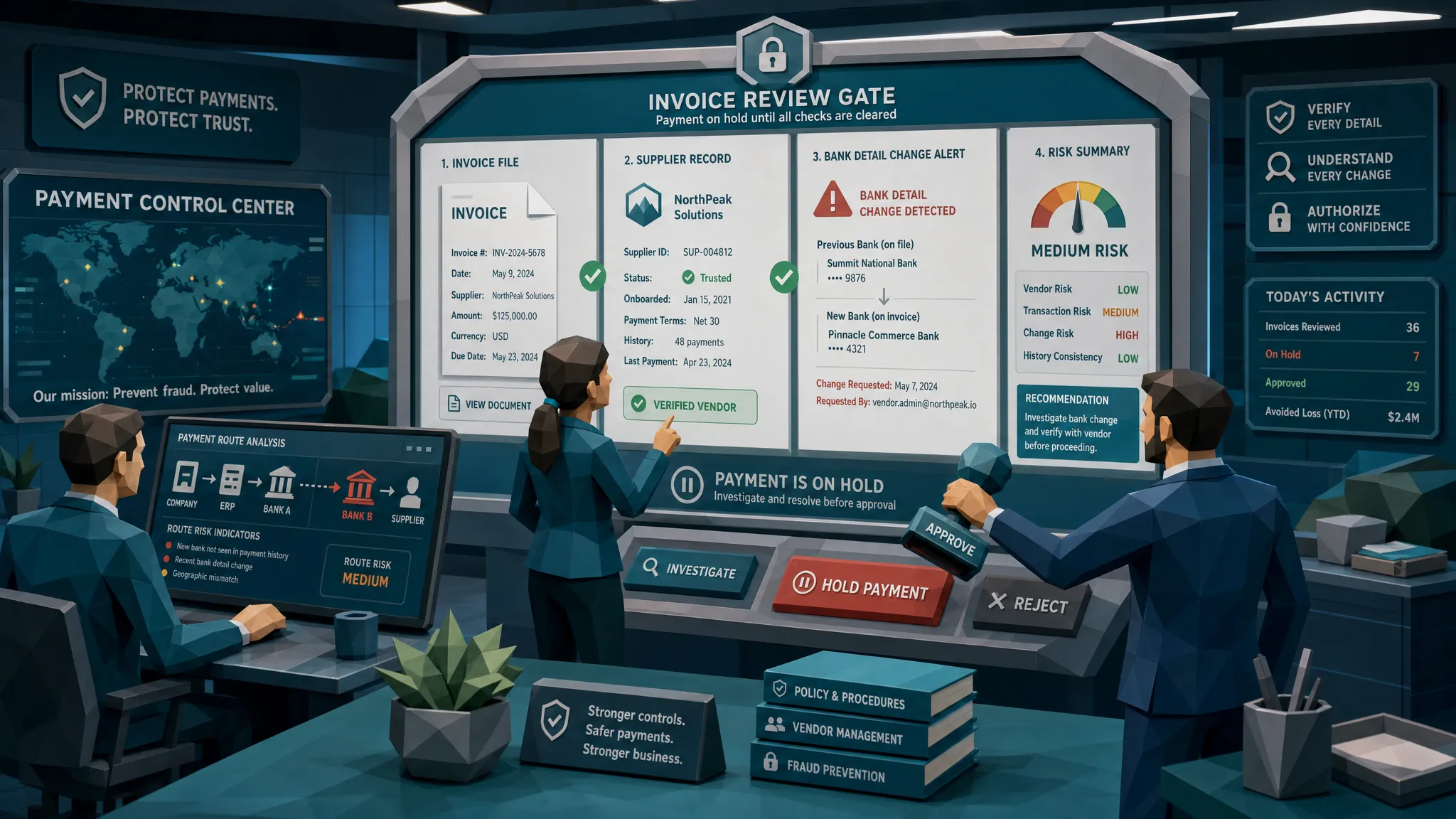

My hot take after a decade around fraud: the best invoice platform is not the one that moves invoices fastest. It is the one that knows when to be annoyingly suspicious before money leaves the building.
Speed is lovely. Clean workflows are lovely. Nobody wants AP to become a medieval checkpoint with candles, stamps, and one person named Brenda who remembers every supplier since 2004. But if an invoice platform can read a PDF, route it to an approver, and trigger payment without asking whether the document, vendor, payment details, and business context make sense together, it is not a control. It is a conveyor belt.
I learned this the unglamorous way years ago. A supplier invoice looked normal, matched the PO, and had the right approver. The fraud was a tiny bank-detail change buried in a document that had clearly been edited after creation. The invoice was readable. The workflow was followed. The payment would have gone out. What saved it was not someone squinting harder at the PDF. It was a pre-payment review that treated the invoice as evidence, not paperwork.
That is the standard I think finance teams should expect in 2026.
The dangerous assumption: readable means reliable
Most invoice platforms are very good at extracting fields. Supplier name, invoice number, date, amount, tax, bank account, payment terms. Great. We need that.
But OCR can read a fake invoice perfectly.
A fraudster does not need to defeat your entire finance operation. They only need to produce a document that looks plausible enough to pass a busy team on a Tuesday afternoon. The pressure is real: vendors want payment, month-end is closing, approvers are traveling, and the inbox is quietly breeding PDFs like rabbits.
The scale of the risk is not theoretical. The FBI Internet Crime Complaint Center reported that business email compromise caused billions in losses in 2023, and AP teams remain a favorite target because they control payment instructions. The Association of Certified Fraud Examiners has long estimated that organizations lose around 5% of revenue to occupational fraud. Even if your organization is much better than average, a single bad payment can make a very boring control failure suddenly board-level interesting.
So, what should an invoice platform catch before payment? In my view, it should catch the gap between a document that is processed and a document that deserves to be paid.
Document tampering, not just ugly formatting
A manipulated invoice often gives itself away, but not in the way people expect. It may not have comic-sans fonts or suspicious spelling. Modern invoice fraud can be clean, tidy, and depressingly professional.
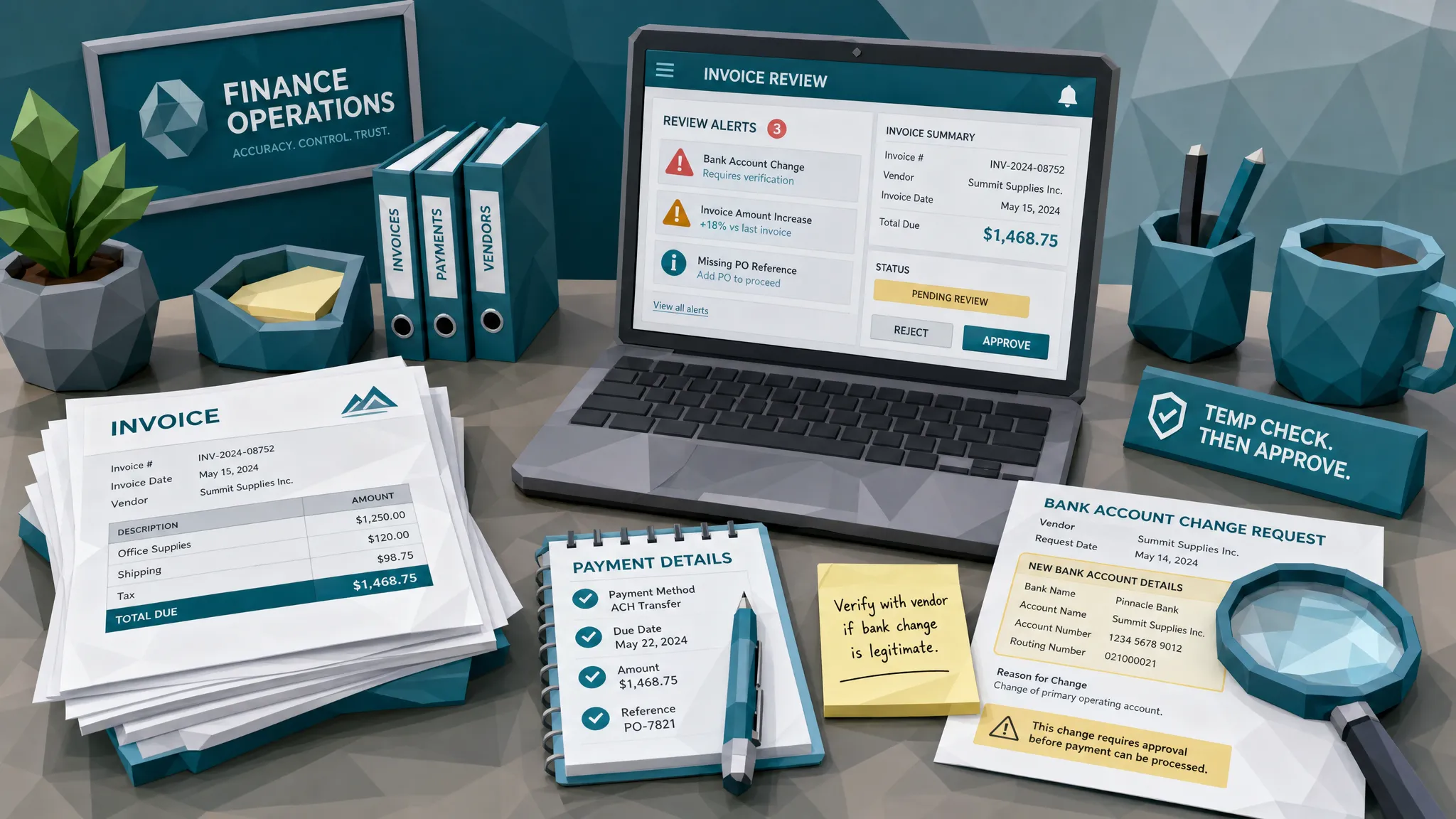
The platform should inspect the document itself. Has one section been edited while the rest of the invoice remains untouched? Do the bank details sit on a slightly different background shade? Are font weights inconsistent in only the payment block? Was the PDF created in one tool, altered in another, then flattened to hide the trail? Are there metadata oddities that do not fit the supposed origin of the invoice?
This is where invoice processing and forensic review need to shake hands. Your platform should not only ask, can I read this invoice? It should ask, can I trust how this invoice came to be?
That is also why I am skeptical of teams that rely only on template matching. A fraudster can copy a real vendor template. In fact, that is often the point. The fake invoice looks familiar because it borrows the look of something legitimate. If you want a deeper dive on this, Docklands has written about why an invoice automation platform still needs forensics, especially when documents are edited, duplicated, or generated to look like the real thing.
Payment details that suddenly get interesting
If I had to pick one place where an invoice platform should be paranoid, I would pick payment information.
Amounts matter, of course. But fraudsters often care more about where the money goes than what the invoice says. A genuine supplier name paired with a new bank account can be more dangerous than an obviously fake supplier. A legitimate invoice number with altered beneficiary details can sail through if your process checks only the operational fields.
A good platform should compare payment details against known supplier records, historical invoices, previous bank accounts, expected countries, and entity relationships. If a vendor has billed you for three years from a UK account and suddenly asks to be paid into a new account overseas, the system should not politely file that as a minor update. It should raise its hand like the kid in class who actually read the assignment.
Here is the small thing many teams miss: payment data should be evaluated inside the document and outside the document. The invoice may say one thing. The supplier master file may say another. The email thread may suggest a third. If those pieces disagree, the platform should slow payment until a human confirms the change through a trusted channel.
And no, replying to the same email thread does not count as trusted verification. That is how a lot of people end up funding someone else’s very nice holiday.
Duplicate and near-duplicate invoices
Duplicate invoices sound dull until you find out how much they cost. True duplicates are easy enough: same supplier, same invoice number, same amount. Near-duplicates are the ones that make life fun, in the fraud-professional sense of fun, which is to say mildly grim.
A near-duplicate might reuse the same invoice with a slightly different number. It might split one invoice into two. It might change the date, round the amount, crop the logo, or resubmit the same receipt image through a different channel. In large organizations, this problem gets worse when entities, sites, projects, or regions use different systems. One part of the business may not see that another already paid something suspiciously similar.
The invoice platform should detect visual similarity, text similarity, repeated line items, reused images, repeated supplier payment details, and suspicious timing. A document can be unique in the invoice-number field and still be a duplicate in the real world.
This is one reason I like invoice analytics when it is used properly. Not dashboards for decoration, but pattern-finding before cash leaves. Docklands covers that angle in more detail in its article on how invoice analytics can reveal fraud before payment.
Mathematical errors that are not innocent
Not every bad total is fraud. Sometimes it is a rushed admin person, a tax configuration error, or a spreadsheet that has been passed around so often it deserves retirement.
Still, math is one of the cleanest places to catch suspicious invoices. The platform should recalculate subtotals, tax, discounts, freight, currency conversions, and line-item totals. It should notice when the total shown on the invoice does not match the sum of the parts. It should flag invoices where tax treatment does not fit the supplier, location, or category. It should question rounded totals that appear too convenient, especially when they sit just below approval thresholds.
Approval-threshold fraud is a classic. If your policy requires senior approval at $10,000, do not be shocked when questionable invoices arrive at $9,875. Fraudsters read policies too. Some of them probably read them more carefully than your employees do.
A strong platform does not treat math as back-office housekeeping. It treats math as evidence.
The business story behind the invoice
This is where I think many invoice platforms are still too narrow. They validate fields, but they do not validate the story.
An invoice is making a claim. It says a supplier did work, delivered goods, charged the right amount, used the correct payment details, and deserves money now. That claim should fit the business context.
Was there a PO? If not, is that normal for this supplier or category? Did the work happen at a real site? Is the approver connected to the project? Does the invoice date make sense against delivery records? Is the supplier billing an entity they normally bill? Has this vendor suddenly changed invoice format, contact email, remittance details, and urgency level all at once?
I once saw a facilities invoice that looked completely ordinary until someone asked a very basic question: why were we paying for emergency roof work at a site that had been closed for six months? No forensic microscope needed. Just context. The invoice was not merely wrong. It was narratively ridiculous.
That is the kind of thing an invoice platform should help surface. Not by making every AP clerk a detective, but by bringing suspicious contradictions into view before payment approval becomes payment regret.
AI-generated invoices and synthetic receipts
Here is the uncomfortable bit: fake documents are getting easier to produce.
I am not saying every finance team needs to panic and live in a bunker made of purchase orders. But the old comfort test, does this look real?, is dying quickly. A document can look real because it was generated or altered to look real. That applies to invoices, receipts, claims evidence, repair estimates, and supporting paperwork.
The insurance world is already seeing this shift in a very visible way. The BBC reported on a sharp rise in fraudulent claims tied to fake images and manipulated evidence, citing Admiral’s 2025 figures. That same behavior is bleeding into finance workflows. If someone can generate a convincing image of damaged property, they can generate a convincing receipt for a client dinner, a repair invoice, or a supplier document.
An invoice platform should detect signs of synthetic generation and manipulation at the file level. It should look for image artifacts, inconsistent compression, unnatural text placement, suspicious overlays, missing provenance, and conflicts between what the document claims to be and what the file properties suggest.
The key is not to accuse every odd-looking PDF of fraud. The key is to rank risk well enough that humans spend time on the right exceptions.
File provenance and access history
Invoices do not arrive in a vacuum. They come through email, portals, shared drives, supplier uploads, expense tools, and sometimes through a chain of forwards so long it could qualify as oral tradition.
The platform should preserve and analyze that trail where possible. Who submitted the invoice? From what domain? Was the attachment forwarded? Was it downloaded, edited, re-uploaded, or converted? Did it come from the expected supplier channel, or from a lookalike email address with one letter swapped? Was the file name recycled from a previous submission?
This matters because fraud often lives in the handoff. A legitimate invoice can be intercepted and modified. A fake invoice can be inserted into a real conversation. A genuine supplier email can be mimicked closely enough that a rushed team does not notice.
Across business workflows, file control is becoming more deliberate. Even tools outside AP, such as Telegram-first file platforms like Cloudon, reflect a broader shift toward managed storage, controlled actions, and secure sharing rather than random document sprawl. For invoice teams, the lesson is simple: the more context you keep around files, the easier it is to spot when something does not belong.
Approver behavior that does not fit the pattern
Approvals are useful, but they are not magic. I have seen plenty of bad invoices approved by smart people who were busy, distracted, or too far removed from the transaction.
An invoice platform should understand approver behavior. Does this person normally approve invoices from this supplier? Is the approval happening unusually fast? Is the approver outside the cost center? Did the invoice bypass the usual project owner? Are several invoices being approved in a cluster just below a threshold?
This is especially important in large, multi-site organizations. A regional manager may know one set of suppliers very well but have no idea whether a similar-looking vendor at another site is legitimate. A platform that treats every approval as equal misses that nuance.
The goal is not to create a surveillance machine. The goal is to catch process drift. Fraud loves process drift. So do honest mistakes, frankly.
Vendor identity and impersonation
Vendor impersonation has become one of the nastiest AP risks because it weaponizes trust. The invoice may use a real supplier name, a real logo, and real contract details. The fraudulent part may be the email domain, bank account, phone number, address, or payment link.
Your invoice platform should compare the supplier identity on the invoice with the supplier master, contract records, prior invoices, tax details, and known communication channels. It should catch lookalike domains. It should flag new remittance details. It should notice when a supplier’s address changes to something that does not match tax or registration data.
This is where I would rather see a platform be slightly irritating than confidently wrong. A vendor bank change should require stronger verification than a routine invoice. If that creates five extra minutes of work, good. Five minutes is cheaper than wiring six figures to a criminal and then having a very quiet meeting with Legal.
Risk scoring that humans can actually use
Here is another opinion I will happily defend over coffee: alerts are not controls unless people can act on them.
A platform that throws 400 warnings into a queue is not protecting AP. It is outsourcing anxiety. The best invoice platform should explain risk in plain language. It should show why an invoice is being held: altered payment block, new bank details, duplicate image, tax mismatch, unusual approver, suspicious metadata, or inconsistent supplier history.
That explanation matters. AP teams need to resolve exceptions quickly. Fraud managers need evidence. Controllers need reporting. Executives need to understand exposure without reading a forensic novel.
Good reporting should separate noise from priority. If you want more on that, the Docklands article on invoice reports that actually help stop fraud is worth a look, because the reporting layer is often where good detection either becomes operational value or dies in a spreadsheet.
What I would ask before buying an invoice platform
If I were evaluating an invoice platform today, I would not start with how many invoices it can process per hour. I would start with what it refuses to pay.
I would ask whether it checks document manipulation, metadata, duplicates, payment changes, supplier identity, mathematical accuracy, and approval anomalies before payment. I would ask whether it can analyze receipts and supporting documents as well as invoices. I would ask whether it uses payment information to build context, not merely to populate fields. I would ask whether alerts are explainable enough for AP, fraud, and audit teams to use without needing a specialist for every case.
And I would absolutely ask for examples. Not glossy demo examples with one obviously fake invoice. Realistic examples. A bank detail changed by one digit. A duplicate invoice with a different date. A supplier invoice generated from a copied template. A receipt altered after submission. A PDF that looks clean but has metadata that tells a different story.
If the vendor cannot show how the platform catches those, I would keep looking.
Frequently Asked Questions
What should an invoice platform catch before payment? It should catch document tampering, fake or impersonated vendors, risky bank-detail changes, duplicate and near-duplicate invoices, math errors, suspicious approval behavior, and inconsistencies between the invoice and real business context.
Is OCR enough to detect invoice fraud? No. OCR reads invoice data, but it does not prove the invoice is trustworthy. A fake or manipulated invoice can be perfectly readable. Fraud detection needs document forensics, payment-context checks, and historical comparison.
Why are bank-detail changes such a high-risk signal? Because many invoice fraud schemes aim to redirect legitimate payments. A real supplier name with a fraudulent bank account can pass basic review unless the platform compares payment details against trusted supplier records and historical patterns.
Can an invoice platform detect AI-generated invoices? A strong platform can flag signs that a document may be generated or manipulated, including file artifacts, metadata conflicts, inconsistent text placement, and unusual image patterns. The point is to escalate risk before payment, not to rely on visual inspection alone.
Who should review invoice fraud alerts? AP teams should handle routine exceptions, but higher-risk alerts may need fraud, finance control, procurement, or vendor management input. The platform should explain each alert clearly so the right team can act quickly.
Before payment is the only moment that really counts
After payment, invoice fraud becomes a recovery problem. Before payment, it is still a control problem. I know which one I would rather manage.
An invoice platform should not merely move documents from inbox to approval to payment. It should challenge the invoice, the file, the supplier, the payment details, and the story behind the transaction. That is how you stop treating fraud as something you investigate later and start treating it as something you prevent now.
If your team is dealing with manipulated invoices, altered receipts, AI-generated documents, or payment details that do not feel right, Docklands AI helps organizations detect suspicious documents before they become expensive mistakes.
Request a Demo Today!
Book your demo below.