How to Identify a Fake Document in Under a Minute
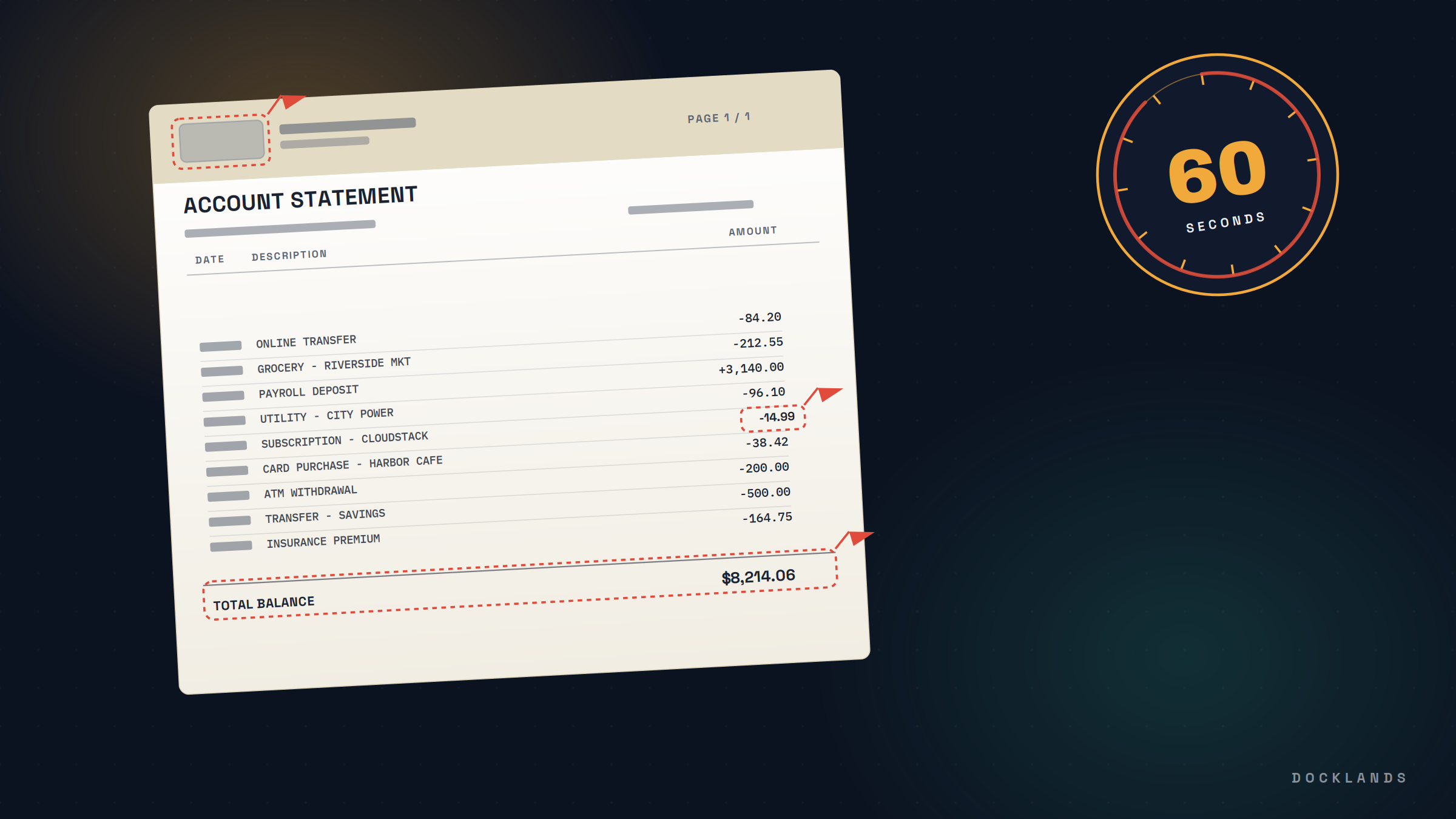

A reviewer looking at a bank statement, an invoice, or a pay stub usually has seconds, not minutes, to decide whether it's real or a well-built imitation. Fraudsters count on that gap. A fake document doesn't need to fool an expert with a magnifying glass. It just needs to pass a quick glance from someone with a full queue and a deadline, whether that queue sits inside a bank, an insurer, or an onboarding team screening new customers.
The good news is that most fakes, counterfeit or altered, fail the same handful of checks, and those checks take less time to run than it takes to read this sentence twice. This article breaks down a 60-second process for spotting a fake document, what each check actually catches, and where a one-minute look stops being enough against more sophisticated forms of deception.
Why One Minute Is the Right Benchmark
Document fraud isn't built to survive a forensic audit. It's built to survive whatever review step it will actually face, which in most organizations is a fast one. A loan officer, claims adjuster, or accounts payable clerk rarely has time to compare a document against an institution's official structure element by element.
That's exactly the gap fraudsters exploit. A forged bank statement with a font that's slightly off, or an invoice where the math doesn't quite reconcile, is designed to slip past someone moving quickly through a stack of records. The fix isn't asking reviewers to slow down for every single document. It's giving them a short, repeatable approach that catches the most common indicators of fraud in the time they already have, regardless of industry or country.
The 60-Second Fake Document Checklist
Run through these five checks in order. Each one takes roughly the amount of time listed, and together they cover the structural elements where forged, altered, and fabricated documents most often break down, no matter the document type.
1. Scan the layout and fonts (10 seconds)
Pull up a genuine sample from the same bank, employer, or vendor if one is available, and compare the two side by side.
- Look for a font that doesn't match the rest of the page, even slightly. A different weight, size, or spacing on one field is a classic sign of a document edited after the original was issued, not a genuine artifact of the source system.
- Check whether text lines up in its columns. Numbers that drift out of alignment or sit unevenly against a table border point toward manual editing rather than a real export.
- Look at the logo. A blurry version, an outdated design, or colors that mimic but don't quite match the institution's current branding are easy to miss at a glance and easy to catch once a reviewer knows to check.
2. Rebuild the math (20 seconds)
Numbers are one of the fastest tells because fraudsters who change one figure often forget to update the ones connected to it, leaving obvious inconsistencies behind.
- On a bank statement, add up the listed transactions and confirm the total matches the closing balance.
- On an invoice or receipt, check that the subtotal, tax, and total actually reconcile.
- On a payslip, confirm that gross pay minus deductions equals the net pay shown, and that the income figure lines up with any attached tax returns.
A mismatch here is one of the strongest single indicators of a fake document, and it takes only a few seconds of mental math to check. The Docklands article on doctored invoices goes deeper into how altered totals leave arithmetic evidence behind.
3. Check the file's data, if it's digital (15 seconds)
Every digital file, especially a PDF, carries data about when it was created, when it was last edited, and what software touched it.
- Open the file's properties and check the creation and modification dates against the document's claimed date.
- Look for signs the file passed through an editing tool rather than the system that would have originally generated it, such as an online banking portal, payroll platform, or government records system.
- Treat a screenshot or flattened image with extra suspicion. Compression strips out data, which is often exactly the point for someone trying to hide a false edit.
This single check is a large part of why original files matter so much more than screenshots. The Docklands article on starting fraud detection with originals covers why requesting the source file, not a duplicate copy, changes what a review can actually catch.
4. Look for internal contradictions (10 seconds)
A document doesn't need an external reference to expose itself as bogus. Sometimes it contradicts its own content.
- A name spelled two different ways on the same page.
- An account number that changes formatting partway through a statement.
- A date that falls on a day the account or institution wouldn't normally process a transaction.
These slip-ups happen because a person or a tool edited part of a document without updating every related field, and they're usually a visible indicator on a careful read rather than something that needs technology to spot.
5. Weigh the combined signal, then decide (5 seconds)
No single flag above is automatic proof of a fake document. A slightly odd font alone might just be a scanning quirk. A math error alone might be a typo. The judgment call comes from stacking the signals before making a final decision.
- One flag: proceed, but note it for the record.
- Two flags: hold for a closer look.
- Three or more flags, or any flag involving the math or underlying data: escalate before approving anything tied to that document.
That's the full sequence, and on a clean document, it genuinely takes under a minute. On a document built as a sham from the start, the same 60 seconds usually surfaces at least one indicator worth acting on.
Where the One-Minute Check Breaks Down
This checklist works well against the most common types of fraud: forged bank statements, altered invoices, and doctored payslips. It has limits, and understanding the role those limits play matters as much as knowing the checklist itself.
- AI-generated documents are built to pass a fast visual check: Unlike a manually edited file, an AI-generated document isn't a real document with one changed field. It's built from scratch using machine learning models trained on patterns learned across thousands of real examples, which means it can look structurally correct at a glance while containing fabricated details that don't hold up under closer review. This is a different threat than a classic forgery or a crude mock-up, and it reflects the rising sophistication fraudsters now bring to the job. The Docklands article on Gen AI claims fraud covers how this category behaves differently from a traditional counterfeit, and the article on deep-fake invoice red flags breaks down what accounts payable agents specifically should watch for.
- High volume erodes the checklist fast: A minute per document sounds manageable until a team is processing hundreds of claims, invoices, or applications a week. At that scale, even a fast manual approach becomes a bottleneck, and fatigue makes reviewers more likely to skip a step or miss a spurious detail. For a broader look at how fake documents show up across different business functions and what a layered review structure looks like at scale, see the Docklands guide on how to catch fake documents.
- A single failure point rarely tells the whole story: Manipulated documents tend to fail across several elements at once, not just one. The Docklands article on tampered invoices covers why relying on any single check, including this one, misses fraud that a combined analysis would catch.
Why Fake Documents Carry Real Consequences
A document doesn't have to be an identity document to create serious risk. Fabricated bank statements, falsified payslips, and duplicate invoices routinely support decisions that never should have been approved, whether that's a loan, a lease, or an insurance payout.
The exposure differs by document type and industry, but the pattern repeats:
- Identity documents: Passports, driver's licenses, and other government-issued IDs get altered or used under a false identity to pass onboarding checks or open accounts.
- Financial records: Bank statements, tax returns, and credit applications get falsified to inflate income or hide risk during underwriting.
- Business documents: Invoices, receipts, utility bills, and certificates get duplicated or edited to support fraudulent payments or padded expense claims.
Beyond the direct financial losses, businesses that miss a fake document during onboarding or a claims decision can face regulatory penalties, fines, and compliance investigations, particularly in regulated industries like banking, lending, and insurance. In the UK and elsewhere, institutions that fail basic verification checks have found themselves facing formal scrutiny long after the original document was accepted, sometimes well beyond the point where records could still be traced back to their true purpose.
When Manual Review Needs Backup
A trained reviewer running the 60-second checklist consistently will catch a real share of fraud attempts. What that reviewer can't do is scale the same scrutiny across every document in a growing queue, and modern forgery, particularly AI-generated content, is built to slip past a fast human read.
That's the gap platforms like Docklands are built to close. Instead of a person eyeballing fonts and re-adding totals by hand, Docklands runs the same categories of checks automatically and at volume, using a combination of forensic analysis and machine learning:
- Digital edit detection for texture anomalies, misaligned tables, and copy-paste artifacts.
- Data forensics comparing a document's edit history and software signature against its claimed origin.
- AI-generated content detection to catch documents produced by generative tools rather than a genuine source system.
- Mathematical checks that verify totals, tax, and line items automatically.
- Physical tampering detection for correction fluid, handwritten edits, and cut-and-paste alterations.
These checks apply directly across insurance claims, accounts payable, and employee expenses, the three use cases where fake documents tend to cause the most damage for customers across industries. For teams whose current invoice workflow automates approvals but doesn't inspect for tampering, the article on invoice workflow software's blind spot covers where that gap tends to show up.
FAQ
What is the difference between a counterfeit document and a falsified one?
A counterfeit document is built entirely from scratch, with no genuine record behind it. A falsified or forged document starts as a real record, issued by a real institution, that has since been altered, such as an edited balance on a bank statement or a changed figure on a payslip.
What is the single fastest way to tell if a document is fake?
Rebuilding the math is usually the quickest high-value check. Adding up transactions against a stated balance, or checking that a subtotal, tax, and total reconcile, takes seconds and catches a large share of altered documents, since fraudsters who change one number often forget to update the rest.
Can a document look completely genuine and still be fraudulent?
Yes. A document obtained under someone else's identity, such as a real passport or bank statement submitted for a purpose it was never meant to support, can pass a visual check cleanly. A well-made AI-generated document can too. This is why content checks and data review matter as much as how a document looks.
Which document types carry the highest risk of fraud?
Bank statements, payslips, tax returns, invoices, receipts, utility bills, and identity documents like passports and driver's licenses account for most of the fake documents institutions encounter, largely because each one plays a direct role in a financial or identity decision.
When should a flagged document be escalated instead of processed?
Any document with two or more indicators, or a single flag involving a math error or suspicious data, is worth holding for a closer look rather than approving on the spot. The cost of a short delay is far lower than the cost of an approved fake document, including the fines, losses, and compliance exposure that can follow.
Do these checks apply the same way across countries and industries?
The five-step approach transfers well across markets, since the underlying elements, layout, math, data, and internal consistency, apply regardless of country or industry. What changes is the reference point: a UK bank statement follows a different structure than one issued in another market, so reviewers still need a genuine sample from the same institution for the layout comparison to mean anything.
The Takeaway
A fake document only has to survive one look. The solution is a short, repeatable checklist that covers layout, math, data, and internal consistency in under a minute, combined with a clear sense of when a flagged document needs more than a quick glance, whatever its purpose or origin.
Teams handling invoices, receipts, and claims at volume can see how Docklands automates this exact process by booking a demo.
Request a Demo Today!
Book your demo below.