Document Forgery Detection with AI: A Practical Guide
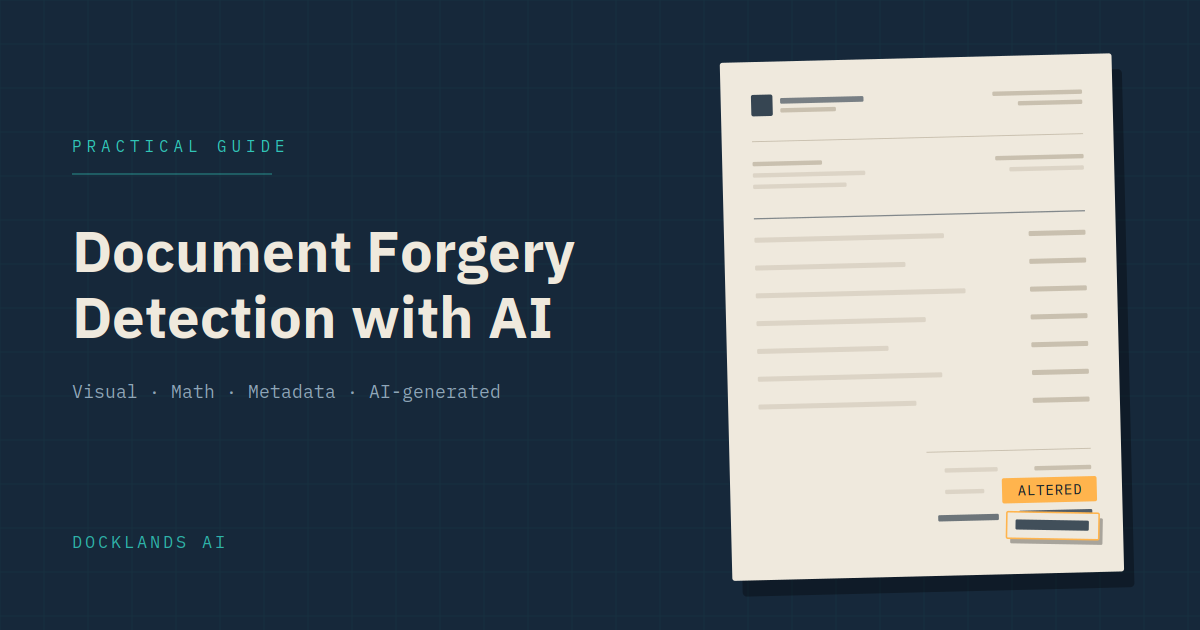

A forged document does not need to fool an expert. It only needs to fool whoever is reviewing it that day, in the time they have to review it. That is the entire premise behind document forgery, and it is why so many fake bank statements, invoices, IDs, and receipts make it through review processes that were never built to catch them.
Document forgery detection is the practice of identifying documents that have been altered, fabricated, or misused to support a claim, application, or payment they should not support. What counts as "good enough" detection has changed fast. A checklist that worked against a forger with a printer and correction fluid does not hold up against someone using photo editing software, template kits, or a generative AI tool that can produce a convincing invoice in seconds.
This guide covers what document forgery actually looks like, the identification techniques and examination steps that catch it, where AI technology fits into that process, and what a business should look for if it is evaluating a solution rather than building a manual review process from scratch.
What Document Forgery Actually Covers
Document forgery is not one thing. It splits into a few distinct categories, and knowing which one is in front of a reviewer changes what to check for.
- Counterfeit documents are built from nothing. There is no genuine original behind them; every detail, from the logo to the account numbers, is invented to imitate a real document.
- Altered documents start out real and get edited afterward. A genuine invoice with a changed total, a real pay stub with an inflated salary, or an actual bank statement with an edited balance all fall here. These are usually the most common type a finance or claims team will encounter, since editing something real is faster than building a fake from scratch.
- Fraudulently obtained documents are the hardest to catch on sight because nothing about the document itself was touched. It is completely genuine, but it belongs to someone else or is being used for a purpose it was never issued for, such as a stolen ID or a legitimate receipt submitted against a claim it was not part of.
Each category leaves a different kind of evidence. Counterfeits tend to fail on structure and fine detail. Altered documents tend to fail on internal consistency, since editing one field rarely updates everything connected to it. Fraudulently obtained documents tend to fail on context, since the document checks out but the story around it does not.
Why Detection Matters Across So Many Industries
Document forgery detection is not a niche concern for banks and border agencies. Any business that relies on a document to approve money, identity, or a claim is exposed.
- Financial services and lending rely on bank statements, tax returns, and pay stubs to approve credit, loans, and mortgages.
- Insurance relies on receipts, repair estimates, medical bills, and photos to validate claims before payout.
- Accounts payable relies on invoices from vendors to approve payments, often at volume and on tight cycles.
- Employee expense management relies on receipts submitted by staff, where duplicate and altered files are common.
- Onboarding and KYC relies on identity documents, such as passports and driver's licenses, for identification and validation before opening an account or granting access.
The documents differ across these use cases, but the underlying question is the same: is this document what it claims to be, and does it belong to the transaction it is attached to. Docklands built its detection layers around three of the highest-volume, highest-risk areas: insurance claims, accounts payable, and employee expenses.
Traditional Detection Methods and Where They Fall Short
Before AI entered the picture, document review leaned on a combination of manual inspection and basic software checks. Both still matter, but neither is sufficient on its own anymore.
- Manual visual inspection works well when volume is low and the reviewer is trained to spot mismatched fonts, uneven alignment, or an off logo. It falls apart at scale. A team reviewing hundreds of invoices or claims a week cannot compare every field against a known genuine sample, and a well-made forgery is designed to pass a fast glance.
- OCR-based systems extract text from a document so it can be read, matched, and processed automatically. OCR is genuinely useful for speeding up data entry, but it was never built to judge authenticity. A related Docklands post, OCR is not fraud detection, covers this gap directly: OCR will happily extract a perfectly formatted total from a document that was edited an hour earlier, because extraction and verification are two different problems.
- Rules-based flags, such as spending thresholds or duplicate invoice numbers, catch some fraud but miss anything designed around the rule. A forger who knows the threshold simply stays under it.
Forgery technique has moved past what these methods were designed to catch, which is why detection has shifted toward layered, AI-assisted analysis and technology that examines a document from several angles at once instead of one.
How AI-Powered Document Forgery Detection Works
AI detection does not replace the checks reviewers already know. It runs them automatically, at a scale and depth manual review cannot match, and adds layers that are difficult for a person to perform by eye at all.
Visual and Image Forensics
Computer vision models are trained on large sets of genuine and forged documents to learn what authentic structure looks like: consistent fonts, correct spacing, aligned tables, and expected security features like watermarks or microprinting. When a document deviates, whether that is a mismatched typeface, an unusual compression pattern around one section, or a texture inconsistency where an edit was pasted in, the model flags it. This is the automated version of the "does something look off" check a trained reviewer performs, run against every document instead of a sample.
Physical Examination: Paper, Ink, and Watermarks
For printed and scanned documents, especially identification documents like passports and driver's licenses, physical composition carries its own evidence. Genuine documents are produced on specific paper stock, with a particular weight, texture, and finish, and reproducing that exactly is hard to do outside the original issuing process. Ink is another marker: official documents often use inks that react differently under UV light, shift color at certain angles, or resist smudging in ways cheaper printing methods cannot replicate. A watermark that is missing, faint, or positioned incorrectly is one of the more reliable single signals of a counterfeit, since watermarks are built into the paper itself rather than printed on top of it. High-resolution image capture lets AI models examine these same physical cues, comparing paper texture and ink behavior against known genuine samples at a level of detail a quick visual check would miss.
Content and Mathematical Verification
A forged document often looks fine but does not add up. Subtotals, tax, and totals should reconcile. A running balance on a bank statement should match the sum of its transactions. Dates should fall in a sequence that makes sense. AI systems can rebuild these calculations automatically and flag anything that does not reconcile, a check that is easy to skip manually when a document is reviewed quickly. The Docklands post on doctored invoices walks through how altered totals leave arithmetic evidence behind even when the visual formatting looks untouched.
Metadata Forensics
Digital files carry information beyond what is printed on the page: creation date, last modified date, the software used to produce or edit the file, and sometimes device details. A document that claims to be a direct export from a bank's online portal should not carry metadata pointing to a PDF editor. A statement dated last month should not show an edit timestamp from yesterday. This kind of forensic layer works best on original files rather than screenshots or heavily compressed copies, since compression strips out the metadata that reveals an edit history. The Docklands posts on why fraud detection should start with originals and metadata forensics for receipts go deeper into what this layer catches that a visual review cannot.
AI-Generated Content Detection
Generative tools introduced a category of forgery that is not an edited real document at all. It is fabricated from patterns learned across thousands of real examples, which lets it look structurally correct while every detail on it is invented. These documents tend to slip past checks built around "does this look edited," because nothing was edited; it was generated whole. Detecting them requires models trained specifically to recognize the statistical fingerprints generative tools leave behind, along with content checks that cross-reference claimed details against what actually exists. The Docklands guide on detecting AI-generated receipts and synthetic invoices covers this shift in more depth.
Pattern and Anomaly Detection Across Volume
A single document can look clean in isolation and still be part of a pattern. The same receipt submitted twice under different names. A cluster of invoices from vendors created around the same date, all just under an approval threshold. Machine learning models trained on transaction history can surface these patterns across thousands of documents at once, something no manual reviewer comparing one file at a time will catch.
Why Layered Detection Beats Any Single Check
None of these layers works well alone. A document can pass a visual check and still fail on math. It can reconcile mathematically and still carry metadata that contradicts its claimed origin. It can look and calculate perfectly and still be an AI-generated fabrication with no real transaction behind it.
This is the core argument behind combining detection layers rather than picking one: a forged document rarely fails in only one place. The Docklands post on tampered invoices makes this point directly, and it applies to forgery detection broadly, not just invoices. The failure is usually spread across the visuals, the numbers, the metadata, and the surrounding context. A single-layer check only ever looks at one of those places, which is exactly why forgers who know the common check can design around it.
Building a Practical Detection Workflow
A workable process does not need to slow down every legitimate document. It needs enough structure that the ones with problems get caught before they support a payout, a payment, or an approval.
- Request original files: A native PDF or an unedited photo carries far more forensic detail than a screenshot or a compressed copy.
- Run automated structural and visual checks: Compare fonts, layout, and security features against known genuine formats for that document type.
- Verify the math: Rebuild totals, balances, and line items rather than trusting the printed figure.
- Check metadata on digital files: Look for edit history and software signatures that contradict the document's claimed origin.
- Screen for AI-generated content: Apply detection built specifically for generative fabrication, since it behaves differently from an edited real document.
- Cross-reference external details: Confirm the business, institution, or individual named in the document actually exists and matches what is claimed.
- Score and escalate on combined signals: One odd font alone is a minor flag. A mismatched font plus a math error plus an inconsistent timestamp is a strong case for closer investigation and manual review.
This structure works whether it is applied to a handful of documents a week or thousands, though the volume is exactly where manual execution of these steps becomes impossible without automation.
Common Challenges in Document Forgery Detection
Even a strong process runs into a few recurring obstacles worth planning around.
- Scale versus thoroughness: Teams processing high volumes of invoices, claims, or receipts cannot manually run every check on every document without adding significant headcount or slowing approvals to a crawl.
- Image quality: Blurry scans, low-resolution photos, and heavily compressed files strip out the fine detail that many checks depend on, including metadata.
- Evolving forgery techniques: Detection built around yesterday's forgery methods, particularly manual edits, needs to keep pace with generative tools that fabricate documents rather than alter them.
- Country and format variation: Bank statements, IDs, and invoices follow different layouts, languages, and security standards across countries, which makes a one-size-fits-all template comparison unreliable.
- False positives: An overly aggressive system that flags too many genuine documents creates its own cost, in reviewer time and in friction for legitimate customers or vendors waiting on an approval.
None of these challenges are reasons to skip detection. They are reasons to choose a process, and a tool, built to handle documents at the volume, format range, and sophistication level a business actually deals with.
What to Look for in a Document Forgery Detection Solution
For teams evaluating software rather than building checks manually, a few capabilities separate a genuine detection tool from a system that only extracts and organizes data.
- Pixel-level image analysis, not just text extraction, to catch texture anomalies, misaligned tables, and copy-paste artifacts.
- Metadata forensics that compares a file's edit history and software signature against its claimed source.
- AI-generated content detection, built specifically to catch documents produced by generative tools.
- Automated mathematical verification of totals, tax, and line items.
- Physical tampering detection for scanned documents, examining paper texture, ink consistency, watermarks, and signs of correction fluid, handwriting edits, or cut-and-paste alteration.
- Screening at full volume, not spot checks, since a fraudster only needs one unchecked document to succeed.
- Workflow integration that fits into existing claims, accounts payable, or expense review processes rather than requiring a separate manual step.
The Docklands post on insurance claim fraud detection models versus document forensics is worth reading for a closer look at why predictive fraud scores and document-level forensics solve different parts of the same problem, and why relying on only one leaves a gap.
FAQ
What is document forgery detection?
Document forgery detection is the process of identifying documents that have been counterfeited, altered, or misused, using a combination of visual, mathematical, metadata, and content-based checks to confirm whether a document is genuine and belongs to the transaction it supports.
What is the difference between document forgery and document fraud?
Forgery specifically refers to creating or altering a document to deceive. Document fraud is the broader category, which also includes genuine documents used for a purpose they were never meant to support, such as a stolen ID or a legitimate receipt submitted against an unrelated claim.
Can AI detect AI-generated documents?
Yes, though it requires detection models trained specifically for this category. AI-generated documents are fabricated from learned patterns rather than edited from a real original, so they need different checks than traditional forgery detection, including content verification against real records rather than a purely visual review.
Is OCR enough for document forgery detection?
No. OCR extracts and reads text accurately but was not built to judge authenticity. A document can be perfectly extracted by OCR while still being a forgery, since extraction and verification solve different problems.
Which industries need document forgery detection most?
Financial services, insurance, accounts payable, employee expense management, and any onboarding or KYC process face regular exposure, since all of these rely on documents like bank statements, invoices, receipts, and identity records to support financial or identity decisions.
The Takeaway
Document forgery works by being reviewed quickly and trusted by default. Detection that holds up combines visual, mathematical, metadata, and content checks rather than relying on any single one, and applies those checks to every document rather than a sample.
Teams handling invoices, receipts, or claims at volume can see how Docklands AI applies these detection layers automatically by booking a demo.
Request a Demo Today!
Book your demo below.