Invoice Fraud Explained and How to Stop It Before Payment
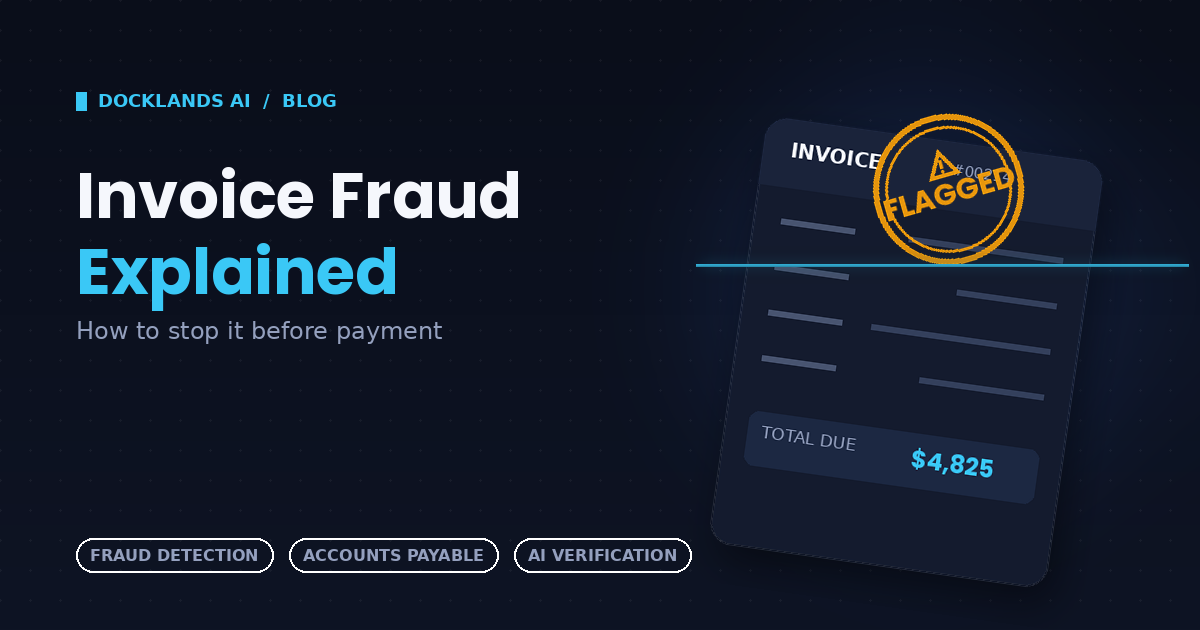

Invoice fraud rarely announces itself. It shows up as an ordinary-looking bill in an accounts payable inbox, a payment update from a supplier who has worked with the company for years, or a request marked urgent from someone claiming to be a finance director. The scam works through deception, not force, and the document does its job by not standing out. By the time anyone questions it, the money is often already gone.
Below is a breakdown of what invoice fraud tends to look like in practice, the schemes that come up most often, and the checks that stop a fraudulent invoice from reaching a payment run.
What Is Invoice Fraud
Invoice fraud is any scheme that tricks a business into paying for goods or services that were never delivered, paying more than what was actually owed, or sending a legitimate payment to the wrong account. It can involve a completely fabricated invoice, a genuine invoice that has been altered, or a real payment redirected through deception rather than a fake document at all.
The target is almost always the accounts payable process, since that is where a business routinely authorizes money to leave. A fraudster does not need to break into a bank account. A convincing invoice and a distracted approver can accomplish the same result with far less effort.
A few related terms tend to get mixed up with invoice fraud, even though each one describes something slightly different. Forgery refers to creating or altering a document to deceive, which describes most fabricated invoices. Counterfeit typically describes a document built to imitate a real one, such as a fake invoice copying a known supplier's format and logo. Embezzlement describes a different pattern, where someone inside the organization, often an employee with access to the payment system, diverts company funds for personal use, sometimes using fake invoices as the paper trail to justify the transaction.
Common Invoice Fraud Schemes

Not every invoice fraud case looks the same, and knowing which type a business is dealing with determines what actually needs to be checked.
- Fake or phantom vendor invoices: A fraudster sets up a vendor record, sometimes with help from someone inside the company, and submits invoices for goods or services that were never ordered or delivered. Larger organizations with high invoice volume are especially exposed here, since a new vendor name can slip past a busy approver.
- Business email compromise and vendor impersonation: A fraudster gains access to or spoofs a supplier's email account, often through a phishing attempt that tricks an employee into entering login credentials on a fake page, then sends a message claiming the vendor's bank account has changed. The invoice itself may look completely normal. The banking information attached to it is the actual target. Sometimes the email includes a link to a fraudulent payment portal designed to capture banking details directly.
- Altered invoices: A real invoice from a real vendor gets intercepted and edited before it reaches the payer, usually to inflate the total or swap out the payment account. This can happen through a compromised email thread or a document sent as an editable file rather than a locked format.
- Duplicate invoices: The same invoice, or a near-identical copy with a slightly different number or date, gets submitted more than once. This works especially well in organizations without strong duplicate detection, where a second payment on the same invoice can go unnoticed for months.
- Overpayment and refund scams: A fraudster sends an invoice for an inflated amount, waits for the overpayment to process, then contacts the business claiming an error and asking for the difference to be refunded to a different account. The original invoice was designed to be paid, not questioned.
- Undelivered goods or inflated billing: A supplier, occasionally a legitimate one operating in bad faith, charges for more units or a steeper rate than what the original agreement or delivery actually supports. This scheme depends on weak matching between invoices, purchase orders, and receiving records.
Why Invoice Fraud Works So Well
Invoice fraud succeeds because it targets a process built for speed, not suspicion. Accounts payable teams handle high volumes of documents on a schedule, often with pressure to close payment runs on time. A fraudulent invoice only needs to look ordinary enough to clear one review.
Urgency is one of the most consistent tools fraudsters use. A message that says a payment needs to go out today, or that a vendor will face a service interruption without immediate payment, pushes an approver to act before verifying. The same applies to authority. An email that appears to come from an executive carries a different kind of pressure than one from an unfamiliar vendor, and fraudsters know it.
Familiarity plays a role too. A vendor a business has paid dozens of times feels safe by default, which is exactly why a payment detail change on an established account deserves more scrutiny, not less.
Fraudsters also rely on knowledge of how a specific organization operates. Someone who takes the time to look up a company's executive names, its approval hierarchy, and the size of its usual invoices can put together a request that blends right into everyday operations. Employees who process payments daily can become desensitized to the volume, which is part of why training and clear escalation steps matter as much as any software control.
Red Flags That Point to Invoice Fraud
A handful of signs show up across most invoice fraud cases, whether the invoice is fabricated or genuine but intercepted.
- A change in bank account or payment details, especially one delivered by email rather than through a verified channel.
- A slightly altered email domain, such as a company name with one letter changed or a different top-level domain.
- An invoice that does not match a purchase order or does not correspond to anything the business actually ordered.
- A sense of urgency pushing the approver to skip standard verification.
- Round numbers on an invoice total, which is less common in real transactions than amounts with cents.
- A duplicate invoice number or amount matching something already paid.
- Vendor details that do not match prior records, including a new address, a new contact name, or inconsistent formatting compared with past invoices from the same supplier.
- A logo or letterhead that looks slightly off, such as the wrong shade, resolution, or version of a supplier's branding.
None of these signs proves fraud on their own. A vendor can genuinely change banks. A round number can be a coincidence. The value of these flags comes from checking them together and verifying anything unusual before payment, not treating any single discrepancy as a final answer.
The Cost of Invoice Fraud
The financial loss from a single successful scam can range from a few thousand dollars to a payment large enough to affect quarterly results, and the damage rarely stops at the transaction itself. A victim organization also absorbs the cost of the investigation, the strain on the vendor relationship if a supplier's name was used without their knowledge, and in some cases the compliance exposure that comes with failing to catch a preventable scheme.
Invoice fraud has grown into a significant problem across the business world, in part because it requires so little technical skill compared with other forms of cybercrime. A fraudster does not need to breach a network or steal data. A well-written email and a convincing invoice are often enough, which is why organizations of every size, not just large enterprises, show up as victims.
The Controls That Actually Stop Invoice Fraud
Awareness catches some invoice fraud. Controls catch the rest, especially at volume. A layered system of oversight, verification, and compliance checkpoints closes most of the gaps that a single reviewer would miss on a busy day.
- Segregation of duties: No single employee should be able to add a vendor, approve an invoice, and release payment. Splitting these responsibilities across different people creates a natural checkpoint that makes internal collusion harder and catches mistakes that a single reviewer might miss.
- Independent verification of payment detail changes: Any request to change a vendor's bank account should be confirmed through a separate channel, such as a phone call to a known contact, not a reply to the email that requested the change. This single habit stops a large share of business email compromise attempts.
- Three-way matching: Comparing the invoice against the purchase order and the receiving record confirms that what was billed matches what was ordered and what actually arrived. Mismatches in quantity, price, or item description are among the most reliable signals of a fraudulent or inflated invoice.
- Vendor master file audits: Regularly reviewing the vendor list for duplicate entries, inactive suppliers still receiving payments, or vendors with incomplete records helps catch phantom vendor schemes before they become routine.
- Duplicate invoice detection: Automated checks that compare invoice numbers, amounts, and vendor details against payment history catch repeat submissions that a manual reviewer working through a queue is likely to miss.
- Document forensics: Visual tampering, inconsistent metadata, and mathematical errors are all detectable signs that an invoice has been altered after it was issued. The Docklands post on doctored invoices covers how a changed total often leaves the surrounding numbers unchanged, which is one of the clearest tells that a document has been edited.
- Employee training and resources: Giving accounts payable staff clear resources, such as a documented escalation process and real examples of past phishing attempts, builds the kind of knowledge that helps someone pause on a suspicious request instead of processing it on autopilot. Regular audits of who has access to vendor records and payment approval also reduce the chance that a gap goes unnoticed for long.
- Machine learning based detection: Pattern-based systems can compare a new invoice against a vendor's payment history and flag anomalies a human reviewer would likely miss, such as a slight shift in formatting, an unusual invoice amount, or a payment request that breaks from a supplier's normal schedule.
How Fraudsters Adapt to Automated Approvals
Accounts payable automation has removed a lot of manual work, but it has also given fraudsters a new target. Rules-based systems are good at catching what they were built to catch, such as missing fields or budget overruns. They are not built to detect a well-formatted PDF with a manipulated total or a vendor record that was never real to begin with.
The Docklands post on automated accounts payable still needing fraud gates covers this gap directly: automation can move invoices through approval faster, but without a layer built specifically to catch tampering, it can also move a fraudulent invoice through just as quickly. A related post on invoice workflow software's blind spot for tampering walks through why routing and approval logic is not the same thing as fraud detection.
This gap has grown as forgery tools have improved. The post on deep-fake invoice red flags breaks down what AP teams should watch for as manipulated PDFs and AI-generated documents become harder to distinguish from the real thing at a glance.
What to Do If Invoice Fraud Is Suspected
Speed matters more than almost anything else once a fraudulent invoice is suspected.
- Stop any pending payment immediately if the invoice has not yet cleared.
- Contact the bank to report the transaction and ask about recovery options if payment has already gone out.
- Preserve all related evidence, including the original invoice, email headers, and payment records, without editing or forwarding them in a way that alters metadata.
- Verify the vendor through a known, separate channel rather than replying to the email or number associated with the suspicious invoice.
- Notify internal stakeholders, including finance leadership and, where appropriate, legal counsel.
- Report the incident to the relevant authorities, since business email compromise and wire fraud often fall under regulatory or law enforcement reporting requirements.
- Review how the invoice got through, since understanding the gap, whether it was a missed verification step, a compromised email account, or a control that does not exist yet, is the only way to close it.
How Docklands Helps Stop Invoice Fraud Before Payment
Docklands AI focuses on catching manipulated, photoshopped, and AI-generated invoices before they cost a business money. That matters because invoice fraud is rarely only about the document. A fabricated invoice can be paired with a fake vendor, a changed bank account, or a payment request sent under false urgency, and the strongest defense looks at all of it together rather than any single detail in isolation.
The platform combines several layers of detection:
- Digital edit detection to catch texture anomalies, misaligned tables, and copy-paste artifacts on altered invoices.
- Metadata forensics to compare an invoice's edit history and software signature against its claimed origin.
- AI-generated content detection to catch invoices produced by generative tools rather than a genuine vendor system.
- Mathematical checks that automatically verify line items, tax, and totals against each other.
- Reporting and analytics that give finance and AP teams visibility into fraud trends by vendor over time.
For accounts payable teams processing invoices at volume, this adds a detection layer that sits alongside existing approval workflows rather than replacing them. More detail on how this applies specifically to AP is available on the accounts payable use case page, and a broader look at how these signals interact appears in the Docklands post on a tampered invoice rarely failing in just one place.
FAQ
What is the most common type of invoice fraud?
Business email compromise leading to a changed bank account is among the most common and costly schemes, since the invoice itself often looks entirely normal while the payment details have been swapped.
How can a business tell if an invoice is fake before paying it?
Check the invoice against a purchase order and receiving record, verify any changed payment details through a separate channel, and look for signs of digital alteration such as font inconsistencies or math that does not add up.
Does invoice fraud always involve a fake vendor?
No. Many of the costliest cases involve a real vendor whose invoice or email was intercepted and altered, or whose identity was impersonated through a spoofed email domain.
What is the single most effective control against invoice fraud?
Independently verifying any change to vendor payment details through a known contact, rather than trusting the request as it arrives, stops a large portion of business email compromise attempts before payment.
Can automation alone prevent invoice fraud?
Automation helps with routing, matching, and flagging obvious errors, but it typically is not built to detect document tampering or fabricated content on its own. A dedicated fraud detection layer closes that gap.
How is invoice fraud different from embezzlement?
Invoice fraud usually involves an outside party deceiving a business into paying a fraudulent invoice. Embezzlement typically involves someone inside the organization misusing their access to divert funds, sometimes using a fake or altered invoice to make the transaction look legitimate on the books.
Where does phishing fit into invoice fraud?
Phishing is often the entry point. A fraudster tricks an employee into revealing login credentials or clicking a malicious link, gains access to a real email account, then uses that access to send a convincing but fraudulent payment request from what looks like a trusted source.
The Takeaway
Invoice fraud depends on a business trusting a document, an email, or a sense of urgency without checking it. The response is not to slow down every payment, but to build verification into the process for the details that matter most: vendor identity, payment accounts, and the document itself.
Businesses that want to see how document-level fraud detection fits into an existing accounts payable workflow can book a demo with Docklands AI.
Request a Demo Today!
Book your demo below.